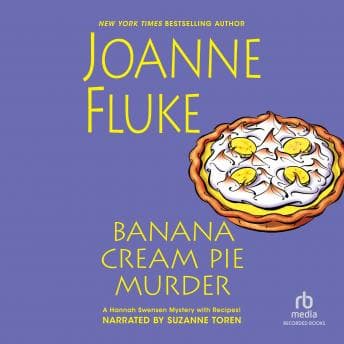

What does it say about a person that they can return from their honeymoon and immediately start investigating a murder? Not as a cop. Not as a private detective. Just as a woman who apparently cannot resist the gravitational pull of other people's deaths. I've been thinking about this for most of the 10 hours I spent with Banana Cream Pie Murder, which I listened to while making a very ambitious dal makhani that I absolutely did not need to make on a Tuesday night. The cooking felt appropriate. This is, after all, a book where banana cream pie and homicide share equal billing.
This is book 21 in the Hannah Swensen series, and I came in as something of an outsider. Fresh eyes. Which means I spent a non-trivial amount of time trying to understand why Hannah, a bakery owner and apparent murder magnet, is the person Lake Eden, Minnesota turns to when someone ends up dead. The victim this time is Victoria Bascomb - a former stage actress who swept into town, made approximately every person she encountered furious with her, and then got herself murdered in the condo below Hannah's mother. Classic. The research actually shows that mystery writers rely heavily on what psychologists call the 'high-conflict personality' as a victim archetype - someone whose death opens up a field of suspects wide enough to fill a novel. Victoria Bascomb is textbook. She's the human equivalent of a lit match dropped into a room full of kindling, and I found myself asking: why does Fluke make her so cartoonishly dislikable? The answer, I think, is function over depth. Victoria isn't meant to be understood. She's meant to be a puzzle box.
The Recipes Are A Character. An Unwelcome One.
Here's where I have to be honest in a way that might annoy fans of this series. The recipes - and there are many - are read in full. Out loud. By the narrator. Within the chapters. I was mid-investigation, genuinely curious about whether the theater director or the jealous understudy did it, and suddenly I was being walked through the steps for banana cream pie filling with the same narrative weight as a clue reveal. Psychologically, this doesn't track as a storytelling choice if you're listening rather than reading. On the page, you can skim a recipe. In audio, you cannot. You are held hostage by the butter and the cornstarch. Suzanne Toren reads them with the same steady, clear delivery she brings to everything else - which is both her strength and, in this context, the problem. She's consistent. She's professional. She doesn't stumble. But consistency applied equally to recipes and murder clues creates a strange flatness, like the audio can't distinguish between what matters and what doesn't.
Toren's narration is genuinely fine outside of this issue. Her pacing is measured - some would say slow, and I'd say they're not wrong, but it suits the cozy register of the book. Lake Eden is supposed to feel like a warm kitchen, not a sprint. If you go in expecting that, Toren delivers it competently.
Hannah Swensen, Amateur Detective and Psychological Curiosity
What makes this character interesting to me - and I'm putting my researcher hat on here, briefly, I promise I'll take it off - is that Hannah exhibits a classic helper identity pattern. Her self-worth appears structurally tied to being needed, whether that's feeding people or solving their problems. She's just gotten married. She's supposed to be settling into domesticity. Instead she's investigating a murder because the pull toward being the one who figures it out is, for her, apparently stronger than the pull toward a quiet life. My therapist would have thoughts about this character. Several of them. None of them simple.
Fluke understands something real about small-town social dynamics - the way everyone knows everyone's business, the way old grudges calcify into motive, the way a newcomer like Victoria can detonate a community just by existing in it. The Lake Eden gossip network functions almost like a secondary character, and that part rings true. The mystery resolution itself is serviceable. Not surprising if you've read much in this genre, but tidily assembled. The genre has sharper edges elsewhere - Razor Girl is what happens when cozy's warm kitchen gets replaced by something considerably more unhinged, and the contrast is instructive.
Who This Is Actually For
If you're already a Hannah Swensen devotee and you've made it to book 21, you know exactly what you're getting and you want it. This review is not for you. You're fine. Go enjoy your banana cream pie.
If you're new to the series and cozy mysteries are your thing - the kind where murder is a puzzle rather than a trauma, where community is cozy rather than claustrophobic - this is a reasonable entry point, though I'd suggest starting earlier in the series. If you're coming from harder-edged mystery and thriller territory, this will feel like switching from espresso to warm milk. Not bad. Just very, very different.
At 1.25x speed, the recipe sections become survivable. I'd call that a genuine recommendation.