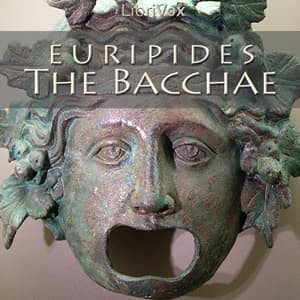

Look, I have a bone to pick with Euripides. You don't just write a play about a god who shows up to his hometown like "worship me or I'll literally destroy your family" and make it NINETY-SIX MINUTES LONG. I was in the middle of a logo redesign for a mezcal brand — the irony of designing for a spirit while listening to the god of wine wreck an entire royal bloodline was not lost on me — and suddenly it was over and I was sitting there with my mouth open and Diego sleeping on my keyboard like nothing happened.
This book felt like getting slapped by something ancient and realizing it still stings.
Dionysus Came to Party and Pentheus Chose Violence
So here's the thing about Bacchae that wrecked me: it's not really about a god punishing mortals. It's about what happens when you refuse to see what's right in front of you. Pentheus is so obsessed with control — with being the rational king, the one who keeps order — that he can't recognize divinity even when it's literally standing in his throne room wearing a smile. And Dionysus? He doesn't rage. He doesn't thunder. He just... waits. He lets Pentheus dress himself in women's clothing and walk to his own death on a mountain. The patience of it is what's terrifying.
And then Agavë comes home carrying her son's head on a stick, thinking it's a lion's, and she's so PROUD, and the moment she wakes up from the madness and realizes —
My heart. MY HEART.
I ugly-cried during Agavë's recognition scene. Like, actual tears on my trackpad. This is a 2,400-year-old play and it still does that. Abuela would have loved this one — she understood stories about mothers and terrible knowledge. She watched telenovelas where women discovered horrible truths about their families, but Euripides wrote the original.
The LibriVox Ensemble — Charming and Uneven in Equal Measure
Okay, let's talk about what you're actually getting with this production. It's LibriVox, which means volunteer readers, which means free, which means you adjust your expectations accordingly. The cast approach is smart for Greek tragedy — having different voices for Dionysus, Pentheus, Cadmus, Agavë, and the others means you can actually follow who's speaking without a program guide.
Elizabeth Klett handles the Chorus and narration, and she's the quiet MVP here. The Chorus in Greek tragedy is this weird communal voice — part gossip, part prophet, part Greek choir (literally) — and Klett gives it this steady, measured quality that anchors everything. When the action gets wild, her Chorus sections feel like someone holding your hand through the chaos.
Bruce Pirie as Cadmus brings genuine sadness to the old king, especially in the final scenes when the family is shattered. Algy Pug's Pentheus has this stiff authority that actually works for the character — Pentheus IS stiff, he IS rigid, that's the whole point. Whether the stiffness is intentional characterization or just how the reader sounds... I'll give them the benefit of the doubt.
But — and this is important — the transitions between readers can feel clunky. There's no music, no sound design, nothing to smooth the handoffs. You get one voice, then silence, then another voice, and sometimes the tonal shift is jarring. Dale Burgess as the Messenger delivering the account of Pentheus's death has a different energy than the scenes before it, and the lack of production glue means you feel the seams.
At 1 hour 36 minutes, you're not making a huge time investment. I listened at 1.0x because even at that speed this thing flies. It's dense but it moves.
Who This Is (and Isn't) For
If you want polished Audible production with a single honey-voiced narrator, this isn't it. If you're curious about Greek tragedy but intimidated by reading it on the page, this is a genuinely good entry point. The multi-voice approach makes the drama legible in a way that reading translations sometimes doesn't. You hear the confrontation between Pentheus and Dionysus as an actual argument between two people, and that changes everything.
Also? If you've ever loved a story about someone who refuses to accept something true until it's too late — about the cost of pride dressed up as reason — this play invented that. Every tragic downfall you've ever read is borrowing from this playbook. The same thing hit me reading Untamed — that particular ache of watching someone dismantle their own carefully constructed world because they finally stopped lying to themselves about what was true.
The Rainy Sunday Book That Bites
This is a rainy Sunday book, but not a cozy one. It's the kind where you stare out the window afterward and think about your mom and what the gods owe us (nothing, apparently). For free? For under two hours? It's worth your afternoon. Just maybe keep the tissues close — Agavë's grief is eternal for a reason.