
"Who will look for you when you're the one who disappears?"
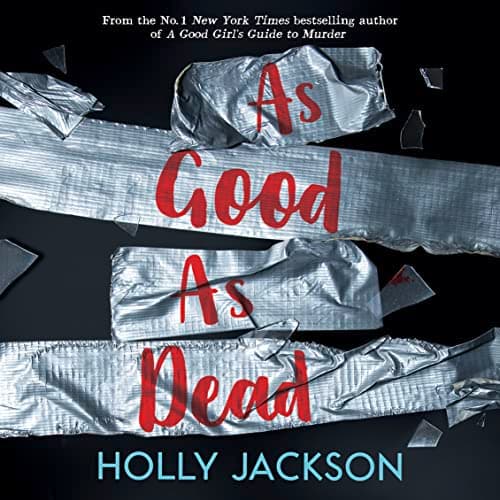
That line hit me around hour two, and I was shelving returns in the horror section at the library - alone, after close, because apparently I haven't learned a single lesson from any book I've ever consumed. Shirley Jackson walked so Holly Jackson could sprint, and in As Good As Dead, Pip Fitz-Amobi isn't just solving mysteries anymore. She's unraveling. The question is whether the book unravels with her in a way that works, or in a way that just... falls apart.
The answer? Both. Frustratingly, beautifully, both.
Pip Fitz-Amobi Didn't Deserve This (But the Story Did)
Let me back up. If you haven't listened to the first two books in the A Good Girl's Guide to Murder trilogy, stop reading and go do that first. This is not a standalone. This is a reckoning - the accumulated weight of everything Pip has done across two prior investigations finally crashing down on her. And Holly Jackson has the audacity to take her plucky, hyper-competent protagonist and break her.
Pip's PTSD, her paranoia, the way she flinches at sounds and spirals into compulsive behavior - this is where the book earns its stripes for me. It understands that horror isn't about gore - it's about dread. The stalker subplot creates this suffocating atmosphere where Pip can't trust anyone, can't sleep, can't stop looking over her shoulder. It's domestic terror. The kind of fear that lives in your house with you.
But here's where it gets complicated. Around the halfway mark, the book pivots hard. Without spoiling it: Pip makes a choice that fundamentally changes the genre of this story. It goes from YA thriller to something much darker, much more morally ambiguous, and the tonal whiplash is real. Some listeners are going to feel like Jackson lost the thread. I think she was pulling a different thread entirely - one about what happens when a "good girl" decides the system is broken and takes justice into her own hands. It's messy. It's supposed to be messy. But the execution stumbles because the pacing in that back half sags. There are stretches - maybe hours 10 through 13 - where it feels like Jackson is stalling, circling the same emotional beats without advancing them.
Four Narrators Walk Into a Crime Scene
The multi-narrator setup is interesting. Clare Corbett carries the heaviest load as Pip, and she commits. That's rare. When Pip's mental state deteriorates - the racing thoughts, the clipped sentences, the way she starts talking to herself in second person as a coping mechanism - Corbett tracks that descent with her voice. There's a scene where Pip is listening back to her own podcast recordings and Corbett shifts between Pip's composed "public" voice and her raw, barely-held-together internal one. That contrast does more character work than pages of exposition could.
Kristin Atherton, Jot Davies, and Maryam Grace fill in the supporting cast, and the transitions between narrators are clean enough. Davies brings a grounded warmth to Ravi that keeps the romance subplot from feeling like dead weight (though honestly, the romance IS the weakest element here - Ravi deserved more to do than worry about Pip). But here's my gripe: with four narrators, you'd expect a full-cast feeling, and it doesn't quite get there. The production is straightforward - no sound effects, no atmospheric audio design. For a book this steeped in paranoia and surveillance, some ambient tension would've elevated the whole thing. A creak. A phone buzz. Something.
Corbett's work in the final third, though? When Pip is making decisions that would've been unthinkable in book one? I listened in the dark. Mistake? Maybe. Worth it? Absolutely. There's a rawness to her delivery that made me genuinely uncomfortable - not because of violence, but because of how convincingly she portrays someone rationalizing the unjustifiable. That specific discomfort - watching a character you've rooted for cross a line and drag you across it with them - is something Double Dexter does too, though from the other direction entirely: what happens when the monster starts worrying about being caught by someone worse.
The Trilogy Problem Nobody Talks About
Here's the thing about trilogies: the final book has to be both a satisfying conclusion AND its own story. As Good As Dead tries to be a commentary on the entire series - on true crime culture, on the cost of playing detective, on systems that fail victims. These are ambitious themes for YA, and I respect the swing. But compared to the tight, puzzle-box plotting of A Good Girl's Guide to Murder, this feels looser, more sprawling, more interested in theme than mechanics.
The stalker-to-serial-killer connection that drives the first half is genuinely tense. The second half, where the book becomes something closer to a moral horror story, is where it'll divide listeners. My podcast listeners are going to love arguing about the ending.
Is it as good as the first book? No. The first book was a locked-room mystery with heart. This is a character study wearing a thriller's clothes. Different muscles, different payoff.
Who Should Listen (And Who Should Skip)
Pick this up if you've finished books one and two and need to see where Pip ends up - the character arc is genuinely bold and the narration sells the emotional cost. Skip it if you're looking for another satisfying whodunit, because the mystery elements take a backseat to Pip's psychological collapse. And if you scare easily around stalker content - threats, surveillance, someone watching from outside your window - this one will get under your skin in ways that feel uncomfortably real.
Sixteen hours and fifty-five minutes. That's a commitment. And honestly, it could've been trimmed by two hours without losing anything essential. But Corbett's performance in those final few hours? That earned the runtime back for me.
Shelving this one under "flawed but worth finishing." Shirley (my cat) was unimpressed. I was conflicted. That's probably the right response.