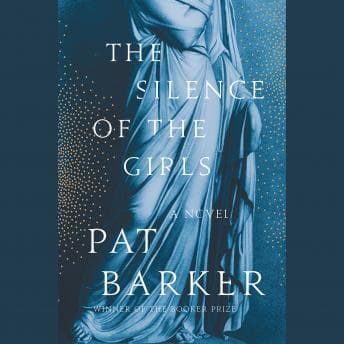

Homer never asked Briseis what she thought. Pat Barker did.
I was walking the lakefront with Denise on a grey November Saturday when Kristin Atherton's voice came through my headphones and said something that stopped me mid-stride. Briseis, watching the Greek soldiers from the shadows of Achilles' compound, describes herself as learning to be invisible - not because she chose to disappear, but because invisibility was the only armor available to her. Denise asked why I'd stopped walking. I said, 'Hold on.' That's the kind of book this is.
What Homer Left on the Cutting Room Floor
Here's what I tell my AP Literature students every year when we read the Iliad: the women are furniture. They're prizes, plot devices, catalysts for male rage. Briseis exists in Homer's text mainly as the reason Achilles sulks in his tent and lets his friends die. She gets maybe a dozen lines. Pat Barker looked at those dozen lines and asked the most obvious question in the world - what was she actually experiencing? - and somehow nobody had quite answered it like this before.
The answer is brutal and unflinching. Briseis is a Trojan queen who watched her husband and brothers die, then became the property of the man who killed them. Barker doesn't soften this. The camp women - concubines, nurses, the women who wash the bodies of the dead - exist in a state of constant managed terror. They've developed an entire economy of survival: who to avoid, when to make yourself useful, how to read the moods of men who own you. This is the Trojan War from the perspective of people for whom the war never ends because they're always on the losing side.
What caught me off guard was the contemporary register of the prose. Some listeners find the colloquialisms jarring - and I understand that reaction, I really do. My first instinct was the same. But I think Barker is doing something deliberate. The women's speech feels modern because their situation feels modern. The distance of archaic language would let us off the hook too easily. When Briseis thinks in idioms we recognize, we can't pretend this is ancient history.
Two Voices, One Problem
Kristin Atherton narrates Briseis's sections with what I can only describe as controlled ferocity. There's a watchfulness to her delivery - you can hear Briseis calculating, weighing every word before she speaks it. The narrator understands that pause is punctuation. When Briseis goes quiet in scenes with Achilles, Atherton makes that silence do real work.
I found that same mastery of quiet tension in Belladonna, another audiobook where she tamps down a wildfire of emotion into something devastatingly restrained.Michael Fox handles the Achilles chapters, and this is where I need to be honest with you: he's good, but the tonal shift is jarring in a way that took me a few chapters to stop noticing. Fox plays Achilles with a kind of educated vehemence that's accurate to the character - Achilles is brilliant and petulant and terrifying all at once - but the transition from Atherton's interior, restrained Briseis to Fox's externalized, declamatory Achilles is like switching radio stations mid-song. Some listeners never adjust. I eventually did, and I think the contrast becomes intentional - Achilles gets to be loud, Briseis has to be quiet. That's the whole point of the book.
Also: Atherton uses various British accents across the female characters, which some reviewers found distracting. I found it useful shorthand for social hierarchy among the captive women. Her ear for dialect is just as sharp in Just My Luck, a thriller that hands her a whole town of characters to voice — she switches registers like a pinball, and it works. Your mileage may vary.
If You Loved Circe, Read This First
If you loved Madeline Miller's Circe - and if you haven't, what are you doing with your life - this is its spiritual predecessor in temperament, though darker by several degrees. Where Miller gives her heroine power and transformation, Barker gives Briseis something harder: survival without redemption, endurance without reward. It's less cathartic. It's more honest.
My students would hate this. Not because it's bad - because it refuses to give them the heroism they're trained to expect. There's no triumphant moment where Briseis reclaims her story on her own terms. The title is The Silence of the Girls, and Barker doesn't betray that silence with a false resolution. The prose deserves to be savored, especially in the quieter scenes between the women themselves, where Barker does her most precise work.
This is why we still read the classics - not because they're perfect, but because they leave so much unsaid. Barker said it. Worth pausing the faculty meeting for.