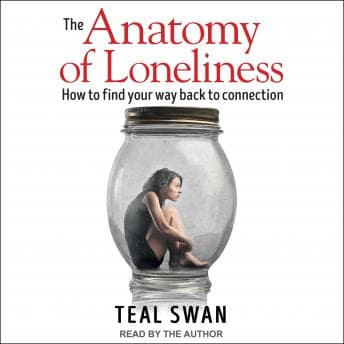

I was halfway through making dal makhani at 10 PM on a Tuesday — the kind of elaborate cooking project I do specifically because I live alone and find it meditative, not sad (I said what I said) — when Teal Swan started describing the three pillars of loneliness: Separation, Shame, and Fear. And I stood there stirring cream into lentils thinking, huh, that's actually a decent framework. Not groundbreaking from a clinical standpoint, but structurally clean. The kind of thing I wish more self-help authors would do instead of vaguely gesturing at "healing."
Let me be upfront about where I'm coming from. I study how narratives shape identity. I'm trained in psychological research. Teal Swan is not a psychologist. She's a spiritual leader who claims extrasensory abilities including clairvoyance, and her authority comes primarily from personal experience — specifically, surviving severe childhood abuse. That's a meaningful credential for empathy, but it's not the same as clinical training, and the book doesn't always make that distinction clear. If you're the kind of listener who needs peer-reviewed citations, this will itch.
But here's where it gets interesting.
The Framework Actually Has Teeth
The separation-shame-fear triad isn't just a catchy label. Swan spends real time on the "weird coping mechanisms" — her phrase, essentially — that people develop around loneliness. The ones that look like connection but actually deepen isolation. The people-pleasing that's really control. The hyper-independence that's really preemptive rejection. It's the same emotional architecture Gary Chapman fumbles toward in 5 Love Languages, except Swan is actually willing to sit with the uglier mechanics of why people fail to receive love even when it's offered directly. I found myself asking: why does she frame these as pillars rather than stages? Because she's arguing they're simultaneous and self-reinforcing, which is... actually consistent with what attachment theory research shows about insecure attachment patterns. She wouldn't use that language, but the structural insight holds.
The Connection Process she introduces — this guided exercise where a "receiver" and "journeyer" move through emotional blockages together — is where things get more spiritual and less empirical. It's essentially a form of guided visualization meets empathic witnessing. My therapist would have thoughts about this technique, specifically around the lack of professional oversight when two non-trained people are doing deep emotional work together. But I can also see why people find it powerful. The need to be truly seen by another person while sitting inside your worst feelings? That's not woo-woo. That's basically what good therapy does.
When Teal Reads Teal
Author-narrated self-help is always a gamble. You're betting that the person who wrote the ideas can also deliver them with the right emotional weight and pacing. Swan's delivery works best during the vulnerable, explanatory passages — when she's walking you through why someone might push away the exact connection they crave, her voice carries genuine emotional knowledge. You can hear the lived experience. It's not performative empathy; it sounds like someone who has actually sat inside that particular darkness.
Where it's less effective is during the more instructional, exercise-heavy sections. The Connection Process steps require a certain precision, and in audio format, you can't flip back to re-read step three. At 7 hours and 14 minutes, the book is a manageable commitment, but I'd recommend having a physical copy nearby for the practical exercises. Audio alone won't cut it for implementation.
The pacing is steady — not rushed, not draggy. But it's the kind of listen that demands your attention. I tried it during a morning jog and found I was missing key concepts because my brain was splitting between breathing and processing shame frameworks. This is a sit-down-and-focus book.
The Psychologist In Me Has Notes
Psychologically, most of this tracks. The idea that loneliness isn't solved by proximity to other humans? The research actually shows that subjective loneliness — the felt sense of disconnection — operates independently of social contact frequency. Swan gets this right intuitively, even if she doesn't cite Cacioppo or any of the epidemiological work on loneliness as a public health crisis.
What doesn't fully track for me is the implied universality. The book treats its framework as applicable to everyone's loneliness, but loneliness rooted in, say, neurodivergence or systemic marginalization operates on different mechanisms than loneliness rooted in childhood trauma. Swan's lens is heavily trauma-focused — understandably, given her background — but that means the book is most useful for a specific subset of lonely people, not all of them. Only Girl in the World is worth reading alongside this one if you want to understand what it actually looks like to narrate severe childhood trauma from the inside — because where Swan theorizes from her experience, Maude Julien renders it viscerally, and the contrast clarifies what each format can and cannot do.
Also, and I say this gently: the spiritual authority Swan claims (the extrasensory abilities, the language of "revolutionary technique") will either draw you in or push you away. There's no neutral ground. I found myself filtering through it to get to the psychological substance underneath, which was often worth the excavation.
Who This Is Actually For (And Who Should Walk Away)
If you're someone who experiences loneliness as a deep, persistent pattern — not situational, not "I moved to a new city" lonely, but the bone-level kind that follows you into rooms full of people — this book will feel seen. Swan names dynamics that most self-help books gloss over. If you're comfortable with spiritual framing and want emotional insight rather than clinical protocol, it's genuinely useful.
If you need evidence-based approaches, if spiritual authority claims make you skeptical (valid), or if you're looking for loneliness solutions that address structural or social factors — this isn't your book. Try Cacioppo's work instead.
My Clinical Impression
This is a fascinating case study in what happens when deep personal insight meets spiritual framework meets real psychological truth. Swan understands something essential about how humans build walls and then feel trapped behind them. The framework is sound enough to be useful, the delivery is emotionally authentic, and the Connection Process — while needing professional guardrails I'd want to see — points toward something real about the healing power of being witnessed. I'm not fully on board. But I'm not dismissing it either. And for a book outside my usual empirical lane, that's saying something.