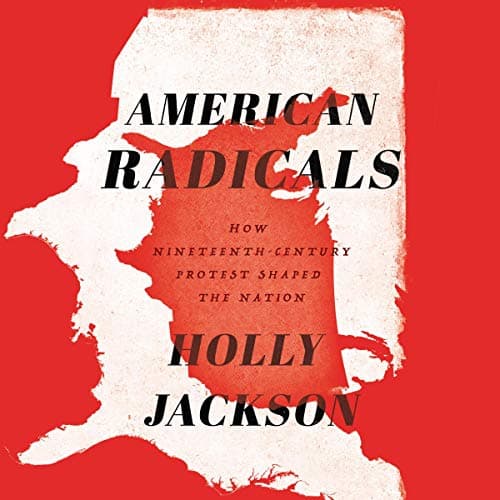
Look, I have a complaint. I picked this up because I saw "Holly Jackson" and my brain short-circuited into thinking this was somehow connected to the A Good Girl's Guide to Murder Holly Jackson, and I was ready for some true crime adjacent deep-dive. Instead I got a nineteenth-century history of American radicals, which is a completely different Holly Jackson, and honestly? I'm not even mad. I'm annoyed at myself for the mixup, but the book earned its place on my shelf within the first hour.
I was reshelving returns at the library - the Tuesday evening shift where nobody comes in and the fluorescent lights hum like they're trying to summon something - and I had this playing through my earbuds while alphabetizing donated paperbacks. January LaVoy's voice filled in the silence between the hum and the occasional creak of the building settling, and suddenly I was standing there holding a copy of Where the Crawdads Sing while learning about Frances Wright, a wealthy Scottish heiress who showed up in America in the 1820s and basically told organized religion and the institution of marriage to go to hell. In the 1820s. Coming from a household where my parents wouldn't let me read Goosebumps, I felt an immediate kinship.
The Forgotten Ones Who Set Everything on Fire
What Jackson - the historian, the professor at UMass Boston, not the YA thriller writer (I will not make this mistake again) - does so well here is connect figures you've never heard of to the ones you have. Marx Lazarus, a vegan from Alabama in the 1800s (let that sink in) who advocated for sexual liberation while harboring what Jackson calls a "dark secret" - he's not a footnote here, he's a full character with contradictions that feel disturbingly modern. Martin Delany, who secretly backed John Brown's raid on Harpers Ferry and then somehow ended up allied with Southern Confederates after the war? That whiplash alone is worth the listen. Jackson doesn't smooth over these contradictions. She lets them sit there, uncomfortable, because that's the point.
The structure moves chronologically from 1826 - both Adams and Jefferson dying on July 4th, which is the kind of detail that sounds made up but isn't - through the Civil War and its aftermath. It's panoramic but never scattered. Each radical gets enough space to breathe without the book becoming a disconnected series of biographical sketches. James Forten organizing the first mass political protest of free African Americans in Philadelphia, William Lloyd Garrison's nonviolent convictions cracking under the weight of the slavery crisis - these stories build on each other. You start to see the network, the way these people influenced and sometimes infuriated each other.
LaVoy Keeps the Chaos Organized
January LaVoy narrates with a steady, measured pace that this kind of dense material absolutely needs. She's not flashy. She doesn't do dramatic voices or theatrical pauses. And that's the right call - this isn't fiction, and it doesn't need someone performing it like a one-woman show. What LaVoy does is keep you oriented. When you're tracking half a dozen radicals across three decades of American upheaval, a narrator who can signal transitions cleanly and maintain consistent energy across eleven and a half hours is doing harder work than it looks. She commits to clarity. That's rare in nonfiction narration, where so many performers either go monotone or overcorrect into PBS documentary mode. I've been thinking about narrator-as-anchor a lot lately after spending time with Tom Lake, where Meryl Streep does something similarly understated - letting the material breathe instead of performing it to death.
That said - and I'm being honest here - I don't have much to say about her character differentiation because this is largely expository history. She's reading Jackson's prose, not performing dialogue. The prose itself is accessible without being dumbed down, academic without being dry. LaVoy serves it well.
Where It Sits in the People's History Tradition
The obvious comparison is Howard Zinn's A People's History of the United States - the blurb literally invokes it - but Jackson's scope is tighter and more narrative. Zinn gave you the whole sweep; Jackson gives you the Civil War era in granular, character-driven detail. If you've read The 1619 Project or Four Hundred Souls, you're in adjacent territory, but Jackson's approach is less anthology and more connected saga. The radicals here aren't isolated figures dropped into themed chapters. They're a network, and the book tracks how their ideas and relationships shaped each other over decades.
For a horror podcast host, this scratched an itch I didn't expect. These are people who were called dangerous, heretical, treasonous - people whose ideas about equality and freedom were treated as existential threats by mainstream America. Growing up in a house where even fantasy novels were suspect, where questioning authority was its own kind of sin, I get it. Not at the same scale, obviously. But the pattern of forbidden ideas being the ones that matter most? That's a story I know.
Who Should Listen (And Who Should Skip)
If you want action-packed narrative history with battle scenes and political intrigue played for thrills, skip this one. It's intellectual history - the history of ideas and the messy, contradictory people who held them. If you need constant momentum or you're listening while doing something that splits your attention, you'll lose the thread. This demands focus.
But if you're the kind of person who pauses an audiobook to look something up because you can't believe what you just heard? You're going to be pausing a lot. My podcast listeners are going to love this - not because it's horror, but because it understands that the scariest thing in American history has always been the gap between what we say we believe and what we actually do.
Shirley (my cat) was unimpressed. But she's unimpressed by everything that isn't a can opener.