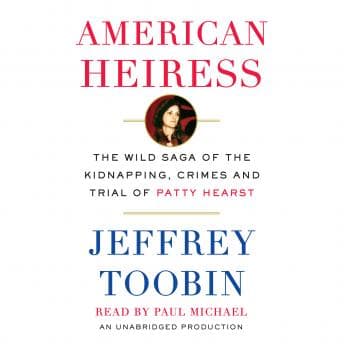

I'm going to complain about something first, because that's what teachers do. Fifteen hours and twenty-five minutes. That's how long this audiobook runs. You know what else takes fifteen hours? Grading a full set of junior essays on The Great Gatsby. I know this because I did both simultaneously last week, and let me tell you—Toobin's account of 1970s radical politics made those essays about "Gatsby's green light symbolizes hope" feel almost bearable.
But here's my actual grievance: Jeffrey Toobin wrote a book about one of the most psychologically complex cases in American history—a young woman's transformation from Berkeley sophomore to machine-gun-wielding revolutionary—and he never quite lets us inside her head. He's a legal analyst, not a novelist, and it shows. The facts are impeccable. The soul is... elusive.
The 1970s Were Genuinely Insane
This reminds me of what I tell my students about historical context: you cannot understand a text without understanding its moment. That same principle applies to Winston Churchill—you can't grasp his leadership without understanding the chaos he was navigating. And the moment Toobin reconstructs is absolutely unhinged. Fifteen hundred terrorist bombings a year. The Symbionese Liberation Army—a group so amateurish they couldn't agree on their own ideology—somehow became the center of national attention for months. The Hearst family literally tried to buy Patty's freedom by feeding the entire Bay Area. Bill Walton, the basketball player, shows up. The Black Panthers. Ronald Reagan. F. Lee Bailey doing F. Lee Bailey things in court.
Paul Michael, the narrator, handles this circus with the steady authority of a seasoned journalist reading his own notes. His vocal characterization of the bickering husband-and-wife team Bill and Emily Harris—those incompetent radicals who kept Patty on the run—captures their toxic dynamic perfectly. You can hear the ideological pretension mixed with petty domestic squabbling. It's almost comic, except people died.
Paul Michael Knows His Lane
Some listeners wanted a female narrator for a book about a female protagonist. I understand the instinct, but I think it misses what Michael does well. This isn't Patty Hearst's memoir—it's a legal and historical analysis with Hearst at its center. Michael delivers Toobin's meticulous research with the precision it demands. His voice has that NPR-adjacent authority that makes you trust the facts even when the facts sound fictional.
The trial scenes are where he really earns his Audie Award credentials. The strategic maneuvering in the courtroom reminded me of the tactical thinking in Art of War—both sides positioning, feinting, trying to control the narrative. When Patty takes the stand and claims she was brainwashed, when the prosecution paints her as a willing revolutionary, Michael modulates between these competing narratives without tipping his hand. Toobin's courtroom writing is genuinely excellent, and Michael treats each dramatic reversal with appropriate weight.
That said, the middle sections drag. There's a long stretch covering Patty's year on the run that feels more like a police procedural than the psychological thriller the material promises. I found myself speeding through faculty emails during these parts. (Principal Martinez, I was definitely not listening to anything during your Wednesday briefing. I was fully engaged with budget allocations.)
The Question That Never Gets Answered
Here's what frustrated me, and I say this as someone who teaches students to interrogate texts: Toobin never commits to an interpretation of Patty Hearst herself. Was she a victim of Stockholm syndrome? A willing convert to radical politics? A privileged young woman who found meaning in violence? He presents evidence for all three readings and then... shrugs.
My students would hate this. I kind of love it.
Because the ambiguity is honest. We don't know what happened inside Patty Hearst's mind during those months in that closet, those weeks on the run, those years in prison. Toobin—to his credit—refuses to pretend otherwise. But it does make for a strangely uninvolving listen at times. You're watching events unfold through bulletproof glass.
Who Should Skip the Faculty Meeting For This (And Who Shouldn't)
If you loved The Run of His Life—Toobin's O.J. book—this is its spiritual successor, though slightly less gripping. True crime devotees and 1970s history buffs will find it absorbing. Anyone teaching American history should probably assign excerpts.
Skip it if you want psychological depth, if you want to understand Patty Hearst as a person rather than a legal case study. You might finish these fifteen hours still wondering who she really was. This also requires focused listening—it's not background material for the gym or your commute.
Maybe that ambiguity is the point. Maybe that's why we're still talking about her forty years later.
Class Dismissed
I listened to the final chapters during a lakefront walk with Denise, and she asked why I kept shaking my head. Because Patty Hearst served less than two years before Jimmy Carter commuted her sentence. Because she later received a full pardon from Bill Clinton. Because she went on to show dogs and appear in John Waters films. The American capacity for reinvention—or forgetting—is genuinely remarkable.
Toobin's book is meticulous, well-researched, and occasionally brilliant. Michael's narration is professional and appropriately measured. Together they've created something that feels less like a story and more like a very thorough legal brief about a story. That's not quite a criticism. It's just not quite a compliment either.








![Steve Jobs [unabridged audiobook] audiobook cover](/_next/image?url=https%3A%2F%2Fcovers.audiobooks.com%2Fimages%2Fcovers%2Ffull%2F9788499923406.jpg&w=1920&q=75)