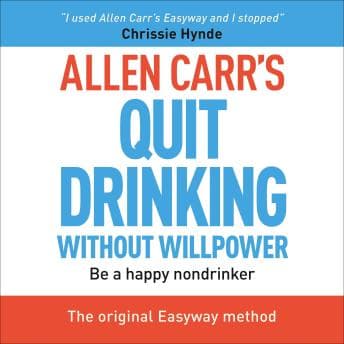

So here's the thing everyone says about Allen Carr books: "I read it and just... stopped." Like it's some kind of cognitive exploit, a zero-day vulnerability in your brain's reward system. I was skeptical. I'm an engineer. I debug systems for a living. You can't just tell someone "the trap is an illusion" and expect their dopamine pathways to rewrite themselves. Right?
I picked this up not because I have a drinking problem per se, but because Kevin and I had gotten into this pattern where a glass of wine after work became two became three became "wait, we killed another bottle on a Tuesday?" And honestly, at 5:47 runtime, it fit perfectly into my week - I figured worst case, I'd get some interesting behavioral psych out of it.
The Cognitive Reframe as a Service
Carr's whole method is basically dependency injection for your belief system. He doesn't ask you to resist drinking. He tries to dismantle the reasons you think you want to drink in the first place. It's less "here's willpower techniques" and more "your mental model of alcohol is a bug, let me show you the stack trace."
And... it kind of works? Not in a mystical way. In a "oh, I've been running on cached assumptions" way. He walks through every supposed benefit of drinking - social lubricant, stress relief, reward after a hard day - and methodically deconstructs each one. The argument that alcohol actually creates the stress it claims to relieve hit me hard. Like realizing the monitoring system that keeps alerting you is also the thing causing the latency.
But here's where I got frustrated: the repetition. Carr repeats his core thesis roughly forty-seven thousand times. I get it - repetition is the point, it's basically spaced repetition for belief change - but at 1.5x speed I was still muttering "yes, I KNOW, the trap is an illusion" by hour three. And those sections where he basically SHOUTS at you in what must be capitalized text in the print version? Jennifer Woodward reads those with this emphatic emphasis that feels like a slightly aggressive meditation app. It's not her fault. The source material is just... preachy. There's no other word for it.
Jennifer Woodward Does What She Can
Woodward's narration is competent and clear. Steady British delivery, good pacing, professional production. But this is a book that's essentially one long argument repeated from seventeen angles, and no narrator alive could make that feel dynamic. She's reading a persuasion manual, not performing a story. It's like asking someone to make a README file exciting. She does fine. The audio is clean. I have zero complaints about the production itself.
The problem is structural: this book is maybe 2.5 hours of actual content stretched to nearly 6. Classic self-help bloat. Every chapter circles back to the same framework. Could've been a blog post? No, but it could've been a tight 3-hour audiobook and been twice as effective.
The Part Where I Admit It Actually Worked (Sort Of)
I was listening to this on a Sunday morning, cleaning the apartment, and I got to the section where Carr talks about the "moment of revelation" - where you're supposed to feel genuinely free rather than deprived. And I realized I'd gone four days without a drink and hadn't thought about it. Not white-knuckling it. Just... hadn't occurred to me.
Now, correlation isn't causation and I'm self-aware enough to know the placebo effect is real. But something about reframing "I can't drink" as "I don't want to drink" actually shifted something. It's the difference between a TODO and a WONTFIX. Both mean you're not doing the thing, but one feels like deprivation and the other feels like a decision.
Kevin listened to parts of it with me. His review: "This is like if a British uncle cornered you at a party and explained addiction for six hours but was actually right about everything." ...Fair.
Who Should Hit Play (And Who Should Pass)
If you're sober-curious or just want to examine your relationship with alcohol, this is worth the time despite the repetition. If you're dealing with serious alcohol dependency, this alone probably isn't sufficient - but as a mental framework to pair with other support, the reframing is genuinely useful.
Skip if: you need evidence-based science (Carr cites almost nothing), you hate being told the same thing repeatedly, or you're looking for an engaging listen. This is medicine, not entertainment.
Perfect for: housework, walks, errands. Skip for: the commute if you're already drowsy - the repetitive structure will put you to sleep before the reframe kicks in.
The ROI Calculation
TL;DR: The ROI on this audiobook is weird. The content is maybe 60% filler, the delivery is workmanlike, and the core argument could fit in a Medium post. But if the reframe actually clicks for you - and it clicked for me more than I expected - the value is enormous. It's a 3-star audiobook experience delivering a potentially 5-star life outcome. I just wish someone would fork the repo and cut it in half.