
"You don't need willpower. You need to understand the trap."
That line hits somewhere around hour two, and I actually paused my dishwasher loading to think about it. Not because it's revolutionary - it's basically the thesis statement of every Allen Carr book since the '80s. But because it's the exact conversation I had with a 26-year-old founder last month who was ripping through a Mango-flavored disposable while telling me his startup needed "more discipline." Buddy, discipline isn't your problem. Understanding is.
I don't vape. Never have. But I picked this up because three of my current clients - all under 30 - do, and two of them have mentioned wanting to quit in the same breath as asking about their burn rate. When your team's addictions are affecting their performance and they're too ashamed to talk about it, maybe the consultant should at least understand the playbook.
The Carr Framework, Repackaged for a JUUL Generation
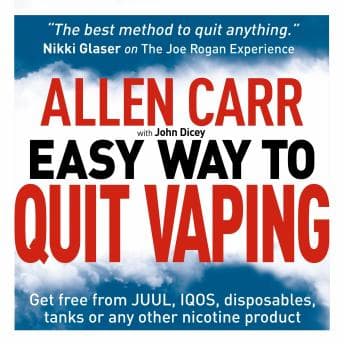
Bottom line: If you've read or listened to Allen Carr's Easy Way to Stop Smoking, you've heard about 70% of this book already. The core method is identical - dismantle the psychological trap, reframe nicotine as a parasite rather than a pleasure, and arrive at freedom through understanding rather than white-knuckle willpower. John Dicey, who runs the Carr organization now (Carr passed in 2006), has adapted the framework for vaping-specific contexts: JUUL pods, disposables, tanks, mods, IQOS heated tobacco devices. The vocabulary is updated. The underlying engine is the same.
And honestly? That's fine. Because the engine works.
The book spends its first couple hours doing what Carr always did - systematically demolishing every excuse you've built to justify your habit. "I enjoy it." No, you enjoy relieving the withdrawal that the last hit created. "It helps me concentrate." No, nicotine withdrawal was what destroyed your concentration in the first place. "I could quit if I wanted to." Then why haven't you? It's repetitive by design. Carr's method is essentially cognitive reprogramming through relentless, patient logic. He's not scaring you with pictures of diseased lungs. He's making you feel stupid for ever believing the lie - and somehow doing it without making you feel attacked.
The vaping-specific additions are useful but thin. There's a section addressing the "but vaping is safer than smoking" argument, which is fair - Dicey doesn't dispute reduced harm compared to cigarettes, but he correctly points out that "less poisonous" isn't "good for you." There's also material on the marketing machinery behind vape culture, the flavoring trap, the social normalization among younger users. These sections feel like they were written by someone who's researched the industry rather than lived in it, but they're competent enough.
Helen Keeley and the Audiobook-as-Therapy Problem
Here's where I need to be honest. Helen Keeley's narration is... fine. Clean, professional, British, measured. She reads like a therapist who genuinely wants you to get better but hasn't had enough coffee. There's a warmth there, but it's clinical warmth. The kind of voice you'd hear in a guided meditation app - soothing, steady, maybe a little too steady. For a book that's essentially trying to reprogram your brain over seven hours, you need that consistency. But at 2.0x speed, her pacing felt robotic in places. I dropped to 1.5x around hour three, which is a rare concession from me.
The bigger issue is that this book demands you listen to it in order, start to finish, without skipping. It literally instructs you not to jump ahead. For someone like me who treats chapter selection like a buffet, this was painful. But I get it - the method is cumulative. Each chapter builds on the previous reframe. Skipping to the "good part" defeats the purpose because there IS no singular good part. The entire listen is the intervention.
Who This Is Actually For (And Who Should Skip)
If you're currently vaping and want to quit - genuinely want to quit, not just feel guilty about it - this is worth your time. The listener reviews back this up. One person said they put down their vape four hours in and never picked it up again. That tracks with how the Carr method has always worked: the quit moment arrives mid-book, not at the end.
If you've already read the smoking version, the ROI drops significantly. You're paying for an update, not a new framework. If you're looking for hard science on nicotine pharmacology or clinical data, look elsewhere - this is psychology, not biochemistry.
If you're a manager, founder, or parent trying to understand why someone you care about can't seem to put the damn thing down? Actually, yeah. Listen to this. Not for yourself. For empathy. For understanding the mental trap before you try to have that conversation. The communication side of that conversation - knowing how to actually be heard when you raise something this loaded - is something How to be Heard addresses with more tactical precision than I expected from a book in that category.
My parents never had a word for "cognitive behavioral therapy." But when my mom quit smoking in 1994, she did it by deciding one morning that cigarettes were beneath her. Not harmful - beneath her. She reframed the entire thing as an insult to her intelligence. That's basically the Carr method, minus six hours of audiobook. Now it has a TED talk. Several, actually.
The Consulting Verdict
This book has a clear value proposition, a proven methodology, and a specific target audience. It delivers exactly what it promises with minimal padding - which at 6 hours 50 minutes, is actually pretty lean for this genre. The narration won't win awards but won't derail the experience either. The repetition is a feature, not a bug, even if it tested my patience.
Jenny would say I'm being harsh rating a self-help book on entertainment value. Jenny is right. This isn't entertainment. It's an intervention in audiobook form. And if it works - which for many people, it apparently does - then the ROI is infinite. A $15 credit versus a lifetime of nicotine purchases? That's not even a calculation. That's just math.