
"We spend roughly 60 percent of our communication time listening, but we retain just 25 percent of what we hear."
I was on my morning jog through Cambridge when Julian Treasure dropped that statistic, and I literally stopped running. Just stood there on the path like a weirdo while joggers swerved around me. Because here's the thing - I teach psychology. I study human behavior. And I'd never really thought about how catastrophically bad we all are at the thing we spend most of our communication time doing.
This is a fascinating case study in what happens when a sound expert turns his attention to the mechanics of human connection. And honestly? My therapist would have thoughts about why it took me this long to listen to it.
When the Expert Becomes the Instrument
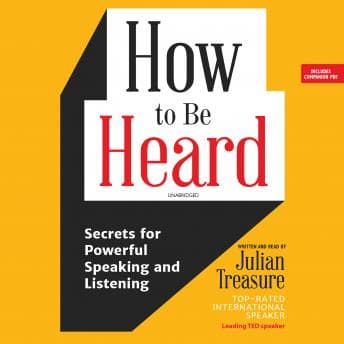
There's something almost too perfect about Julian Treasure narrating his own book on speaking and listening. The man has five TED Talks. Five. His voice is basically his resume, and you can hear it - that British clarity, the measured pacing that never feels rushed even when he's covering dense material. He practices what he preaches, which sounds obvious but is surprisingly rare in self-help.
The research actually shows that author-narrated nonfiction can go either way. Some authors have no business behind a microphone. Treasure, though? He nails it. I wish I could say the same about 7 Eternal Laws of Success, which had narration issues that made it hard to stay engaged. His vocal variety when demonstrating different speaking techniques isn't just instructive - it's genuinely engaging. When he talks about the "seven deadly sins of speaking" (gossip, judging, negativity, complaining, excuses, exaggeration, and dogmatism), you can hear him embodying the alternatives.
That said - and I found myself asking this around hour seven - does twelve and a half hours feel like a lot? Yes. It does. Some sections meander in ways that made me zone out during my cooking sessions. The book could've been tighter. But the practical exercises scattered throughout kept pulling me back.
The Psychology That Actually Tracks
What makes this book compelling is that Treasure understands human nature at a level most communication books miss entirely. He's not just giving you tips about projecting your voice or making eye contact. He's digging into why we don't listen - the filters we've built, the assumptions we carry, the internal noise that drowns out external input.
The protagonist exhibits classic avoidance patterns - and by protagonist, I mean all of us. We tune out because listening is hard. It requires presence. It demands we temporarily suspend our own narrative to enter someone else's. Treasure gets this. He frames listening as a skill that atrophies without practice, which (speaking as someone who reads too much research on cognitive decline) is exactly right. SuperFreakonomics takes a similar evidence-based approach to human behavior, though it focuses more on the counterintuitive patterns we miss.
His framework for "conscious listening" - the exercises he provides - these aren't fluff. They're grounded in actual attentional psychology, even if he doesn't always cite the literature. I appreciated that he includes interviews with professional speakers and CEOs, though I'll be honest: some of those segments felt more like padding than revelation.
The Parts That Dragged (And the Parts That Didn't)
Look, I'm going to be real for a second. Around the middle chapters, there's a stretch where the pacing slows considerably. Treasure gets deep into vocal mechanics - pitch, timbre, prosody - and while it's useful information, it's not exactly riveting during a 6 AM run. I found myself bumping the speed to 1.25x for those sections.
But then he hits the stagecraft material - how to actually deliver a talk, the common errors speakers make, the psychology of stage presence - and suddenly I'm hooked again. This is where his TED experience really shines. He's not theorizing. He's lived this.
The section on "danger words" particularly stuck with me. Five words that undermine your credibility every time you use them. I won't spoil them, but I caught myself using one in a faculty meeting the next day and cringed internally.
Who Should Listen (And Who Should Skip)
If you present regularly - conferences, meetings, classrooms - this is pretty much essential. The practical toolkit alone is worth your time. If you're more interested in the listening side (which, honestly, is where most of us need more help), the first half delivers. Skip this if you want something quick and punchy; twelve hours is a commitment, and some listeners have rightly noted the length feels excessive.
My mother would probably tell me I already talk too much and don't need a book about speaking. She'd be partially right. But the listening sections? Those I needed. We all do.
Would I listen again? Probably not cover to cover. But I've already bookmarked the vocal exercises and the stagecraft chapters for a re-listen before my next conference presentation. That's the thing about genuinely useful audiobooks - they become reference material, not just entertainment.