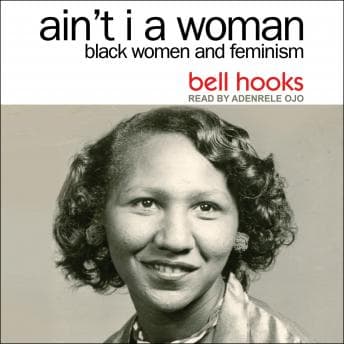

I was making chana masala at midnight — the kind of elaborate cooking-for-one my therapist would call "self-soothing" and I call "Tuesday" — when bell hooks described how the nineteenth-century feminist movement essentially looked at Black women and said, "We meant white women." I put down my spatula. Because I found myself asking: why does mainstream feminism keep replicating the exact hierarchies it claims to dismantle? hooks had the answer forty years ago. We just weren't listening.
The Case Study Nobody Wanted to Be
What makes this book so disorienting — in the best way — is how hooks refuses to let anyone off the hook (yes, I hear it). Not white feminists, not Black men, not Black women themselves. The protagonist of this story, if we can call her that, is the collective psyche of Black womanhood under a system that never bothered to see it clearly. And hooks examines that psyche the way I wish more researchers would: historically grounded but psychologically sharp.
She traces how slavery didn't just dehumanize Black women physically but created a psychological framework where Black femininity was defined as absence — the absence of the protections, the pedestals, the fragile-flower mythology that white womanhood was built on. Sojourner Truth's original question — "Ain't I a woman?" — wasn't rhetorical. It was diagnostic. The research actually shows that identity formation under conditions of systematic exclusion produces exactly the kind of double-bind hooks describes: you can't claim womanhood when the definition was written to exclude you, but you can't escape womanhood when the violence targets you because of it.
Compared to more recent intersectional feminist texts — Kimberlé Crenshaw's work, Mikki Kendall's Hood Feminism — hooks reads as the foundation they're all building on. Less polished in spots, more raw, and sometimes more repetitive (she circles back to certain arguments in ways that feel like she's making sure you cannot miss the point). But that rawness is the point. This isn't a book written for people who already agree. It's a book written to crack open assumptions, and you can feel hooks's frustration vibrating through every chapter.
Adenrele Ojo Understands the Assignment
Solo narration for a book this dense is a gamble. Nearly nine hours of one voice carrying complex theory about race, gender, and power? That could go very wrong. But Ojo — and I've heard her on other titles — brings something specific here that I want to name: restraint. She doesn't perform hooks's anger. She doesn't dramatize the historical passages about enslaved women's experiences for emotional effect. She reads with what I'd call controlled gravity, letting hooks's own words do the heavy lifting.
There's a poetic quality to Ojo's cadence that works especially well for hooks's prose style, which swings between academic argument and something closer to sermon. Ojo handles both registers without making the transition feel jarring. My one note — and it's minor — is that the pacing stays fairly uniform throughout, which means during the more data-heavy sections (hooks citing statistics, listing historical examples), the ear can drift if you're not actively paying attention. This is not a background-listen book. I tried it during my morning jog once and realized I'd zoned out for an entire section on the suffrage movement. Had to rewind twenty minutes. Lesson learned.
Where the Psychology Doesn't Track (And Where It Lands Hard)
I'll be honest about one thing that bugged me as a researcher: hooks sometimes makes sweeping claims about Black women's collective psychology without distinguishing between structural forces and individual experience. She'll describe how Black women "internalized" certain beliefs about themselves in ways that, psychologically, flatten a pretty complicated picture. Internalization isn't one thing. It's not uniform. And the mechanisms differ wildly depending on class, geography, generation.
But — and this is a big but — hooks wrote this in 1981. She was building the framework that later scholars would refine. Criticizing her for not having Crenshaw's vocabulary is like criticizing Freud for not being a neuroscientist. (My therapist would have thoughts about that analogy.) What hooks does get right, brilliantly right, is the emotional architecture of systemic exclusion: what it feels like to be invisible inside a movement that's supposed to be about your liberation. That's a case study in betrayal trauma, whether she uses that term or not. Ernest Becker was doing something structurally similar in Denial of Death — building a psychological framework around a kind of collective blind spot, the thing a whole culture organizes itself to avoid seeing — and I kept thinking about both books together, how the most uncomfortable theory is always the kind that makes the data make sense.
The chapter on racism within the feminist movement hit hardest. Not because the information was new to me — I teach this stuff — but because hooks's specificity is brutal. She names names. She quotes actual statements from white feminist leaders that are so casually dehumanizing you have to sit with them. And Ojo reads those passages with exactly the right amount of flatness, like: here it is. Look at it.
Who Needs This in Their Ears (And Who Might Struggle)
If you're someone who reads contemporary feminism and wants to understand where the conversation started fracturing along racial lines — this is essential. If you study psychology, identity, or any flavor of social justice work, hooks will make you uncomfortable in productive ways. And if you're a reader who prefers arguments that land clean and stay organized — be prepared. hooks is passionate, and passion sometimes means circling the same territory from four angles when two would've sufficed.
Skip this if you need audiobooks to be relaxing. This isn't relaxation. This is nine hours of someone asking you to think harder than you want to.
The Diagnosis
I finished this at 2 AM with cold chana masala on the counter and a head full of questions I should've been asking years ago. hooks wrote a book that functions like a psychological assessment of an entire culture's blind spots — and four decades later, the results still hold. That's not nostalgia. That's accuracy.