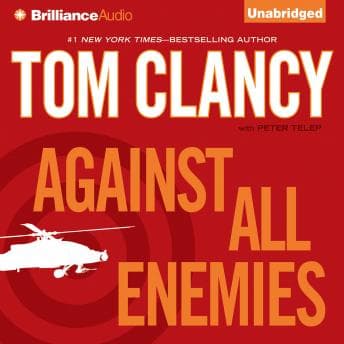

I was shelving returns at the library last Thursday — late shift, the building mostly empty except for the hum of the HVAC and one teenager who refused to leave the graphic novel section — when I hit play on this. Eighteen hours of Tom Clancy. Or rather, eighteen hours of Tom Clancy and Peter Telep, because let's be honest about the co-author situation here. I figured a military thriller about Taliban-cartel alliances would pair nicely with the low-grade creepiness of an empty public building at night. I was half right.
When Two Villains Team Up and Neither Is Scary Enough
Here's the premise: the Taliban funnels opium through a Mexican drug cartel to fund jihad on American soil, and ex-Navy SEAL Max Moore has to infiltrate and dismantle the whole thing. On paper? That's a horror movie for national security analysts. Two of America's biggest real-world threats joining forces. The kind of scenario that should keep you white-knuckling your steering wheel or gripping your headphones.
But Against All Enemies has an old Clancy problem amplified — it's so busy being a techno-thriller that it forgets to make you feel the threat. The action sequences hit hard, especially the early raid scenes where Moore is doing SEAL things in Mexico. Those chapters move. Weber's narration locks in during combat — his pacing tightens, his voice drops, and suddenly you're paying attention instead of half-listening. But between the gunfights, there's a lot of operational detail that reads like someone transcribed a briefing. Which, look, some people love that. I get it. But compared to early Clancy — The Hunt for Red October, Clear and Present Danger — this feels like the franchise running on muscle memory rather than genuine tension.
The dual-threat concept never quite pays off the way it should. The cartel side has more energy than the Taliban side, and when the story ping-pongs between Middle Eastern contacts and border chaos, the connective tissue feels thin. You're told these worlds are colliding. You don't always feel it. By Order of the President ran into similar trouble — the threat architecture is impressive on paper, but the emotional stakes keep slipping through the cracks.
Steven Weber Is Doing the Heavy Lifting (With One Weird Stumble)
Steven Weber is a three-time AudioFile best narration winner and an Earphones Award recipient, and you can hear why. The man handles accent shifts between American military personnel, Mexican cartel figures, and Middle Eastern characters with a fluidity that keeps eighteen hours from feeling like a slog. His dialogue delivery sounds natural — not performed, not read, but spoken — which is the difference between a narrator who understands acting and one who's just reading words aloud. The narrator commits. That's rare.
But here's where it gets funny. There's a male character whose name, in Weber's pronunciation, comes out sounding like "Aunt Sarah." I'm not making this up. For what felt like multiple chapters, my brain kept conjuring an older woman in a cardigan every time this guy showed up. It's the kind of thing that shouldn't matter but absolutely does when you're deep in a military thriller and suddenly picturing your aunt at Thanksgiving instead of a covert operative. Once I figured out what was happening, I adjusted. But it pulled me out of the story more than once.
There's also some voice-blending between male characters that gets tricky in dialogue-heavy scenes. Weber gives everyone a slightly different tone, but when you've got five or six American military guys talking in the same room, the distinctions blur. Not a dealbreaker, but it means this is an active-listening audiobook. You zone out for three minutes and suddenly you have no idea who's speaking.
Who This Is Actually For
If you're a Clancy completist, you already own this. If you're new to Clancy, don't start here — go back to the originals where the formula was fresh and the dread felt real. If you want a solid military thriller for a long road trip or a week of commutes, Weber's narration genuinely elevates material that would otherwise be middling. He's the reason this stays engaging through eighteen hours when the plot occasionally coasts.
But if you're coming to this expecting the kind of white-knuckle, can't-pause experience that the best thrillers deliver? You'll be disappointed. This is competent. Professional. Well-narrated. It is not, however, the book that's going to make you miss your highway exit.
(Shirley — my cat — slept through my entire listening session at home. For once, her indifference matched my energy.)
The Stamp on the Return Slip
Weber saves this from being forgettable. The premise had real potential — Taliban-cartel alliance is genuinely chilling if you think about it for more than five seconds — but the execution plays it safe when it should be twisting the knife. I listened, I was entertained enough, and I moved on. That's fine. Not every thriller needs to haunt you. But the best ones do, and this one doesn't even try.