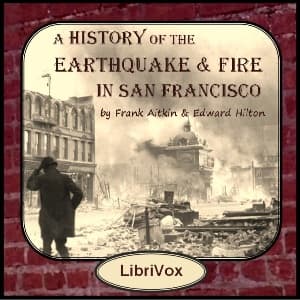

"The city was not burning in one vast conflagration, but in a hundred fires."
That line stopped me cold. I was cleaning my Beretta at the kitchen table - Ranger sprawled at my feet - when the narrator dropped that description of San Francisco on April 18, 1906. A hundred fires. Not one dramatic Hollywood blaze, but the slow, systematic destruction of an entire city block by block. That distinction matters, and it tells you everything about why this book still works over a century later.
When the After-Action Report IS the Story
Let me cut to the chase: this is a primary source document, not a thriller. Frank Aitken and Edward Hilton published this thing before 1906 was over - while the rubble was still warm, basically. And that immediacy is both its greatest strength and its biggest limitation. You're getting the raw data, the real-time accounting of what went wrong, who made what decisions, and how a city that thought it was invincible got humbled in 72 hours.
What hit me hardest was the infrastructure failure cascade. Broken water mains meant the fire department was essentially fighting with empty hoses. Gas lines feeding fires they couldn't extinguish. The military getting called in to dynamite buildings to create firebreaks - sometimes making things worse. I've seen this scenario play out in real life, in different contexts. When your logistics chain collapses, training doesn't matter much. The book lays out this cascade with an engineer's precision, and if you've ever run an emergency response exercise or dealt with disaster planning, the parallels to modern vulnerabilities will make your skin crawl.
The authors don't sensationalize. They catalog. Nearly 3,000 dead, 500 city blocks gone, and they present it with the clinical detachment of a field report. Some readers will find that cold. I found it respectful. The facts are horrific enough without embellishment.
The LibriVox Variable
Here's where I have to be straight with you. This is a LibriVox production, which means volunteer narrators rotating through chapters. The quality is... uneven. That's the nature of the beast with these community recordings. You'll get one reader who sounds like a retired professor with perfect diction, followed by someone who sounds like they're recording in a bathroom with their phone. No consistent voice, no consistent audio quality, no consistent pacing.
Does it ruin the experience? Not entirely, but it does prevent you from settling into a rhythm. I bumped my speed to 1.25x as usual, and some narrators handled that fine while others became harder to track. If you're used to polished Audible productions with a single professional narrator, recalibrate your expectations. This is free, it's a public domain recording, and you get what you pay for. But the content underneath is solid enough to push through the production inconsistencies.
Why a 118-Year-Old Disaster Report Still Matters
I run a security consulting firm. Half my job is convincing corporate clients that the disaster they think will never happen absolutely will. This book is Exhibit A for that argument. San Francisco in 1906 had plenty of warnings - seismologists had been raising alarms, the water infrastructure was known to be fragile, and the fire department was underfunded relative to the city's density and building materials. Nobody listened until the ground started shaking at 5:12 AM.
The author clearly did their homework - or more accurately, they were living inside their homework. The specificity of the account, from individual street-by-street fire progression to the political maneuvering around relief funds, reads like someone who walked the destruction personally. There's a section on the refugee camps that reminded me uncomfortably of displacement operations I've seen overseas. Different century, same human chaos when people lose everything overnight.
At 5 hours and 45 minutes, it's a manageable commitment. Dense enough to keep you engaged during a long drive to a client site in Houston, short enough that you won't lose the thread between sessions.
Who Needs This Intel
If you're a history junkie who wants primary sources rather than modern reinterpretation - this is your thing. Emergency management professionals, urban planners, anyone in disaster preparedness will find it eerily relevant. Military folks and security types will recognize the command-and-control failures. The same kind of high-stakes command breakdowns under fire show up in Miracle at Midway - different theater, different century, but the same gut-punch of watching a system strain against the limits of what any plan can account for.
If you want dramatic storytelling, character development, or any kind of narrative arc beyond "things got very bad and then slowly got less bad" - skip it. This isn't Erik Larson's "Isaac's Storm." It's the raw field report that someone like Larson would use as a source.
Worth your time? Here's the debrief: solid historical content, free to access, imperfect audio that you'll tolerate if the subject grabs you. The 1906 earthquake destroyed one of America's greatest cities in four days, and this book - written while the ashes were still cooling - tells you exactly how and why. Ranger slept through most of it, but he's not much for infrastructure policy.




![Steve Jobs [unabridged audiobook] audiobook cover](/_next/image?url=https%3A%2F%2Fcovers.audiobooks.com%2Fimages%2Fcovers%2Ffull%2F9788499923406.jpg&w=1920&q=75)