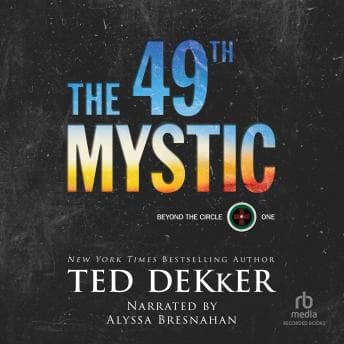

Denise and I had an unspoken agreement during our Saturday lakefront walk: she gets the podcast choice on the way out, I get the audiobook on the way back. Last weekend I was mid-stride somewhere between Navy Pier and the Adler Planetarium, lake wind doing its best to ruin my earbuds, when Rachelle Matthews - blind girl from Eden, Utah - started dreaming herself into another world. I didn't stop walking for two hours. Denise noticed. She didn't complain. That's how you know something's working.
Let me be honest about where I'm coming from with Ted Dekker. I teach Hawthorne and Flannery O'Connor - writers who understood that spiritual darkness and human darkness are the same darkness, just lit differently. Dekker is operating in that same territory, only he's doing it with the pacing of a thriller and the cosmology of a fever dream. The 49th Mystic is not subtle about what it's doing. Rachelle exists in two worlds simultaneously - small-town Utah and a place called Other Earth - and Dekker uses that dual-reality structure to ask the question he's apparently been asking his entire career: what if the material world is the dream and the spiritual world is what's actually real? My students would roll their eyes at this. Rob Bell works through that same inversion in What is the Bible? - different genre entirely, but the same insistence that the ancient texts are pointing at something more structurally real than the world we can measure. I found myself pausing the playback at the edge of the lake to just... sit with it for a minute.
Two Worlds, One Blind Girl, Zero Patience for Comfortable Faith
What makes this particular setup work - and what separates it from generic Christian fantasy - is that Rachelle's blindness isn't metaphorical window dressing. It's structural. She navigates both worlds without the sight everyone else takes for granted, which means she's reading Other Earth through touch, sound, and the testimony of people who may or may not be trustworthy. There's something genuinely interesting happening there. The girl prophesied to find five ancient seals can't see the world she's supposed to save. Dekker knows what he's doing with that.
The five seals themselves function less like a treasure hunt and more like a theological curriculum. Each one Rachelle finds corresponds to something she has to understand about fear, identity, and what it means to trust something you can't verify. I kept thinking about Bunyan - not the prose style, obviously, but the architecture. Pilgrim's Progress is also a quest narrative where the geography is spiritual and the obstacles are psychological. Dekker is working in that lineage, just with considerably more adrenaline and considerably less allegory that announces itself with a capital letter.
The comparison I keep reading - that this doesn't quite reach the original Black-Red-White trilogy - is probably fair. That trilogy had a rawness to it, a sense that Dekker was figuring out his own theology in real time. This one is more polished, more confident, which is both its strength and its slight weakness. The rough edges are gone, and some of those rough edges were doing interesting work.
What Alyssa Bresnahan Understands About Silence
The narrator understands that pause is punctuation. Bresnahan's reading of Rachelle's moments of disorientation - waking in one world, falling asleep into another, never quite sure which reality deserves more weight - uses silence the way a good stage actor uses stillness. She doesn't rush through the transitions. She lets the strangeness breathe. Over seventeen hours, that restraint adds up to something. By the time Rachelle is deep in Other Earth navigating a world she can't see among people who treat her as either prophet or threat, Bresnahan's voice has established enough emotional credibility that you trust her completely.
The prose deserves to be savored here, and to her credit, Bresnahan seems to know that. She's not performing at you. She's reading with you. The emotional delivery in the scenes where Rachelle confronts her own fear - and there are several, because the five seals basically require her to dismantle her own psychology piece by piece - lands without tipping into melodrama. That's harder than it sounds with material this explicitly spiritual.
Who This Is Actually For
If you loved C.S. Lewis's Space Trilogy for its willingness to take Christian cosmology seriously as imaginative territory rather than just allegory, this is its spiritual successor - faster, louder, less Oxbridge, but operating from the same conviction that the invisible world is more real than the visible one. If you want your spirituality kept safely in the subtext, look elsewhere. Dekker has no interest in subtext here. He's writing the text.
Worth noting: this is book one of two. It ends with momentum rather than resolution. I was warned about this and still felt the particular frustration of a story that stops rather than ends. Rise of the Mystics is already in my queue. The lakefront walk that started this will have to finish it.