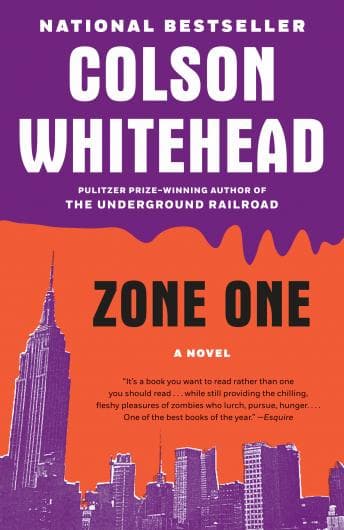

Colson Whitehead wrote a zombie novel that's allergic to being a zombie novel. And honestly? I respect that more than I enjoyed it.
I picked this one up on a late Tuesday night, couldn't sleep - one of those 0200 brain-won't-shut-off situations. Figured a post-apocalyptic zombie book would be the right kind of dark to match the mood. What I got instead was a literary meditation on trauma, mundanity, and American dysfunction wearing zombie makeup. Not exactly what I ordered, but not without merit.
The Smartest Clearing Operation You'll Ever Sit Through
Let me cut to the chase. Zone One isn't really about killing zombies. It's about a guy nicknamed Mark Spitz - after a drowning incident, not the swimmer - grinding through the cleanup phase of the apocalypse. The actual reclamation of lower Manhattan south of Canal Street. Civilian sweeper teams going floor by floor, office by office, clearing out "stragglers" - these broken infected who just... stopped. Frozen in place at copy machines, standing in conference rooms, staring at nothing. Going through the motions of their pre-plague routines like some kind of terrible muscle memory.
That concept hit me harder than any fast-zombie chase scene could have. I've seen guys who came back from deployment and kind of stalled out. Went through the motions. Whitehead's stragglers aren't just monsters - they're a metaphor for everyone who was already sleepwalking through life before the world ended. The book knows this. It wants you to know it knows this. And sometimes it's so busy being clever about it that the actual story loses oxygen.
The structure jumps between Mark Spitz's present-day clearing operations and flashbacks to the collapse - Last Night (everyone's origin story of when things fell apart), the desperate survival phase, encounters with other survivors. Whitehead's prose is genuinely sharp. His observations about corporate America, about bureaucracy surviving the apocalypse (Buffalo as the new capital, complete with acronyms and HR-style classifications for the infected), about the absurdity of rebuilding civilization with the same broken playbook - it's biting stuff. The provisional government issuing motivational slogans while bodies are still warm? I've seen that scenario play out in real life, minus the zombies.
Where Bennett's Voice Meets Whitehead's Labyrinth
Here's where it gets complicated. Beresford Bennett has a genuinely good voice - warm, measured, the kind of voice you'd want reading you bad news because it might soften the blow. But Whitehead's sentences are these long, recursive, self-interrupting things that coil back on themselves, and Bennett sometimes sounds like he's navigating them for the first time. You can hear the seams. There are stretches where the narration finds its groove and the haunted, exhausted tone is perfect for Mark Spitz's flat emotional register. Then there are passages where the rhythm just... doesn't lock in, and you're listening to someone reading dense literary prose rather than living inside a story.
At 1.25x, which is my default, the pacing actually improved. Bennett's natural delivery runs a little slow for the material, and bumping the speed helped the longer sentences feel more like thoughts flowing rather than being assembled word by word. I'd actually recommend going even faster for some of the more meandering flashback sections.
This is where it lost me periodically - the book demands your full attention. Not because the plot is complex (it's actually quite thin), but because Whitehead buries the emotional payload inside paragraphs-long digressions. Look away for thirty seconds and you've missed the one devastating observation packed inside two hundred words of scene-setting. It's the opposite of an action book. It's an atmosphere book. A mood book. A book that wants to sit with you in the dark and talk about what we lost.
Who This Is (And Isn't) For
If you're picking this up expecting World War Z or a straight survival thriller, you will be annoyed. Possibly angry. There are exactly zero extended action sequences in the traditional sense. The zombie kills are clinical, routine, described with the same energy as filling out after-action paperwork. That's intentional - and it works thematically - but it also means long stretches where you're waiting for something to happen and Whitehead is busy deconstructing consumer culture through the lens of abandoned Midtown restaurants.
But if you've read The Things They Carried and understood why O'Brien spent more time on the weight of supplies than on firefights, you'll get what Whitehead is doing here. Shots in the Dark operates in that same register - less interested in the bang than in what lingers after the smoke clears. He's writing about the weight. The exhaustion. The absurdity of trying to be normal when normal is gone. Worth your time? Here's the debrief: the book is a solid B+. The audiobook execution drops it a notch. Bennett is fine but not the narrator this particular prose style needed - someone who could make those serpentine sentences feel effortless rather than effortful.
Ranger fell asleep during this one, but in his defense, so did I once. Picked it back up the next morning. Still thinking about those stragglers standing at their desks. That image won't leave me alone, and I suppose that means the book did its job.