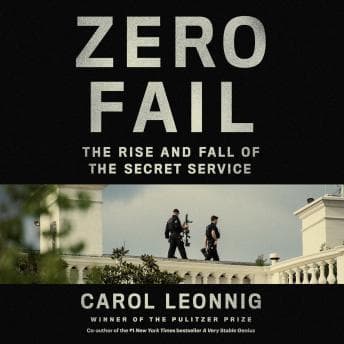

I was up at 0430 last Tuesday - old habits die hard - sitting on the back porch with coffee while Ranger dozed at my feet, and I finished the last two hours of this book as the sun came up over Austin. Appropriate, actually, because Zero Fail is the kind of book that makes you want to watch the sunrise and think about institutions - how they're built, how they rot from the inside, and how the people at the top usually make it worse.
Let me cut to the chase: Carol Leonnig wrote one hell of an investigative report. Whether it works as a 20-hour audiobook is a more complicated question.
When the Detail Work Is Spotless
The author clearly did their homework. Leonnig spent nearly a decade on this beat at the Washington Post, and it shows. She traces the Secret Service from its post-Civil War origins through the gut-punch of Dallas in '63, the redemption arc of the Reagan assassination attempt in '81, and then the slow, ugly decline through the Obama and Trump years. The Cartagena prostitution scandal, the White House fence jumper who made it deep into the building before anyone stopped him, the armed man who actually fired shots at the residence while agents stood around confused - these aren't hypotheticals. They happened. And Leonnig lays them out with the precision of a good after-action report.
I've seen this scenario play out in real life - not with the Secret Service specifically, but I spent 25 years watching the military cycle through the same pattern. Elite unit gets built on blood and sacrifice, develops a reputation, then leadership starts protecting the reputation instead of the mission. Gibbon documented the same rot in History of the Decline and Fall of the Roman Empire Vol. IV — different century, different institution, same corrosive dynamic where prestige becomes the enemy of function. Budget fights, toxic culture, people afraid to report problems because the brand matters more than the truth. Leonnig nails that institutional decay cycle cold. If you've ever served in any capacity, you'll recognize the pattern and it'll make your blood pressure spike.
What really got me was the whistleblower material. Leonnig convinced dozens of agents - current and former - to go on record or at least speak candidly about what's broken. That takes trust, and it takes guts from both sides. The picture they paint is damning: outdated equipment, chronic understaffing, a leadership class more interested in covering up failures than fixing them.
The Newspaper Problem
Here's where it lost me, at least in stretches. At 20 hours and 27 minutes, this is a substantial commitment, and the book sometimes reads like what it partially is - a collection of deeply reported newspaper investigations stitched together into a chronological narrative. The transitions between eras can feel abrupt, like you're jumping from one long-form article to the next rather than following a single through-line. There are chapters that absolutely fly by, and others where you're deep in bureaucratic detail that would make a Pentagon briefing feel exciting.
I don't say that to be dismissive - the detail matters. But around hour 12, I found myself wishing Leonnig had picked maybe three or four central characters and woven their careers through the whole book instead of giving us the wide-angle institutional survey. The information is all important. The structure just doesn't always serve the audiobook format.
Two Narrators, Two Different Experiences
So here's the thing about the audio production: Maggi-Meg Reed handles the bulk of the narration, and she's solid. Clean, professional delivery with a newscaster quality that fits the material - she lets the facts do the heavy lifting without getting in the way. Leonnig herself narrates the introduction and closing sections, and the difference in polish is noticeable. Not terrible, but you can hear the gap between a professional voice actor and a journalist reading her own work. Leonnig's sections feel more personal and authentic, sure, but they lack the crispness that Reed brings. I'd have been fine with Reed handling the whole thing, honestly.
I listened at 1.25x and it worked perfectly for Reed's sections. Leonnig's parts I actually slowed down slightly because her cadence is different - less rhythmic, more conversational.
Who Needs This Briefing
If you care about government institutions, executive protection, or just want to understand how an agency charged with the most important security mission in the country managed to get this broken, this is essential listening. History and politics folks, this is your lane. If you're looking for a thriller or some kind of action-packed ride, wrong book - this is journalism, not entertainment, and it's better for it.
Skip it if 20 hours of institutional analysis sounds like punishment. No shame in that.
Mission Debrief
Worth your time? Here's the debrief: Leonnig wrote the definitive account of the Secret Service's decline, and she did it with the kind of sourcing that most authors only dream about. The audiobook format isn't perfect - it's long, occasionally structurally uneven, and the dual-narrator setup creates some friction. But the substance is undeniable. I finished it feeling genuinely alarmed about the state of presidential security, and genuinely grateful that someone with Leonnig's access decided to write it all down.
Ranger slept through most of it, which means it wasn't exciting enough for a combat veteran's dog but was calm enough for a peaceful morning. Take that however you want.