
Somewhere around hour three, June Hayward is rationalizing - again - why she deserves to publish a dead woman's novel, and I set my sweet tea down on the porch railing and said out loud to nobody: "Child, who raised you?"
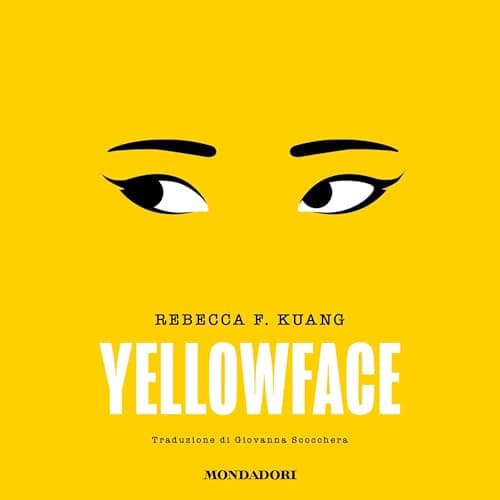
That's the thing about this Italian edition of Yellowface. R.F. Kuang writes June's interior monologue with such precise self-delusion that you find yourself arguing with her like she's sitting across from you. And this is the discovery that surprised me most: I expected satire, I expected publishing-world skewering, but I didn't expect to feel so deeply implicated. Because June's rationalizations - "The story deserves to be told," "Athena would have wanted this," "I'm actually improving it" - they echo the kinds of justifications I heard for forty years in academia. Different context, same architecture of theft dressed up as service. The same quiet corrosion of self-serving logic - dressed up in the language of care and merit - runs through Lessons in Chemistry, where a woman's intellectual labor is systematically absorbed by the men around her, each of whom has convinced himself he's simply making use of available resources.
The Anatomy of a Perfectly Unreliable Thief
Kuang does something technically fascinating here. June narrates her own crime in first person, and every chapter tightens the screw a quarter turn. She steals Athena Liu's manuscript about Chinese laborers in World War I, publishes it under the name "Juniper Song" - ambiguous enough to let readers assume she might be Asian - and then watches her career explode. The genius is that June never has one dramatic villain moment. It's all incremental. She edits out some of Athena's more specific cultural references because they "slow the pacing." She accepts praise for "her" research with a tight smile. She monitors Twitter like a woman checking for tumors.
And here's where Kuang's background as a scholar of Chinese studies shows - the details about the Chinese Labour Corps, about 140,000 men recruited to dig trenches and clear battlefields on the Western Front, aren't just window dressing. They're the stolen heart of the book within the book, and the fact that June treats this history as content to be optimized is the sharpest knife in Kuang's drawer.
Giada Bonanomi and the Italian Question
Now, I should be honest. This is the Italian translation by Giovanna Scocchera, narrated by Giada Bonanomi, and my Italian is - well, let's say it was better when my husband Carlo and I spent that summer in Umbria thirty years ago. I listened to this edition because a former student sent it to me, insisting the translation captured something the English couldn't. And I'll say this: Bonanomi's narration carries a cool, controlled irony that suits June's character. There's a flatness to her delivery during June's worst self-justifications that feels deliberate - she's not winking at the audience, she's letting June hang herself with her own words. Whether that's a conscious interpretive choice or simply the cadence of Italian prose, I can't say with certainty. But it worked on me.
What I can say is that the eleven-hour runtime felt right at 0.85x. Some stories need time to breathe, and this one needs you to sit with June's discomfort, to feel the slow social media pile-on building like weather.
Where Kuang's Blade Dulls
The second half doesn't sustain the first half's tension. Once the Twitter mob arrives and the accusations start flying, the novel shifts from psychological portrait to something closer to a thriller - and not a particularly surprising one. June's paranoia about whether Athena's ghost is literally haunting her felt like Kuang hedging her bets, trying to keep genre readers engaged when the literary engine was doing just fine on its own. I wanted more of the publishing industry's complicity - the editors who don't ask questions, the marketing team that leans into the ambiguous pen name - and less of the "is this supernatural?" feints that go nowhere.
My late husband would have loved the first seven hours. The last four, he'd have set the book down and gone to prune the peach trees.
Who Should Listen (And Who Should Skip)
If you've ever worked in any creative field where credit is currency - academia, publishing, music, film - this book will make you squirm in recognition. If you spend time on literary Twitter (or whatever we're calling it now), Kuang's recreation of pile-on dynamics is almost uncomfortably precise. But if you want a protagonist you can root for, or if you need the moral questions resolved cleanly by the final chapter, you'll leave frustrated. June doesn't learn. That's the point. But it's also the limitation.
Final Grade
A solid B+. Kuang is whip-smart, the premise is irresistible, and the first half is the most precise dissection of white entitlement to other people's stories that I've read since... well, since I lived through the canon wars of the 1990s. The Italian narration adds a strange, useful distance - hearing American publishing madness filtered through another language made it feel almost anthropological. But the novel reaches for too many genres in its back half and doesn't fully commit to any of them. Still. That opening act. That slow, meticulous construction of a woman convincing herself she's the victim of her own crime. Language as sacred - this gets it, at least for the first seven hours.