
What does it cost a woman to love a child that isn't hers — and what does it cost that child to love her back?
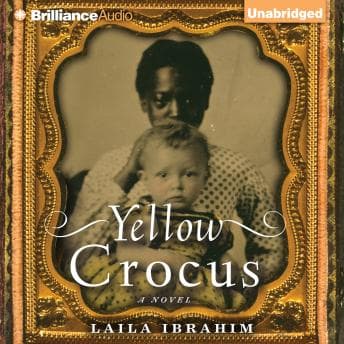
I started Yellow Crocus on a Tuesday during Sophie's nap, thinking I'd listen for maybe twenty minutes and then switch to laundry folding mode. Sophie slept for an hour and forty-five minutes that day (unprecedented, possibly miraculous), and I didn't fold a single towel. I just sat on the couch with my eyes closed and let Bahni Turpin wreck me.
The Quiet Devastation of Being Handed Someone Else's Baby
The premise hits different when you're a mother. Mattie, an enslaved woman, is pulled away from her own newborn son to nurse baby Lisbeth — a white infant she didn't ask for and has every reason to resent. But she doesn't resent her. She can't. Because that's what mothers do — they love the baby in their arms, even when their heart is screaming for the one that was taken away. Laila Ibrahim doesn't rush past this. She lets you sit in the grief of it, the biological impossibility of nursing someone else's child while your milk was meant for your own.
And here's the thing that got me — Lisbeth's biological mother, Ann, isn't painted as a villain. She's just... broken. Overwhelmed by plantation life, emotionally shut down, performing the role of Southern wife while barely holding herself together. As a mom who has definitely locked herself in the bathroom pretending she can't hear anyone calling her name, I felt an uncomfortable flicker of recognition. Not the slavery part, obviously. But the part where a woman loses herself inside the performance of what she's supposed to be? Yeah. That landed.
Bahni Turpin Made Me Forget I Was Listening to One Person
I've listened to Bahni Turpin before and she's always good, but something about this particular book brings out her best. Her Mattie has this low, steady warmth — there's a weight to it, like someone who has learned to carry heavy things without dropping them. Her young Lisbeth is bright and curious without being annoying (which, if you've ever listened to an adult narrator try to voice a child, you know is a genuine achievement). And when Lisbeth grows up, you can hear it — the voice doesn't just get older, it gets more guarded. More plantation wife. More Ann.
The moments in the slave quarters felt the most alive to me. Turpin shifts into something lighter, more musical — there's laughter and teasing and community, and it makes the contrast with the Big House even sharper. The main house scenes feel airless and stiff by comparison, and I'm pretty sure that's intentional on both Ibrahim's and Turpin's part.
At 8 hours and 24 minutes, this is a perfect length for my life. I finished it in about five days of car time and nap time listening. Survived 47 pauses and still made sense — the story moves chronologically, the chapters are clean, and Ibrahim doesn't play timeline games. Bless her for that.
Predictable Doesn't Mean It Didn't Matter
Look, I'll be honest. Some of the plot beats are exactly where you think they're going. If you've read any historical fiction about the antebellum South, you'll see certain turns coming. The forbidden friendship. The inevitable reckoning. The moment where Lisbeth has to choose between the world she was born into and the woman who actually raised her.
But here's what I kept thinking: predictable isn't the same as unearned. Ibrahim's background is in developmental psychology and attachment theory, and you can feel that. The relationship between Mattie and Lisbeth doesn't just happen because the plot needs it to — it builds the way real attachment builds. Skin-to-skin. Repetition. Being the one who shows up. By the time the big emotional moments arrive, they don't feel manufactured. They feel inevitable in the way real love is inevitable.
Did it make me cry at school pickup? Yes. Specifically the scene where Mattie has to say goodbye to Lisbeth when Lisbeth is old enough that she understands what's happening but not old enough to do anything about it. I was in the carpool line with tears running into my coffee and Emma asked me if I was okay and I said "allergies" which is the lie I tell most often between March and November.
Who This Is For (and Who Should Know What They're Getting Into)
If you want something that examines the intimacy and horror of slavery through a very specific, very personal lens — two women, one bond, impossible circumstances — this will gut you in the best way. If you need your historical fiction to cover broad political scope or battle scenes, this isn't that. It's small and domestic and devastating. Content warnings for slavery, violence, and racism — nothing gratuitous, but Ibrahim doesn't look away either.
Not groundbreaking, but sometimes you don't need groundbreaking. Sometimes you need a story that reminds you that love across impossible divides is the most human thing there is. Armored actually gave me that same unexpected gut-punch — completely different setting, but that same insistence that human connection matters most when everything around it is trying to destroy it. And then you need to sit in your car in the garage for an extra ten minutes before you go inside and make dinner.
Worth Every Minute of My Precious Silence
I'm adding this to the short list of books I'll actually recommend to other moms — the ones who text me "I need something good but I only have like an hour a day." This is that book. Bahni Turpin is that narrator. And eight hours is exactly the right commitment level for a story that stays with you way longer than its runtime.