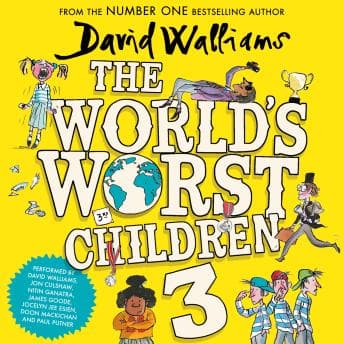

I was stress-cooking biryani at 10 PM on a Tuesday—the kind of elaborate project you undertake when your brain refuses to stop analyzing the defense mechanisms of your undergraduate students—when I decided I needed something aggressively uncomplicated. Something that would not require me to think about attachment theory or childhood trauma or why people make terrible choices. Enter David Walliams and his parade of monstrous children. World’s Worst Children 2 had already taught me that Walliams treats misbehavior like a carnival attraction with tiny, badly regulated guests.
Here's the thing about *World's Worst Children 3*: it's basically a collection of case studies in antisocial behavior, except instead of clinical analysis, you get punchlines. And honestly? My therapist would have thoughts about how relaxing I found that.
Ten Little Nightmares, Served With a Wink
The structure here is elegant in its simplicity. Ten stories. Ten awful kids. Each one a perfect little behavioral specimen. Hank the prankster. Tandy with her "titanic tantrums" (the alliteration is relentless, and I mean that as a compliment). These aren't nuanced character studies—they're cartoons of childhood id, the parts of ourselves we learned to suppress through socialization. Each kid exhibits classic oppositional defiant patterns, except Walliams knows exactly what he's doing. He's not trying to explain these children. He's celebrating their awfulness, then delivering cosmic justice in the form of absurdist consequences.
What makes this work—and I found myself asking: why does this formula succeed where so many imitators fail?—is that Walliams understands the child's perspective on authority. Adults are obstacles. Rules are suggestions. And the universe will eventually catch up with you, but in the meantime, the chaos is glorious.
Six Narrators Walk Into a Recording Booth
The full-cast approach here is ambitious. Six narrators for a three-hour audiobook means you're getting roughly 30 minutes per performer, give or take. Doon Mackichan, Jon Culshaw, Nitin Ganatra, and the rest bring genuine comedic chops—these are British comedy veterans, not random voice actors. The timing is sharp. The energy is high without tipping into that exhausting children's-media-screaming that makes parents want to drive into traffic.
But here's where I have to be honest: the audiobook credits don't specify who voices which character, and the transitions between performers blend together in a way that makes it hard to distinguish individual contributions. I can tell you the ensemble approach creates variety—you're never stuck with one voice for too long—but I can't point to a specific moment where Jocelyn Jee Esien's delivery made a joke land harder than Paul Putner's would have. The production is polished. The comedy timing works. Beyond that, I'm working with impressions rather than specifics.
(My analytical brain hates this. My "just let yourself enjoy things" brain is fine with it.)
The Psychology of Schadenfreude, Age 8
Here's a fascinating bit: research actually shows that children engage with moral content more effectively when the "bad" behavior is exaggerated to the point of absurdity. Nobody's going to imitate Tandy's tantrums because they're physically impossible. But the emotional truth—the frustration, the desire to be seen, the rage at a world that doesn't bend to your will—that lands.
Walliams gets this. He's not moralizing. He's not lecturing. He's just saying: here are some kids who are the worst, and here's what happens to them. Kids can draw their own conclusions. It's transgressive without being dangerous. A safe container for exploring the question every child secretly asks: "What if I just... didn't behave?"
At Three Hours, This Is Basically a Comedy Album
The duration is perfect for what it is. Ten stories, no filler, no padding. You could knock this out on a road trip with kids, or in chunks during weekend chores. At 1.0x speed, the comedic timing stays intact—I wouldn't recommend speeding this one up. The jokes are calibrated for that specific rhythm.
**Who's this for?** Parents who need a shared listen that won't make them claw their eyes out. Kids aged 7-12 who secretly (or not so secretly) enjoy watching fictional brats get their comeuppance. Adults who want something light after consuming too much heavy content. **Skip it if** you need narrative depth or character arcs—this is sketch comedy, not literature, and it knows it. When I want Walliams with a more functional emotional core, Midnight Gang is where my case notes get softer.
Is it going to change your life? No. Is it going to make you think deep thoughts about the human condition? Also no. But sometimes you need a palate cleanser. Sometimes you need to laugh at fictional children getting their comeuppance while you stir a pot of rice and pretend your research papers are writing themselves.
Case Closed (For Now)
They're not, by the way. They never are.