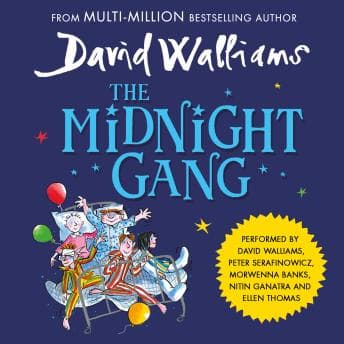

What is it about children's hospitals that makes for such psychologically rich storytelling?
I was chopping onions for a dal that I'd inevitably eat alone over three days when this question hit me. I'd been listening to The Midnight Gang while cooking – partly because my therapist says I need to stop treating meal prep as a chore and start treating it as self-care, partly because I was curious whether David Walliams could pull off something more emotionally sophisticated than his usual gross-out humor.
He did. And I wasn't prepared.
The Psychology of Powerless Children Finding Agency
Here's what makes this story work as a case study in child psychology: these kids are sick. Really sick. They're in a hospital ward, stripped of autonomy, poked and prodded, separated from their families. The protagonist exhibits classic response patterns to trauma – Tom arrives after a cricket ball to the head, disoriented and scared, only to encounter a terrifying porter and a genuinely wicked matron who seems designed to maximize children's suffering.
But then – the Midnight Gang.
What Walliams understands (and I suspect he understands it intuitively rather than academically) is that children don't process powerlessness the way adults do. They don't rationalize or accept. They create. The midnight adventures aren't just escapism – they're the children reclaiming control over their own narratives. Trash does something remarkably similar – three kids with nothing but circumstance stacked against them, and they respond not with despair but with this fierce, inventive agency that I kept wanting to diagram on a whiteboard. Each dream they help fulfill for a fellow gang member is an act of psychological resistance.
The research actually shows that imaginative play serves exactly this function for hospitalized children. Walliams may write fart jokes, but he's accidentally stumbled into legitimate therapeutic territory here.
Five Narrators, One Surprisingly Cohesive Voice
I'll be honest – when I saw five narrators listed, I braced myself for chaos. Multi-narrator productions can go very wrong. But Peter Serafinowicz, Morwenna Banks, Nitin Ganatra, Ellen Thomas, and David Walliams himself manage something impressive: they feel like an ensemble rather than a relay race.
The comedic timing is sharp – particularly in scenes with the matron, who's performed with such delicious villainy that I found myself pausing my dal to just... listen. There's a specific quality to how the children's voices are rendered that avoids the trap of making them sound cutesy or patronizing. These are kids dealing with real fear, real illness, and the narration respects that.
The voice work leans more on tonal shifts and emotional register than heavy accent differentiation – which works for this story. You're never confused about who's speaking, but the distinctions are subtle rather than theatrical. The emotional delivery during the dream-fulfillment scenes genuinely moved me. And I'm a woman who analyzes fictional characters for a living. I'm not easily moved.
The Slow Burn Problem (And Why It Might Not Matter)
Some listeners found the first hour or so a slow burn. I get it. The setup takes its time – establishing the hospital, introducing the cast, building the sense of dread around the matron. If you're listening with impatient kids in the car, this could be challenging.
But psychologically, this pacing makes sense. You need to feel the weight of the children's circumstances before the midnight adventures feel earned. The comeuppance of the matron (which I won't spoil, but – satisfying) wouldn't land without that buildup.
My advice? Commit to the first hour. The payoff is worth it.
Who Should Queue This Up (And Who Should Skip)
This is marketed as kids and family, and yes, it works beautifully for that. But I found myself asking: why does this hit adults too?
Because we all remember what it felt like to be small and scared and at the mercy of institutions that didn't care about our dreams. The Midnight Gang is wish fulfillment in the best sense – not escapist fantasy, but the fantasy that kindness and imagination can triumph over cruelty.
Skip this if: you need action from minute one, or if hospital settings trigger difficult memories (the themes of childhood illness are handled gently but they're present).
Listen if: you want something genuinely heartwarming that doesn't feel manipulative, or you're looking for a family listen that won't make you want to claw your ears off after the third repeat.
My Therapist Would Approve
I finished the last hour while eating my dal, alone at my kitchen table, and I'll admit – I teared up. Not because the ending is sad (it isn't), but because Walliams captures something true about childhood resilience. These kids, facing the scariest thing imaginable, choose to make magic for each other.
That's not saccharine. That's psychologically accurate.
One of Walliams' simpler stories, but also one of his most effective. Sometimes less is more – fewer gross-out gags, more heart. This is that book.
Now if you'll excuse me, I have leftover dal and approximately zero intention of sharing it with anyone.