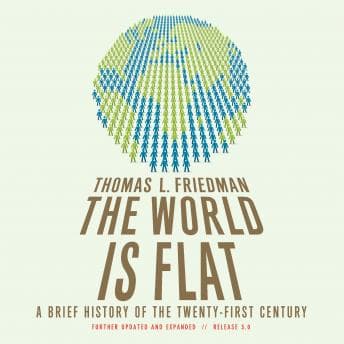
Is globalization still relevant when we're watching supply chains crumble and countries retreating behind trade barriers?
That question kept circling my mind during a long drive to Houston for a client meeting last week. Twenty-seven hours is a serious commitment—longer than most deployments I've briefed for—and I'll be honest, I wasn't sure Friedman's 2007 analysis would hold up in 2024. But here's the thing: understanding how we got here matters if you want to understand where we're going. And Friedman, for all his critics, did see the battlefield before most of us knew there was a war.
The Intel Brief That Aged Like Fine Wine (Mostly)
Let me cut to the chase. Friedman's central thesis—that technology flattened competitive advantages between nations—isn't exactly breaking news anymore. We've all seen it play out. But what struck me, listening with nearly two decades of hindsight, is how many of his predictions landed. The rise of India's tech sector, China's manufacturing dominance, the gig economy, remote work becoming normalized—he called it. Not perfectly, but better than most of the "experts" I was briefing with back in '05.
The book operates like a strategic assessment. Friedman identifies ten "flatteners"—from the fall of the Berlin Wall to workflow software to offshoring—and then shows how they converged to reshape global economics. It's methodical. Sometimes too methodical. (Ranger fell asleep twice during the supply chain sections, and he's usually a good sport.)
Where Friedman earns his keep is in the stories. He's got a journalist's eye for the telling detail—the call center worker in Bangalore adopting an American accent, the Chinese factory owner explaining just-in-time manufacturing. These vignettes stick with you longer than the theory.
Oliver Wyman Earns His Combat Pay
Wyman's got a tough job here—this isn't a thriller, it's essentially a 27-hour TED talk with occasional character appearances. And he handles it well. His American voice is irrepressible and energetic (maybe too energetic for some of the drier passages), but when he shifts to an Indian gentleman or a Chinese businessman with formal but slightly broken English, you actually hear the global economy Friedman's describing.
Is it perfect? No. Some of the accents walk a fine line, and I could see listeners getting uncomfortable with the stereotyping. But Wyman's not mocking—he's differentiating, and in a book with this many international voices, that matters. The man's won five Audies for a reason.
My bigger issue is length. This book could've been a tight 15 hours and hit harder. Friedman repeats himself. A lot. By the third time he explained the Dell supply chain example, I was checking my mirrors more than listening. At 1.25x speed (my standard), it's manageable. At 1x? You'd better really love globalization theory.
Where the Mission Gets Complicated
Here's where I have to be honest about what this book doesn't do: it doesn't predict the backlash. Friedman's optimism about globalization—the idea that economic interdependence would prevent conflict and lift all boats—looks naive after Trump, Brexit, and the current reshoring movement. He briefly touches on the "too flat, too fast" problem, but he underestimates how many people would get left behind and how angry they'd get about it. That same pattern of overlooked consequences shows up in Radium Girls, where industrial progress left workers poisoned while executives counted profits.
This isn't a fatal flaw. The book is history now, not prophecy. But if you're looking for solutions to our current mess, you won't find them here. What you'll find is the clearest explanation I've encountered of how the world changed between 1989 and 2007. That's still valuable intel.
Compared to Friedman's other work—"The Lexus and the Olive Tree" or his later climate stuff—this one's his most comprehensive. It's also his most repetitive. Three Pulitzer Prizes don't make you immune to needing an editor.
Who Should Gear Up (And Who Should Stand Down)
Worth your time if: You want to understand the economic forces that shaped the last two decades. You're a policy wonk, business strategist, or just someone who likes knowing how the world actually works. The audiobook format works well for multitasking—I got through most of it on highways and in parking lots.
Skip it if: You want current solutions, not historical analysis. You're already well-versed in globalization theory. Or if you have limited patience for repetition—there's a reason some listeners wanted this condensed.
Cooper Out
Thomas Friedman wrote a book that explained the world to millions of people who didn't understand why their jobs were moving overseas or why suddenly everyone needed to learn Mandarin. That book is now a historical document—valuable for understanding how we got here, less useful for figuring out what comes next.
Oliver Wyman delivers it with professionalism and energy. The length is a slog, but at increased speed, it's manageable. I don't regret the 27 hours. But I'm also not sure I needed all of them.
Ranger approved this one—eventually. Though he did give me a look around hour 20 that suggested we should've picked something with more explosions.