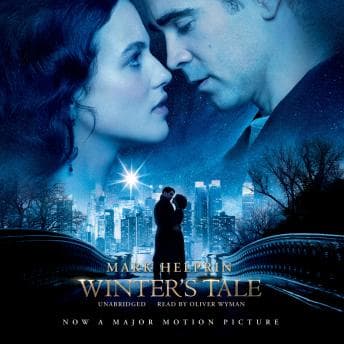

People told me Winter's Tale was unfilmable, and then Hollywood proved them right in 2014. But here's the thing nobody warns you about: this book is also nearly unlistenable. Not because it's bad—God, no—but because at nearly twenty-eight hours, Mark Helprin wrote something so dense and sprawling and drunk on its own language that your brain needs recovery time between sessions. I started this on a Saturday morning walk along the lakefront with Denise. By the time I finished, three weeks later, the season had actually changed. Which felt appropriate.
Some listeners find Oliver Wyman irritating here. I've seen the complaints. And I get it—I do. But I think they're wrong, or at least wrong for the wrong reasons.
The City as a Character Wyman Has to Voice
Let's talk about what Helprin is really doing in this book. Winter's Tale isn't really a novel in the way most people understand novels. It's a prose poem about New York City stretched across multiple timelines, stuffed with characters who appear and vanish like figures in a snowstorm, built around the idea that a city can achieve something like grace. Peter Lake—Irish burglar, orphan, mechanical genius—falls in love with Beverly Penn, a dying girl in a mansion he's trying to rob. That's the hook. But Helprin treats that story the way Melville treated whaling: as a launching pad for everything else he wants to say about light, justice, mortality, and the architecture of clouds.
The prose is the point. Helprin will spend four pages describing the way winter light hits the Hudson River, and those four pages will be more alive than entire chapters of most novels. My students would hate this. I love it. The narrator understands that pause is punctuation, and Wyman—to his credit—doesn't rush through those passages. He lets them breathe. He trusts the language enough to slow down when Helprin goes into one of his extended meditations on the physics of beauty.
But here's where the polarization makes sense. If you're listening to this expecting plot momentum, expecting dialogue-driven scenes that clip along, you're going to suffer. Helprin writes long stretches where nothing happens except description—gorgeous, lavish, sometimes excessive description. And Wyman narrates all of it with this earnest, almost reverent tone that some people hear as awe and others hear as monotony. I landed on awe, mostly. But I won't pretend there weren't moments around hour sixteen where I was grading sophomore essays and Wyman was describing yet another snowfall and I thought: brother, I need you to pick up the pace.
Dozens of Voices for a City of Millions
Wyman's real achievement is the character work. We're talking dozens of distinct voices here—Peter Lake gets this rough, uneducated Irish warmth that sits perfectly against the Dickensian grandiosity of characters like Pearly Soames, who Wyman voices with a kind of theatrical menace that reminded me of a villain from a Victorian penny dreadful. The gentle souls—Beverly Penn, the various innocents Helprin scatters through the narrative—get softer, more intimate treatment. It's not subtle work, but it shouldn't be. This is a novel that operates at the register of myth. Wyman's vocal range matches its ambitions.
Where he occasionally falters is in the transitions. Helprin's prose shifts between intimate close-up and cosmic wide-angle sometimes within a single paragraph, and Wyman doesn't always navigate those gear changes smoothly. There are moments where the emotional pitch stays elevated when it should pull back, and the effect is a kind of flattening—everything important, nothing foregrounded. At twenty-eight hours, that's a real problem. You need contrast to sustain attention over that kind of duration.
This Is Not Background Listening. This Is a Commitment.
I want to be honest about something: this audiobook defeated me twice before I finished it. The first time I tried, years ago, I gave up around hour eight. The second time, I made it to fourteen. This time I committed—no speed adjustment, 1.0x, the full ride. The prose deserves to be savored, and rushing Helprin's sentences would be like fast-forwarding through a cathedral.
If you loved Dickens or García Márquez—the magical realism, the belief that a city contains multitudes of overlapping realities—this is their spiritual successor filtered through a distinctly American sensibility. It's the kind of book that makes you believe New York isn't just a place but an argument about what civilization could become. Tolkien was doing something in the same spiritual neighborhood with Silmarillion—building a world so complete and myth-saturated that the story almost becomes secondary to the act of creation itself.
But if you need tight plotting, if long descriptive passages make you restless, if twenty-eight hours of a single narrator without any production frills sounds like punishment—skip the audio. Read the physical book instead, where you can set your own pace and re-read those impossible sentences about light and winter.
Worth Pausing the Faculty Meeting For?
Absolutely. But clear your calendar. This isn't a commute listen or a background companion. This is a dedicated, focused, probably-need-a-notebook experience. Wyman gives you a performance worthy of the material about seventy-five percent of the time, and even in the stretches where his reverence tips toward monotony, the language itself carries you. I finished the last hour alone in my kitchen at midnight, dishes undone, and I just sat there for a while afterward, thinking about snow.