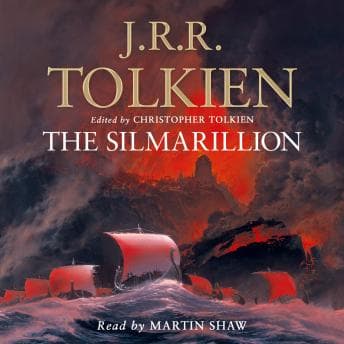

Look, I'm just gonna say it: The Silmarillion broke my brain in the best possible way. I've tried reading this thing three times over the years. Three times I've bounced off it somewhere around the Noldor leaving Valinor because I couldn't keep Fingolfin and Finarfin and Finwë straight in my head. But listening to Martin Shaw narrate it while I was supposedly debugging my procedural terrain generator? Something finally clicked.
This isn't a novel. Let's get that out of the way immediately. If you're expecting Frodo and Sam trudging through Mordor, you're going to be confused and probably a little annoyed. If you want that kind of journey, Return of the King delivers it perfectly—but that's not what we're doing here. The Silmarillion is mythology. It's the Bible of Middle-earth, complete with a creation myth, genealogies that would make the Book of Chronicles jealous, and enough tragedy to fuel a thousand Greek plays. Tolkien wasn't writing a story here - he was building a religion.
The Voice That Makes It Work
Martin Shaw's narration is... okay, I need to find the right word here. Reverent? That sounds pretentious, but it's accurate. He reads this like he genuinely believes he's recounting sacred history, and somehow that works. His pronunciation of the Elvish names is chef's kiss - and trust me, that matters when you're dealing with characters named Maedhros and Maeglin and Maglor and you need to actually tell them apart.
The pacing is deliberate. Some people call it slow. I'd call it measured. Shaw gives you time to actually process what's happening, which you desperately need because Tolkien will casually drop a paragraph that covers three hundred years of history and then move on like nothing happened. There's this moment during the Nirnaeth Arnoediad - the Battle of Unnumbered Tears - where Shaw's delivery just... shifts. Gets heavier. You feel the weight of what's being lost even though Tolkien is describing it from this distant, historical remove.
His character voices are subtle but effective. He's not doing full-on Steven Pacey-level character acting (nobody is, let's be real), but when Morgoth speaks versus when Manwë speaks, you know the difference. That matters in a book where half the characters are literally gods.
Where the Mythic Hits Different
Here's the thing my D&D group doesn't understand when I try to explain why The Silmarillion matters: this is the source code. Every fantasy world-building trope you've ever encountered? Tolkien either invented it or perfected it here. The tragic oath that dooms an entire bloodline? That's the Sons of Fëanor. The hidden kingdom that falls through betrayal? That's Gondolin. The mortal man who falls in love with an immortal being and must choose between worlds? Beren and Lúthien, baby. (Side note: their story absolutely wrecked me. Like, I had to pause my code review because I was having feelings in my cubicle.)
The magic system isn't a system at all - it's more like... cosmic music? The world is literally sung into existence in the Ainulindalë, and that musical metaphor runs through everything. Morgoth's evil is described as discord. It's Sanderson-level thematic consistency, except Tolkien did it first and he wasn't even trying to be clever about it.
But I'll be honest: there are sections that drag. The chapter on the Maiar felt like reading a D&D monster manual entry. Some of the genealogies made my eyes glaze over even in audio form. And the Akallabêth, while important for understanding Númenor, feels like an appendix that got promoted above its station.
Would I Listen Again?
Already started my second listen. (Don't tell Dr. Patel.)
This audiobook is 15 hours of dense, archaic, sometimes bewildering mythology - and I mean that as a compliment. It's not for everyone. If you need action beats every chapter, skip it. If complex family trees make you want to throw your phone, definitely skip it. But if you've ever wondered why Galadriel seems so sad, or what Elrond actually lived through, or why Sauron is considered a lesser evil compared to what came before?
This is the answer. Martin Shaw delivers it with exactly the gravitas it deserves.
My only real complaint is that I couldn't find much about Shaw's other work online, which is a shame because I'd listen to him read a phone book at this point. The production is clean, the audio quality is solid, and the whole thing feels like it was made by people who actually care about Tolkien's legacy.
Yes, it's 15 hours. Yes, you'll probably need to listen twice. Yes, it's worth it. My D&D group is getting a Silmarillion-inspired campaign whether they like it or not.