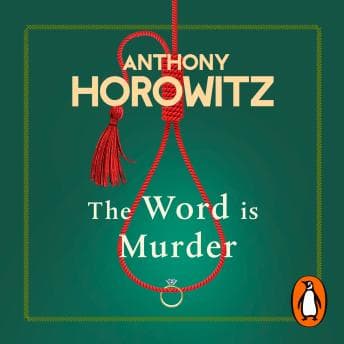

"She planned her own funeral. But did she arrange her own murder?"
I was chopping onions for a biryani that would take three hours and feed one person when that opening hook landed. Diana Cowper walks into a funeral home, meticulously arranges every detail of her own send-off, and six hours later she's strangled in her own home. The research actually shows that people who plan their deaths rarely do so without reason—but the psychology here? This is a fascinating case study in misdirection, both the victim's and the author's.
The Author as Guinea Pig
Here's where Horowitz does something genuinely clever. He inserts himself—not a fictionalized version, but *Anthony Horowitz*, bestselling author, creator of Alex Rider, writer for Midsomer Murders—as the reluctant Watson to detective Daniel Hawthorne's insufferable Holmes. The protagonist exhibits classic avoidant attachment patterns with a side of professional narcissism, constantly reminding us of his TV credits while being dragged through crime scenes by a man who treats him like an inconvenient notebook.
What makes this character compelling is that Horowitz-as-character is genuinely annoyed. Hawthorne is gruff, pushy, secretive about his past, and treats the famous author like an intern. Rory Kinnear's narration captures this dynamic perfectly—his Hawthorne has this working-class directness that grates against the more refined, slightly indignant Horowitz. The comedic timing in their exchanges had me laughing over my simmering pot.
My therapist would have thoughts about this character—both of them, actually. Hawthorne's deliberate withholding of information reads as classic control behavior, while Horowitz's compulsion to stay despite constant humiliation suggests something worth examining.
Metafiction That Actually Works
I've read too many "author inserts himself into story" experiments that collapse under their own cleverness. This one doesn't. Partly because Horowitz commits to the bit—real locations, real career details, real-seeming frustrations about the publishing industry. The line between fact and fiction blurs in a way that keeps you slightly off-balance, which is exactly where a mystery reader should be.
But here's the thing. Some listeners found the POV shifts jarring—the narrative occasionally pulls back from first person in ways that feel like the author got trapped by his own device. The final chapter, in particular, has this tonal mismatch that a few reviewers noted. I found myself asking: why does Horowitz really need to break the fourth wall quite so often? It's a high-wire act, and while he mostly sticks the landing, there are wobbles.
Kinnear handles the metafictional complexity beautifully. His Horowitz sounds appropriately exasperated, his Cowper (in flashbacks) has this prim quality that makes her murder feel like the universe punishing propriety, and Hawthorne... Hawthorne sounds like a man who knows exactly how annoying he is and doesn't care. The narration is so good you forget it's there—it becomes the movie playing in your head.
The Mystery Itself
Psychologically, this tracks. The clues are fair, the solution is satisfying, and there are enough red herrings to keep even obsessive puzzle-solvers guessing. Night Prey plays similar games with misdirection, though the stakes feel more visceral there. Horowitz understands human nature—particularly the ways grief, guilt, and old secrets curdle into violence. The victim's funeral planning isn't just a hook; it's a window into a woman who knew something was coming, even if she couldn't name it.
The pacing does drag slightly in the early chapters before Hawthorne and Horowitz's partnership solidifies. Some listeners wanted the collaboration to start faster, and I get that. But once it clicks, it *clicks*. Nine hours felt like four.
Who This Is (and Isn't) For
If you loved BBC's Sherlock—the deduction porn, the difficult genius, the long-suffering companion—this is your audiobook. Open Season scratches a different itch, less cerebral, more visceral, but the investigative rhythm is similarly addictive. Golden age mystery fans who want something modern but respectful of the form will find a lot to love. Skip it if metafiction makes you itch, or if you need your detective to be likeable. Hawthorne is not likeable. He's compelling, which is different.
Case Closed, Notes Filed
This is the rare mystery that rewards both the puzzle-solver and the character-study reader. Horowitz has created something genuinely new by making himself the experiment—and Kinnear's narration elevates the whole enterprise from clever gimmick to immersive experience. The biryani was excellent, by the way. But I barely tasted it. I was too busy trying to figure out who the hell Daniel Hawthorne really is.
I still don't know. Which means I'll be back for book two.