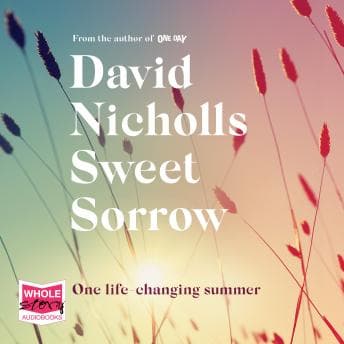

David Nicholls wrote a book about a teenage boy doing Shakespeare over one summer in 1997 and somehow made me feel every single feeling I've ever had about being young and dumb and terrified of the future.
I wasn't expecting that.
The Summer I Didn't Know I Was Grieving
I started Sweet Sorrow during Sophie's nap on a Tuesday, and by Thursday I was sitting in the car in my garage for an hour and fifteen minutes instead of my usual forty-five, texting my husband "Sophie still napping" (she was not still napping, Lucas was feeding her goldfish crackers and watching Bluey, don't @ me). This book got under my skin in a way I didn't see coming.
Charlie Lewis is sixteen, his parents' marriage has just detonated, his dad is on the couch mixing beer with antidepressants, and Charlie's supposed to be the kid in this scenario but he's basically running the household. There's a scene where he sprints home because he's suddenly terrified about what his dad might have done with those pills and that beer, and Rory Kinnear reads it with this quiet, controlled panic that - look, I had to pull over. I was on my way to pick up Emma from gymnastics and I literally pulled into a Walgreens parking lot because I couldn't see the road.
Made me cry at school pickup. Worth it though.
But here's the thing Nicholls does so well: he balances the heavy stuff with genuinely funny material. Charlie gets roped into performing Romeo and Juliet with a ragtag theater company ("the Company," and yes it does sound like a cult), and the backstage chaos scenes are so perfectly awkward. Teenagers forgetting lines, bumping into set pieces, the specific horror of being a sixteen-year-old boy who has to say Shakespeare's words out loud in front of people. I was laughing during drop-off, which is better than my usual dead-eyed stare at the carpool line.
Rory Kinnear Understands Teenage Boys Better Than Teenage Boys Do
Okay, so the narration. Rory Kinnear. I need to talk about Rory Kinnear.
He does this thing with Charlie's voice where there's a layer of bravado over absolute terror, and you can hear both simultaneously. When Charlie's around his mates, Kinnear gives him this slightly louder, slightly too-casual tone - the "I'm fine, everything's fine" energy that anyone who's ever been sixteen recognizes instantly. But in scenes with Fran, the girl who basically detonates Charlie's carefully constructed wall of not-caring, his voice gets softer and a little faster, like Charlie's brain is running ahead of his mouth. Which - yes. That's exactly what first love sounds like.
The scene in the broom closet where Charlie's mum tries to talk to him about the divorce is devastating. Kinnear strips everything back, keeps Charlie's responses monosyllabic but loaded with so much unsaid stuff that I could feel the weight of it. He differentiates every character clearly too - Charlie's dad has this slightly slurred, exhausted quality, Fran is bright and quick, Charlie's friends each have their own register. In scenes with five or six people, I never lost track of who was talking. Which matters when you're listening at 1.25x while also preventing a toddler from eating sidewalk chalk.
Survived toddler snack negotiations and a mid-chapter sprint to gymnastics pickup - and the story still held together perfectly.
First Love as a Temporary Superpower
What got me most about this book - and maybe this is the former marketing manager in me, always looking for the core insight - is that it's not really a love story. I mean it IS, Fran and Charlie are wonderful together, but it's more about how falling in love for the first time makes you brave enough to become someone new. Charlie joins the theater company for Fran, but Shakespeare gives him something separate from her. A vocabulary for all the enormous feelings he's been stuffing down about his dad, his family, his own future.
It's set in 1997 and Nicholls nails that era without making it a nostalgia parade. No cell phones. Mix tapes. The specific boredom of a British summer when you're sixteen and have nowhere to be and no money to get there. At 13 hours it's longer than my usual picks, but I genuinely didn't notice. Finished it in about six days, which for me is basically a speed record.
The ending isn't a neat bow. It's bittersweet in a way that feels earned - sweet sorrow, get it - and I sat with it for a while after. Not ugly-crying, but that tight-chest feeling of remembering who you were at sixteen and being simultaneously grateful and sad that you can't go back.
Who Needs This in Their Ears
If you loved One Day, you'll love this, but honestly it stands completely on its own. Perfect for anyone who remembers being young and afraid and doing something brave anyway. Not ideal for background listening - Kinnear's performance deserves your actual attention. But it made the school run feel shorter and nap hour genuinely quieter, and if you're a parent watching your own kids stumble toward growing up, keep tissues handy.
This is the pick I'd fight for at book club (if I ever have time for book club again). Though honestly, given how neither Friend of the Family nor anything else on my list lately has wrecked me quite this thoroughly, Sweet Sorrow is the one I'd actually show up for.