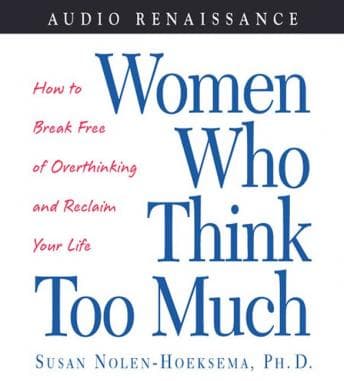

What happens when a psychologist who's spent her career studying rumination writes a book about it — and you listen to it while doing the exact thing she's telling you not to do?
I was chopping onions for chana masala at 9 PM on a Tuesday, replaying a conversation with my department chair about funding for the third time that evening, when Sheryl Bernstein's steady voice cut through my spiral: overthinking isn't problem-solving. It's the illusion of problem-solving. And I literally stopped mid-chop because — yeah. That landed.
The Researcher Who Practiced What She Studied
Susan Nolen-Hoeksema wasn't just another pop-psychology voice telling women to "stop worrying and be happy." She was a Yale professor whose actual research — longitudinal studies, not anecdotal fluff — showed that women are significantly more likely than men to engage in what she calls "overthinking": repetitive, passive dwelling on distress rather than active coping. The distinction matters. She's not pathologizing worry. She's identifying a specific cognitive pattern where you replay negative feelings without ever moving toward resolution. The gap between clinical precision and lived experience is something Sarah Smarsh navigates from a completely different angle in Heartland — where structural forces shape inner lives just as powerfully as any cognitive pattern Nolen-Hoeksema charts.
The book draws heavily from her community study of over 1,300 people, and I found myself asking: why does this research feel both validating and slightly dated? Published in 2003, some of the cultural references and case studies feel like they're from a different era. But the core psychology? The research actually shows that the rumination patterns she identified have only intensified with social media and constant connectivity. Her framework — that overthinking leads to depression leads to more overthinking in a vicious feedback loop — still holds up remarkably well. I've cited similar cyclical models in my own papers on narrative identity and self-concept.
What makes this book compelling is that Nolen-Hoeksema doesn't just diagnose. She breaks her intervention into three stages: breaking free from overthinking in the moment, moving to "higher ground" through reframing and action, and avoiding future traps. The strategies aren't revolutionary — distraction, scheduled worry time, behavioral activation — but they're grounded in actual data rather than inspirational Instagram wisdom. My therapist would approve.
Where the Framework Gets Thin
Here's where the psychology nerd in me gets restless. At three hours, this is a quick listen, and it shows. Nolen-Hoeksema identifies three types of overthinkers — rant-and-ravers, those who stew over life's big questions, and post-event processors — but the distinctions feel undercooked. She gives case studies for each, and some of them are genuinely useful illustrations of how rumination hijacks different personalities. But others read more like composites than real people. Psychologically, a few of these character sketches don't track — they're too neat, too cleanly resolved by applying Step 2 or Step 3.
And the gendered framing. Look, she's right that women are socialized differently around emotional expression, and her research backs up the gender gap in rumination rates. But the book sometimes slips from "women are disproportionately affected" to "this is a women's problem," which — no. The cognitive mechanisms she describes are universal. The social pressures are gendered. That's a different claim, and conflating them weakens the argument.
The section on how our culture encourages overthinking through the "let's talk about your feelings" therapeutic ethos of the late '90s and early 2000s is actually fascinating — a genuine challenge to the assumption that processing emotions endlessly is always healthy. She argues that certain types of emotional processing actually deepen distress rather than relieving it. This is a fascinating case study in how pop psychology can distort clinical findings. I wish she'd spent more time here and less on the self-help prescriptions.
Bernstein Behind the Mic
Sheryl Bernstein's narration is... functional. Steady pacing, clear diction, professional delivery. She reads the case studies and the research summaries with the same even tone, which works for the academic sections but flattens the emotional moments. When Nolen-Hoeksema describes a woman lying awake at 3 AM catastrophizing about her marriage, Bernstein delivers it like she's reading a conference abstract. Not bad. Just not particularly alive. For a three-hour listen, it's fine — you're here for the content, not the performance.
Who Gets the Most Out of This
If you're someone who's read seventeen self-help books about anxiety and found them all vaguely patronizing, this one might surprise you. Nolen-Hoeksema writes like a researcher first and a self-help author second, which means less cheerleading and more "here's what the data says." If you want warm encouragement and personal transformation stories, look elsewhere.
Skip it if you're already familiar with cognitive behavioral approaches to rumination — you won't find much new here. And if the gendered framing will irritate you (it irritated me, and I study gender and narrative for a living), be warned.
But if you've never had someone explain why your brain does that thing at 2 AM — the loop, the replay, the endless why-did-I-say-that — with actual science behind it? Three hours well spent.
My Prescription
This is solid, research-backed psychology wrapped in a self-help package that's showing its age around the edges but still fundamentally sound. I listened while cooking and then again on my morning jog the next day, which either means it's good or means I was overthinking about overthinking. Probably both. Nolen-Hoeksema passed away in 2013, and it's a genuine loss to the field — she understood human nature in ways that were rigorous without being cold. Not a perfect book. But a useful one, and in self-help, useful beats perfect every time.