
What happens when a city decides it can believe in Edison's lightbulb and talking to the dead at the same time?
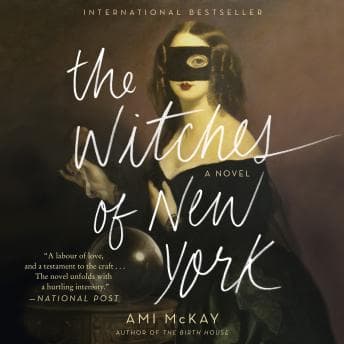
That's the question humming underneath Ami McKay's Witches of New York, and it's a better question than you might expect from a novel with "witches" in the title. I started this one during a Sunday morning lakefront walk with Denise - she was ahead of me, power-walking like she does when she's annoyed about something - and by the time I caught up to her near Montrose Harbor, I was so deep into 1880s Manhattan that I nearly walked into a cyclist. She was annoyed about something else after that.
The Classroom I Wish I Could Build
Here's what McKay does that I genuinely admire: she builds a version of Gilded Age New York where women's power - intellectual, spiritual, entrepreneurial - exists in the cracks between what men will allow. Adelaide Thom and Eleanor St. Clair run their teashop, Tea and Sympathy, as a kind of underground salon where women come for "tea" the way my students come to my office hours for "help with their essay" when really they just need someone to listen. The shop is a front, a sanctuary, and a business all at once, and McKay never simplifies that tension.
Then there's Beatrice Dunn, seventeen and fresh from the country, answering a classified ad that might as well read "come discover you're extraordinary and also in danger." I teach seventeen-year-olds. I know exactly what that combination of fierce capability and terrifying naivety looks like. McKay gets it right - Beatrice isn't a chosen-one cliché so much as a young woman whose gifts make her visible in a world where visibility gets women burned. Figuratively. And sometimes not so figuratively.
This reminds me of what Hemingway said about writing - that the dignity of movement of an iceberg is due to only one-eighth being above water. McKay's research into the period sits mostly below the surface, but you feel the weight of it. The spiritualist movement, the Bowery, the specific brand of American hucksterism that could sell you a séance and a patent medicine on the same afternoon - it's all there without becoming a Wikipedia article in novel form.
Where the Ghosts Get Lost in Translation
Now. The séance scenes. I have to be honest about this. There are moments where spirits communicate by spelling out words letter by letter, and in audio format, this is - I'll say it - genuinely hard to follow. Your brain wants to assemble the letters into words, but Julia Whelan is reading them aloud one at a time, and you're doing mental Scrabble while trying to track the emotional stakes of the scene. It's not Whelan's fault. It's a fundamental problem with translating a visual device into audio. I rewound twice during one séance and still wasn't sure I caught everything. If you're listening while grading papers at 11 PM (not that I would ever do such a thing), you will miss things.
The pacing is the other thing. At fourteen-plus hours, this is a commitment, and McKay's narrative wanders the way a good conversation wanders - sometimes into fascinating side streets, sometimes into alleys where you wonder how you got there. The plot isn't the engine here. Atmosphere is. If you need plot momentum the way my students need their phones, this will test you. But the prose deserves to be savored, and McKay is doing something patient and deliberate with her three women's stories that doesn't lend itself to breathless pacing.
My students would hate this. I love it.
Julia Whelan Knows What a Pause Is Worth
The narrator understands that pause is punctuation. Whelan's performance is controlled and atmospheric - she doesn't do big vocal gymnastics between characters, but the shifts are consistent enough that you always know who's speaking. Her reading carries this ominous undercurrent that suits the material perfectly, like she knows something bad is coming even when the scene is just two women selling chamomile. Her voice does something particular with Adelaide's weariness versus Beatrice's earnestness - it's subtle, a slight tightening, a different breath - and it works.
Whelan has won Audies for a reason, and this is a performance that rewards listening at 1.0x. (Yes, I'm that person. The author chose those words and Whelan chose those pauses.)
Who Gets an A and Who Should Drop the Course
If you loved The Essex Serpent or Sarah Perry's brand of historical fiction where ideas matter as much as plot, this is its spiritual successor. I found that same slow-burn immersion in Book of Two Ways, which also puts a woman at the center of a world that keeps asking her to choose between what she knows and what she feels. If you're drawn to women's stories set against the machinery of a world that wasn't built for them - and you have the patience for a slow burn - this is worth your time. If you need a tight thriller structure or you're planning to listen while running errands, you'll lose the thread. This one demands focus. Worth pausing the faculty meeting for, but maybe not the best companion for folding laundry.
The Annotation in the Margin
McKay wrote a novel about women who make space for themselves in a world that keeps trying to close around them, and she set it in a historical moment where science and superstition shook hands at the door. It's imperfect - the plot could use more backbone, and those séance scenes genuinely suffer in audio - but the world is rich, the women are real, and Whelan's narration holds the whole thing together with quiet authority. I finished it on a Tuesday night, papers still ungraded beside me, and sat with it for a while before starting anything else. That's not nothing.