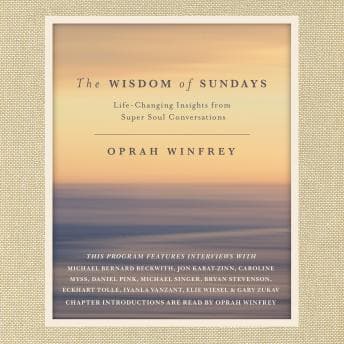

"The wound is where the light enters." Rumi said that, and Oprah quotes it somewhere in the first hour of this audiobook. I was on my morning jog through Cambridge when it hit me—not the quote itself, which I'd heard a hundred times, but the way the conversation around it unfolded. This is essentially a psychology lecture series disguised as spiritual content, and honestly? I'm here for it.
Look, I approached this with my researcher brain fully activated. Super Soul Sunday always struck me as pop spirituality, the kind of thing my mother would forward me clips of with heart emojis. But here's the thing—when you strip away the production and just listen to these conversations, there's genuine psychological insight buried in the spiritual language. Eckhart Tolle talking about ego? That's attachment theory and self-concept research repackaged. Michael Singer on letting go? Classic cognitive defusion from ACT therapy. The frameworks differ, but the underlying mechanisms of human behavior are the same.
The Psychology Underneath the Spirituality
What makes this collection fascinating—and I mean this as a case study, not just entertainment—is watching how different thought leaders approach the same fundamental question: why do humans suffer, and what do we do about it?
Bryan Stevenson's segment hit me hardest. His work on criminal justice and mercy isn't abstract philosophy; it's applied psychology of forgiveness and moral development. When he talks about proximity to suffering as a path to understanding, he's describing what we'd call perspective-taking and empathy cultivation in the research literature.
Caroline Myss brings the mystical language, which—okay, I'll be honest—made me roll my eyes initially. But underneath her talk of "sacred contracts," she's essentially describing narrative identity theory. The stories we tell ourselves about who we're supposed to be. My dissertation touched on exactly this. Mindbody Prescription explores similar territory—how the stories we tell about our pain shape the pain itself. We construct meaning through narrative, and when those narratives break down, we experience crisis. She's not wrong. She's just using different vocabulary.
Jon Kabat-Zinn's segment was the most directly psychological, obviously. Mindfulness-based stress reduction has decades of empirical support now. Hearing him in conversation rather than lecture mode added something. The research actually shows that conversational learning activates different neural pathways than didactic instruction. (Yes, I'm being that person. My students would recognize this tangent.)
Where Oprah Gets in Her Own Way
Here's my honest critique, and I say this with genuine respect for what she's built: Oprah interrupts. A lot. There are moments where a guest is building toward something—you can hear the thought forming—and she jumps in with her own experience or an "aha" moment. As someone who studies how stories shape identity, I found myself wanting to yell "let them finish!" into my earbuds.
The editing doesn't help. These are clearly excerpts from longer televised conversations, and the cuts sometimes feel abrupt. One moment you're deep in a discussion about consciousness with Michael Singer, the next you're jarred into a new topic. The volume inconsistencies between Oprah's chapter introductions and the interviews themselves are noticeable too—I kept adjusting my phone while trying not to trip over uneven sidewalks.
And look, without the visual component of the original show, some conversations lose something. Body language and facial expressions carry so much psychological information. Elie Wiesel's segment, in particular—I found myself wishing I could see his face. The weight of his words deserves that context.
Who'll Get Something From This (And Who Won't)
The protagonist of this audiobook—and yes, I'm treating Oprah as a character here, don't judge me—exhibits classic patterns of someone who's done genuine internal work and wants to share the map. Her personal essays introducing each chapter are the most intimate parts. She's not performing wisdom; she's processing it. There's a vulnerability there that the interview format sometimes obscures.
Psychologically, this works best for listeners already on some kind of growth trajectory who want companionship, not instruction. It's not a how-to. It's more like... eavesdropping on therapy sessions with really insightful therapists. (My therapist would have thoughts about me framing it that way, but she'd also probably agree.)
If you're uncomfortable with spiritual language, you'll struggle. Gary Zukav talks about the soul in ways that would make my empirically-minded colleagues squirm. But I kept translating in my head—"soul" as "authentic self," "spiritual journey" as "identity development"—and it tracked. The underlying psychological truths are solid, even when the packaging is woo-woo. Skip this if you need empirical citations with your insight, or if Oprah's interview style grates on you. But if you can translate spiritual vocabulary into psychological concepts? There's real substance here.
At just under five hours, it's digestible. I finished it over four morning runs, which felt right. This isn't meant to be consumed in one sitting. It's meant to be absorbed in pieces, the way you'd take a vitamin. Not exciting, but it does something.
My Clinical Assessment
Would I assign this to my psychology students? No. Would I recommend it to my mother? Already did. Would I listen again? Probably not cover to cover, but I bookmarked the Stevenson and Singer segments. Some conversations are worth revisiting when you need a reminder that human beings are capable of growth. The research supports that, too.