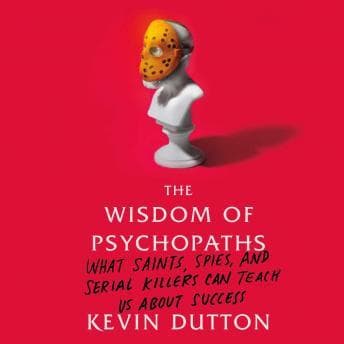

Everyone and their LinkedIn hustle-bro has been recommending this book for like a decade now. "Oh you HAVE to read Wisdom of Psychopaths, it'll change how you think about leadership." So I went in expecting another pop-psych airport book that could've been a blog post. And honestly? It's better than that. But also... not by as much as the hype suggests.
Your Favorite Surgeon Might Score Higher Than Bundy
Kevin Dutton's core thesis is basically a spectrum argument - psychopathy isn't binary, it's a dial, and certain professions (surgeons, CEOs, lawyers, special forces operators) actively select for traits that sit on that dial. Fearlessness, emotional detachment, laser focus under pressure, charm. The comparison between a neurosurgeon who can calmly slice into brain tissue while cracking jokes and a serial killer who can calmly do... other things... is genuinely unsettling in a way that stuck with me for days.
The strongest parts are when Dutton goes gonzo journalist. He actually visits Broadmoor - a high-security psychiatric hospital in the UK - and talks to patients who are, by any clinical measure, dangerous psychopaths. And these conversations are fascinating. One patient casually explains manipulation tactics with the same energy as a senior engineer explaining system architecture. Dutton also undergoes transcranial magnetic stimulation himself to temporarily dampen his emotional responses, essentially getting a brief window into psychopathic cognition. That section alone is worth the listen - he describes the world becoming sharper, more geometric, stripped of emotional noise. As someone who's been on-call at 3AM staring at dashboards trying to suppress panic, I found that weirdly relatable.
The science mostly holds up, though it's pop-science level. Dutton is an Oxford research psychologist, not a TED-talk-industrial-complex guy, and you can tell he actually knows the literature. He references real studies, real brain imaging data. But he also cherry-picks pretty aggressively. The "functional psychopath" framework is interesting but he never really grapples with the counterargument: maybe those successful surgeons and CEOs aren't psychopaths at all, maybe they just share a few surface traits. The conflation bothered me more as the book went on.
This Is Basically Freakonomics But For Your Dark Side
If you liked Freakonomics or Thinking, Fast and Slow - that genre of "here's a counterintuitive reframe on human behavior backed by studies" - this hits the same dopamine receptors. Dutton's writing style is punchy and anecdote-heavy, which translates well to audio. He's British, so there's a dry wit running through even the darker material that keeps it from feeling exploitative.
But here's my gripe: at 8 hours 21 minutes, it's about 2-3 hours too long. The middle section - where he's cataloging psychopathic traits and mapping them to professional success - gets repetitive. Confidence, check. Ruthlessness, check. Charm, check. I get it. By the fourth example of a CEO who "just doesn't feel fear the way you and I do," I was reaching for the speed dial. The same repetitive trait-cataloging problem dragged down Trident K9 Warriors for me too — there's only so many times you can read "and then the dog did something incredible under impossible pressure" before your eyes glaze over, even when the underlying material is genuinely fascinating. I bumped to 1.75x for most of chapters 5-7 and missed nothing.
Erik Bergmann narrates, and he's solid. Not Ray Porter (but who is), though he earned his AudioFile Earphones Award honestly. Clean delivery, good pacing, and he differentiates the quoted characters well - the Broadmoor patients get subtly different vocal textures than the researchers, which helps in a book with a LOT of quoted dialogue. No complaints, but also not a performance that elevates the material the way a great narrator can. He's the reliable Postgres of audiobook narrators: does the job, no drama, you trust it.
Who Gets the Most ROI Here
I was listening to this during a particularly brutal week of back-to-back incident reviews at work, and I'll admit - there's something darkly comforting about hearing that emotional detachment can be a feature not a bug. (Kevin, my boyfriend, overheard a chapter while I was making dinner and asked if I was "studying for a promotion or planning something worse." Fair question.)
Perfect for: commute, gym. Skip for: bedtime - the serial killer adjacent content will keep your brain spinning. Best suited for anyone in high-pressure roles who's curious about the psychology of performance under stress. If you manage people, there's genuinely useful stuff here about identifying and working with high-psychopathy-trait individuals.
But if you've already read Jon Ronson's The Psychopath Test, you're getting significant overlap with less humor. Ronson covers similar ground - Broadmoor visits, the psychopathy checklist, functional vs. criminal psychopaths - but with more self-deprecating wit and better narrative structure. Dutton brings more academic rigor, Ronson brings more heart. Your call.
The Commit Message
TL;DR: Worth your commute, but not a must-own. Solid pop-psychology that'll give you genuinely interesting dinner party ammunition about psychopathy as a spectrum. The first-person experiments (visiting Broadmoor, the brain stimulation) are the highlight. Sags in the middle with repetitive examples. At 1.5-1.75x, it's a clean 2-commute listen. The ROI on this audiobook is decent - you'll think differently about that one coworker who never flinches in a crisis. Whether that's comforting or terrifying is up to you.



![Steve Jobs [unabridged audiobook] audiobook cover](/_next/image?url=https%3A%2F%2Fcovers.audiobooks.com%2Fimages%2Fcovers%2Ffull%2F9788499923406.jpg&w=1920&q=75)