
I was halfway through making chana masala—onions caramelizing, whole spices crackling in the oil—when I realized I'd been standing motionless at the stove for ten minutes. Not because I'd burned anything (though I nearly did), but because Levitt was explaining why terrorists should consider attacking shopping malls instead of airports, and my brain couldn't decide whether to be horrified or fascinated.
This is the Freakonomics experience in a nutshell. And honestly? It's a fascinating case study in how we consume ideas.
131 Blog Posts Walk Into an Audiobook
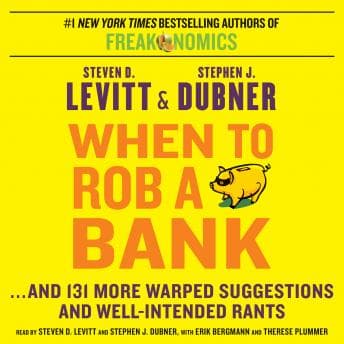
Let me be upfront about what this book actually is: 131 blog posts curated from a decade of Freakonomics.com. Some are brilliant little thought experiments. Others are half-baked musings that probably should have stayed in the drafts folder. Research shows our brains crave narrative arcs—beginnings and endings, cause and effect. Give and Take has a similar issue—lots of fascinating case studies that don't quite cohere into a unified argument. This book has none of that. It's appetizers all the way down.
And weirdly, that works for certain listening contexts. Cooking. Commuting. Folding laundry. The kind of activities where you can tune out for thirty seconds and not miss a crucial plot point because there is no plot. Each post is self-contained. You get the premise, the data, the counterintuitive conclusion, and then you're onto something completely different.
But—and this is significant—if you're looking for the depth of the original Freakonomics, you won't find it here. These are sketches, not paintings. The piece on why flight attendants don't get tipped? Genuinely interesting. The random aside about backgammon strategy? I found myself asking: why is this here, exactly?
Four Narrators, One Problem
Here's where things get complicated. Four narrators. Two authors, two professionals. And the quality differential is... something.
Dubner is genuinely pleasant to listen to. He's got that radio-trained smoothness—makes sense, given his podcast background. When he's reading, you're in good hands. Erik Bergmann and Therese Plummer handle their sections with the kind of clean professionalism you expect from seasoned audiobook narrators.
Levitt, though. The economist. The guy whose brain produces these fascinating ideas. He should not be reading his own work aloud. I say this with genuine respect for his intellect, but the man does not enunciate. His pacing is slow in a way that doesn't feel deliberate—it feels like he's reading off a teleprompter for the first time. My mind wandered constantly during his sections, which is a problem when he's explaining actual economic concepts.
Classic expertise-versus-communication disconnect. Brilliant thinker. Not a performer. And in an audiobook, that matters.
I found myself speeding up to 1.25x during Levitt's sections just to maintain engagement. Dubner's sections I left at normal speed. It's an odd listening experience, constantly adjusting.
Who Gets the Most Out of This
This is for the Freakonomics completists—people who've read the books, binged the podcast, and want more of that particular flavor of contrarian economics. It's for commuters who want intellectual stimulation without commitment. It's for people who enjoy having their assumptions poked at, even if the poking is sometimes shallow.
Skip it if you need cohesive arguments or narrative momentum. And if you're new to Freakonomics, start with the original. This is dessert, not dinner.
What makes this collection compelling is also what limits it: the authors' willingness to follow any question, no matter how trivial. Why does KFC run out of chicken? When should you rob a bank (answer: never, the ROI is genuinely terrible)? These are fun. But they're also the intellectual equivalent of scrolling Twitter—briefly stimulating, rarely satisfying.
Field Notes from the Archive
I finished this over three cooking sessions and one particularly long wait at the DMV. It served its purpose. I learned some things—the piece on what people actually lie about was genuinely illuminating, and their analysis of gun death reduction strategies felt more rigorous than most of the posts. The behavioral psychology angle reminded me of Ordinary Men, which examines how ordinary people make extraordinary moral choices—though obviously with far weightier subject matter. But I also forgot half of it by the next day.
This doesn't track as a unified work because it isn't one. It's a curated archive. A greatest hits album where some of the hits are B-sides at best. The production is clean, no audio issues, just the narrator inconsistency I mentioned.
Worth a credit? Probably not at full price. But if you've got a subscription with credits burning a hole in your pocket, or you catch it on sale, it's decent background listening for when you need your brain mildly engaged but not fully committed. C'est la vie académique—sometimes you get the dissertation, sometimes you get the footnotes.