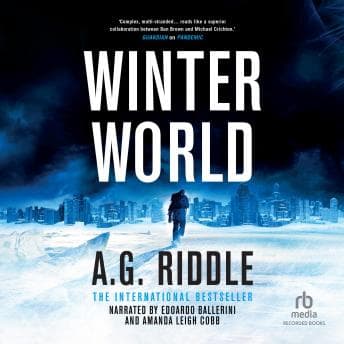

Look, I'm going to be honest with you - I started this at 6:17 AM on a Tuesday, wedged between a guy manspreading into my personal space and someone's overly fragrant breakfast burrito. Not ideal conditions. But by the time we hit Palo Alto, I'd completely forgotten I was on a train.
That's the thing about Winter World. It's basically The Martian meets Independence Day, but with an ice age instead of aliens. (Okay, maybe aliens? I won't spoil it.) The premise is simple: Earth is freezing, nobody knows why, and there's a mysterious object floating in space that might be responsible. Humanity sends a team to investigate. Things go sideways. Classic Riddle.
The Dual Narrator Gamble That Actually Works
So here's where I was skeptical. Dual narration can go really wrong really fast - like when the voices don't match the tone, or one narrator is clearly phoning it in while the other is giving their all. I've abandoned audiobooks over this. (Looking at you, that one thriller I won't name.)
But Edoardo Ballerini and Amanda Leigh Cobb? They're actually good together. Ballerini handles James Sinclair - the genius scientist wrongfully imprisoned, because of course he was - and he brings this quiet intensity that works for the character. The guy's been through some stuff, and you can hear it. Cobb takes Emma Matthews, the ISS commander watching civilization collapse from orbit, and honestly? Her sections hit different. There's this scene where Emma's reading messages from her sister about how bad things are getting on Earth, and Cobb delivers it with this restrained desperation that got me.
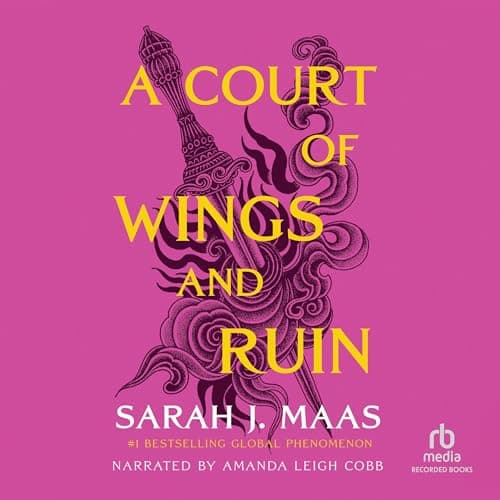
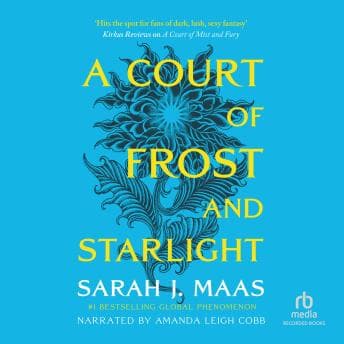
Now, I've seen some reviews saying Cobb isn't as strong as Ballerini, and... I don't entirely disagree? Ballerini has this gravitas that's hard to match. But Cobb holds her own. The handoffs between narrators are clean, no jarring transitions, and you always know whose head you're in. Cobb also narrates Court of Wings and Ruin, where she juggles even more POV characters—turns out she's really good at keeping voices distinct. That's harder than it sounds.
The Science Is... Fine? Let's Talk About That
Okay, I debug distributed systems for a living. I notice when things don't add up. And Winter World has some moments where I was like "hmm, that's not really how orbital mechanics work" or "pretty sure that's not how radiation shielding functions." But here's the thing - Riddle doesn't pretend to be writing hard sci-fi. He's writing a thriller that happens to be set in space. The science is plausible enough to keep you moving, and honestly? At 6 AM, I'm not doing physics calculations anyway.
The pacing is where this book earns its commute-worthiness. Riddle knows how to end chapters on hooks. Every time I thought "okay, one more chapter before I have to switch to that work podcast," I'd hit another cliffhanger and suddenly I'm walking into the office still listening. The middle section on the space station drags slightly - there's a lot of "we need to figure out what this thing is" spinning wheels - but it picks back up hard in the final third.
Who's This For (And Who Should Skip)
This is an 11-hour audiobook that felt like 7. I finished it in about 5 commutes, which for me is the sweet spot. It's not demanding enough that you'll miss critical plot points if someone's having a loud phone conversation next to you, but it's engaging enough that you won't zone out. Perfect for long commutes, gym sessions, avoiding your inbox.
If you need airtight scientific accuracy, maybe sample first. The premise requires some suspension of disbelief, and if you can't get past that, you'll be frustrated. But if you can roll with it? You're in for a good ride.
The ROI on this audiobook is solid. You get a complete story (though it's clearly book one of a series - the ending wraps up the immediate conflict but leaves plenty of threads dangling), good narration, and enough twists to keep you guessing. Is it going to change your life? No. Is it going to make your commute disappear? Absolutely.
If you want something with a similar sci-fi thriller vibe but don't mind going old-school, Black Star Passes scratches that same space adventure itch—though fair warning, the science there is even more hand-wavy.
Speed Settings and Final Debug
I listened at 1.5x and it worked perfectly. The narrators have good pacing naturally, so speeding up doesn't make them sound like chipmunks. I wouldn't go faster though - there are some quieter emotional moments that benefit from breathing room.
Kevin's already asking if he can borrow my Audible login to listen to this one. (The answer is yes, but only because he introduced me to Bobiverse and I owe him forever for that.) If you liked The Martian's problem-solving energy but want more apocalyptic stakes and dual perspectives, this is your next listen.