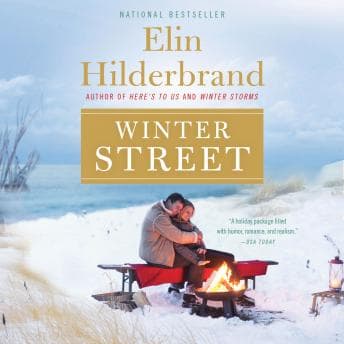

Let me register a formal complaint on behalf of English teachers everywhere: I was supposed to be grading essays on The Great Gatsby last Saturday morning, and instead I walked the entire lakefront — twice — because I couldn't stop listening to a Christmas novel about a Nantucket inn owner whose wife kisses Santa Claus. Not metaphorically. Literally Santa Claus. The guy in the red suit she hired for the inn's holiday party. This is what Elin Hilderbrand does to you.
When Chekhov's Santa Fires
Here's the thing about Winter Street that I didn't expect: it's structurally absurd and emotionally effective at the same time, and I'm still not entirely sure how Hilderbrand pulls that off. The setup reads like a holiday movie pitch — Kelley Quinn, owner of the Winter Street Inn, walks in on his wife Mitzi mid-kiss with the seasonal Santa employee, and this one moment detonates the entire Quinn family Christmas. Meanwhile, his hedge fund son Patrick is nursing what sounds like a federal crime waiting to happen, his bartender son Kevin is sleeping with the French housekeeper Isabelle (classic), his daughter Ava is stuck in that particular romantic purgatory where the guy is perfect but won't commit, and his youngest, Bart, is deployed in Afghanistan and unreachable.
That's a lot of plot threads for seven hours. Hilderbrand doesn't so much weave them together as she juggles them — and occasionally drops one — but the juggling is entertaining enough that you forgive the drops. What surprised me was how much I cared about Kelley. He's not a complicated literary creation. He's not Atticus Finch wrestling with moral ambiguity. He's just a dad who wanted a nice Christmas and got chaos instead, and there's something genuinely affecting about watching him try to hold it together while his ex-wife Margaret — the nightly news anchor, which is exactly the kind of detail Hilderbrand loves — sweeps back in to save the day.
My students would hate this. I found it completely irresistible.
What Erin Bennett Actually Does Here
The narrator understands that pause is punctuation. Erin Bennett has narrated all the Winter Street books, and you can hear why — she's found a genuine rhythm with this family. That same ear for character comes through in Winter Solstice, where she handles a sprawling cast with similar warmth. What she does well, specifically: she doesn't make Kelley sound like a sitcom dad. There's a quiet exhaustion in how she reads his chapters that keeps him from tipping into caricature. And she handles the male characters without the usual audiobook awkwardness of a female narrator doing a man's inner monologue — Kevin especially, whose sections have this slightly sheepish quality that fits a guy who knows he's making questionable life choices and is doing it anyway.
The Isabelle chapters are where I'd push back slightly. The French accent work is... present. It's there. It communicates "French" without fully committing to it, which is probably the safe choice, but if you're hoping for something that really leans into the Nantucket-summer-staff atmosphere, it's a little flat. Not distracting, just not quite the texture the character deserves.
One note: there's a Booktrack edition with background music that some listeners apparently found maddening. I listened to the standard version. Strongly recommend staying there. Holiday piano tinkling underneath a scene about a federal investigation would be genuinely unhinged. I haven't subjected myself to the Winter Street: Booktrack Edition, but the reviews suggest it's exactly as jarring as you'd imagine.
This Is Why We Still Read the Classics... Just Kidding, This Isn't a Classic
But here's what it is: a very competent, genuinely warm piece of holiday fiction that knows exactly what it's doing. Hilderbrand isn't trying to write Middlemarch. She's trying to write the literary equivalent of a good Christmas movie — one where the family is messy enough to feel real, the stakes are low enough to be comforting, and the ending is satisfying without being saccharine. On those terms, Winter Street works.
Seven hours is the right length. It doesn't overstay its welcome. The third-person narration frustrated at least one reviewer I came across, and I understand it — there's a lot of "Ava thought" and "Kevin said" that can feel mechanical when you're reading on the page. Aurally, Bennett smooths that over considerably.
If you want to feel something true and difficult, listen to Middlemarch. If you want to walk the lakefront on a gray November morning and feel unexpectedly cheerful about dysfunctional families and the persistence of hope, this is the one. Worth pausing the faculty meeting for — and I say that as someone who has paused many faculty meetings for many audiobooks.