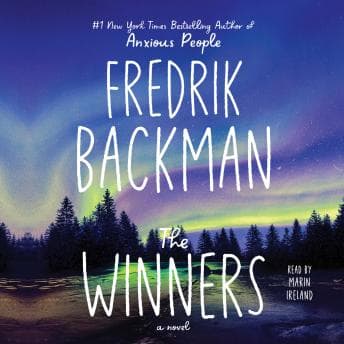

Here's my complaint: Fredrik Backman will not stop doing this to me.
I started Winners during a Saturday walk along the lakefront with Denise - one of those early October mornings where the wind off Lake Michigan has just started making its intentions clear. We made it maybe forty minutes before I had to stop walking because I couldn't trust my legs and my ears at the same time. Denise looked at me, saw my face, and said, "Beartown again?" She knows. She's seen this before.
That's the thing about finishing a trilogy. You think you're prepared. You've done Beartown, you've done Us Against You, you know what this author does to you. You've built up scar tissue. And then Backman finds the exact same spot and presses harder.
Beartown Is Still Doing What Beartown Does
Let me be honest about the book itself before I get to Marin Ireland, because you deserve the full picture. Winners is 21-plus hours, and yes - some of that runtime is Backman in full sermon mode. There's a reviewer somewhere calling the moralizing "subtle as a sledgehammer," and I won't pretend that's wrong. Backman has opinions. About loyalty. About small towns eating their own. About what men teach boys without meaning to. He will state these opinions. Repeatedly. In different metaphors. My students would call it heavy-handed. I'd call it Backman trusting his readers less than he should, because the story already makes the argument better than the commentary does.
But here's the thing: when the story is working - and for most of 21 hours, it is - it's working at a level that makes the moralizing feel like a reasonable tax on the experience. Amat's storyline gutted me. A kid who was supposed to be the town's redemption story, who had the talent and the hunger and the right origin story, just... broken by an injury and a system that used him up. That's not a metaphor Backman announces. He just shows you the empty rink at 4 AM and lets you sit with it. Maya coming home felt exactly right - not triumphant, not healed, just present in a way she hadn't been. And the fourteen-year-old boy with the pistol. I won't say more. But I want you to know that when the book's final act arrived, I was standing completely still on the lakefront path while other joggers moved around me like water around a rock.
This is why we still read - and listen to - the classics of contemporary grief fiction. Not because they're comfortable. Because they show us the cost of things. After Ever Happy reminded me of that same principle — grief fiction that earns its devastation by refusing to let you look away from what love actually costs people.
What Marin Ireland Is Actually Doing for 21 Hours
I've said before that great narration is performance art, and Ireland earns that designation here in ways that are specific enough to describe. She's not doing character voices in the theatrical sense - no exaggerated Swedish accents, no broad differentiation to signal who's speaking. What she does is subtler and harder: she modulates the weight of sentences. Backman writes these long, rolling, aphoristic passages - the kind where he's building to a gut-punch final clause - and Ireland knows exactly where the punch lands. She gives it space. The pause before the thing you didn't see coming is punctuation. She understands that.
The emotional sections - and there are several that will undo you - she plays completely straight. No trembling voice indicating this is sad now. She just reads it at the right pace and trusts the words. That restraint is what makes it devastating rather than manipulative. I've listened to narrators who cry their way through grief scenes and it always distances me from the text. Ireland stays in the room with you instead.
She's narrated the entire Beartown trilogy, which matters more than it sounds. These characters have accumulated history across three books, and Ireland carries that history in how she voices them. When Maya speaks, there's a specific quality to it - not a vocal trick, just a consistency of character - that tells you this is someone who survived something and is still figuring out what that means.
Who Should Actually Listen to This
If you haven't read Beartown and Us Against You: stop. Go back. This is not a standalone. You will be lost and, worse, you will not feel the weight of what's happening because you won't know what these people have already cost each other.
If you've read the first two and you're worried this one won't stick the landing: it does. Mostly. The length is real, the moralizing is real, but the payoff is real too.
If you're looking for something light or propulsive: wrong book. This is a 21-hour sit with grief and community and the specific way small towns hold grudges like heirlooms. Worth pausing the faculty meeting for - but not the kind of listening you do while half-distracted. Ireland's performance rewards attention.
My students would find this slow. They'd want to know why we're spending so much time in a hockey town in Sweden with people who are sad about things that happened two years ago. I'd tell them that's exactly the point. Some losses don't resolve on a schedule. Some towns don't let you leave. Some stories take exactly as long as they take.
This one took 21 hours and a cold October morning on the lakefront, and I'd do it again.