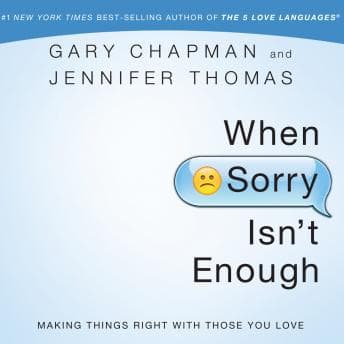

Everyone raves about this being "The Five Love Languages but for apologies" and honestly? They're not wrong. Chapman built the original framework in 5 Love Languages, and if you haven't read that one first, this book hits about 30% harder when you do—the two really are meant to be read as a pair. But what nobody tells you is how weirdly validating it is to realize you've been apologizing in the wrong programming language for your entire adult life.
I was somewhere around hour two, packed into the 7:15 AM express, when the framework clicked. Kevin and I had gotten into it the night before about something stupid—I think it was whose turn it was to meal prep—and I'd done my usual thing: apologized in the way *I* wanted to be apologized to. Which, according to Chapman and Thomas, is basically the relationship equivalent of writing Python when your partner's system only runs Java.
Bottom Line: Worth your commute if you've ever said "I'm sorry" and watched it land like a lead balloon.
Your Apology Has a Type Mismatch
Chapman and Thomas break down apologies into five distinct "languages": expressing regret, accepting responsibility, making restitution, genuinely repenting, and requesting forgiveness. The framework is simple—almost too simple—but the examples they provide are weirdly specific and useful.
Here's what actually stuck with me: they explain how some people need to hear "I was wrong" (accepting responsibility), while others need "What can I do to make this right?" (restitution). My brain immediately mapped this to debugging. You can acknowledge a bug exists all day long, but if your teammate needs to see the fix deployed before they trust the system again, your verbal acknowledgment is worthless. Same energy.
The book gets into some genuinely uncomfortable territory—they discuss scenarios where one partner keeps apologizing the "wrong" way for years, building resentment on both sides. Nobody's the villain. It's just a communication mismatch that compounds over time like technical debt.
Kelly Gets Out of the Way (In a Good Way)
Look, this isn't Ray Porter. There's no vocal fireworks here. But Kelly Ryan Dolan does exactly what you want for a relationship self-help book: reads clearly, keeps a conversational pace, doesn't try to dramatize the case studies. The production is clean—no weird audio artifacts, no jarring transitions between chapters.
At 4 hours 38 minutes, this is a two-commute listen at 1.5x. Perfect length. No padding. Chapman and Thomas make their point, give you examples, and move on. The ROI on this audiobook is solid—it's not one of those business books that could've been a blog post.
Where It Gets a Little Church-y
Fair warning: Chapman is a pastor, and it shows. There are references to faith and marriage counseling that assume a fairly traditional framework. If you're not religious, you can mentally translate "God's design for relationships" to "healthy relationship dynamics" and still get value. But if Christian framing actively bothers you, this might not be your jam.
The book also skews heavily toward romantic relationships and parent-child dynamics. Workplace apologies get maybe one chapter. Chapman leans into this same domestic focus in Loving Your Spouse When You Feel Like Walking Away too—the man has a lane and he stays in it. I wanted more on professional contexts—how do you apologize to a skip-level manager? To a direct report you accidentally threw under the bus in a meeting? That's where my life actually needs help, but the book stays pretty firmly in the family lane.
Who This Is (and Isn't) For
Great for long-term relationships where the same arguments keep cycling. Anyone who's been told "that's not a real apology" and genuinely didn't understand why. Couples who've read The Five Love Languages and want the companion piece.
Skip if you're looking for workplace communication frameworks, or if you're allergic to Christian relationship counseling. If you need something more clinical and less pastoral, look elsewhere.
Deploying to Production
I finished this in two commutes and immediately texted Kevin a summary of the five apology languages. His response: "So you're saying I need to actually say what I did wrong, not just say sorry?" Yes. That's literally it. Sometimes the simple frameworks are the ones that stick.
The book won't revolutionize your life, but it gave me a shared vocabulary for something I'd been doing wrong for years. And honestly? At under five hours, that's a pretty good trade for two train rides.
Now if only Chapman would write The Five Languages of Production Incident Postmortems. I'd pre-order that immediately.