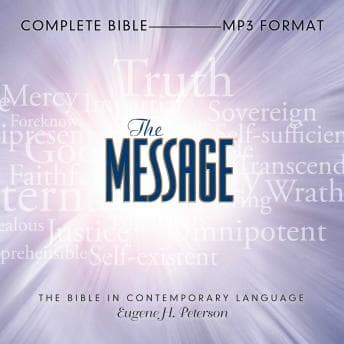

I'll be honest - I've been a bit of a snob about The Message for years. Twenty years teaching English will do that to you. Peterson's paraphrase always felt like someone translating Shakespeare into a text message. My colleagues in the theology department loved it. I'd nod politely and reach for my NRSV. So when I finally sat down with this 78-hour behemoth, it was less out of spiritual hunger and more out of curiosity - the way you'd finally watch a show everyone's been telling you about for a decade.
I was wrong about a few things. Not everything. But a few things.
When Familiar Words Hit Different
Here's what Peterson actually did, and what I only started to appreciate around hour twelve: he went back to the original Hebrew and Greek and asked, "What would this sound like if someone said it to you over coffee?" And the result is genuinely startling when you've spent your whole life hearing the King James cadences. Take the Psalms - where you expect "The Lord is my shepherd, I shall not want," Peterson gives you "God, my shepherd! I don't need a thing." The exclamation point alone. That's a choice. That's interpretation.
And that's where this gets interesting for someone like me, because I'm always telling my students that translation IS interpretation. Every word choice is an argument. Peterson isn't hiding behind formal equivalence; he's making his argument loud and clear. The prophets sound angry - actually angry, not ceremonially displeased. Paul sounds like he's dictating letters in a hurry, which, historically, he was. There's an earthiness to Ecclesiastes that made me stop grading mid-sentence and just listen.
Is it the Bible? That's the wrong question. It's a reading of the Bible. And in audio form, with Kelly Ryan Dolan narrating, it becomes a performance of a reading of the Bible. Two layers of interpretation between you and the source text. My grad school self would've had a stroke.
Kelly Ryan Dolan and the Problem of Playing God
Let's talk about the impossible job Dolan signed up for: narrating the entire Bible. Seventy-eight hours. Sixty-six books. Poetry, law, history, prophecy, apocalyptic vision, personal correspondence. That's not a narration gig - that's an endurance event.
Dolan's approach is steady and clear, which sounds like faint praise until you consider the alternative. An overly dramatic reading of Scripture turns into a sermon; too flat and you're listening to someone read a phone book in ancient Hebrew drag. He finds a middle register - warm, direct, present. The prose in Peterson's paraphrase is conversational by design, and Dolan leans into that without tipping into casualness. There's a lively quality to his delivery that keeps the narrative books - Genesis, Exodus, the Samuels - moving forward with genuine momentum.
But here's my honest critique: at 78 hours with a single narrator, you lose the tonal range that Scripture demands. The shift from the tender poetry of Song of Solomon to the bureaucratic lists in Numbers should feel like whiplash. Instead, it smooths out. Dolan is consistent, and consistency is both his strength and his limitation. I found myself wanting a different voice for the prophets - something with more gravel, more fury. When Amos says (in Peterson's words) "Do you realize what you've done?" to Israel, I wanted to feel the room get smaller. Instead, it stays pleasant. Pleasant is fine for Philippians. It's not enough for Jeremiah.
The 78-Hour Question
I listened to this over about six weeks - walking the lakefront with Denise on Saturday mornings, grading papers at my desk until my eyes gave out and I switched to just listening, and yes, during at least two faculty meetings that did not require my full attention. (Principal Martinez, the strategic planning session was riveting. I definitely wasn't in Leviticus.)
And here's what I'll say about the commitment: this is not a book you "finish." It's a resource you move through. Some stretches - the prophetic books, the Gospels, Romans - are genuinely electric in Peterson's language. Others - the genealogies, the temple measurements in Ezekiel - are exactly as exciting as you'd expect, no matter whose words you drape over them.
The book introductions Peterson wrote for each section are a nice touch, giving context before you dive in. But they're brief. If you're coming to Scripture for the first time, you'll want a study guide alongside this.
Who This Is For (And Who Should Keep Their RSV)
If you've grown numb to the Bible's language - if years of hearing the same verses have turned them into wallpaper - this will wake you up. Peterson's paraphrase strips the varnish off. You'll disagree with some of his choices. Good. Disagreement means you're paying attention.
If you want scholarly precision, this isn't it. Peterson would've told you that himself. The One Year Chronological Bible NLT sits closer to that scholarly end of the spectrum - same accessibility goal, different philosophical approach to getting there. This is the Bible as a living, breathing conversation rather than a museum exhibit. Dolan's narration serves that purpose well, if not spectacularly.
My students would probably still hate it. Seventy-eight hours is a lot to ask of anyone who thinks a TikTok over 90 seconds is "long-form content."
The Annotation in the Margin
This reminds me of what Hemingway said about prose being architecture, not interior decoration. Peterson stripped the decoration. What's left is structure - the bones of the story. Whether those bones are enough depends on what you came looking for. I came looking for reasons to be skeptical and left with a handful of passages I'd never heard quite that way before. That's worth something. Maybe not 78 hours of something, but something real.