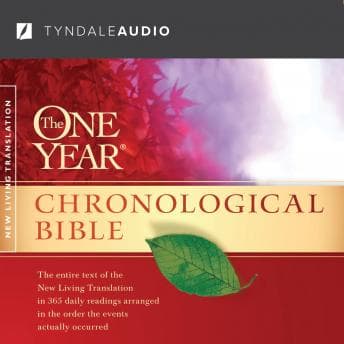

Look, I'll be honest - when I first saw the runtime on this one, I laughed out loud. Seventy-four hours. That's longer than my entire summer reading list for the AP Lit kids. But here's the thing about the One Year Chronological Bible: it's not meant to be consumed like a novel. It's a discipline. A daily practice. And Todd Busteed gets that.
The Voice That Carries You Through
I've listened to a lot of Bible audiobooks over the years - some dramatized with full casts and sweeping orchestral scores, others so dry they could cure insomnia. The Bible (WEB) Old Testament - complete leaned more toward the dry side for me, which made me appreciate Busteed's approach even more. Busteed lands somewhere beautifully in between. His delivery is conversational without being casual, reverent without being stuffy. You can hear the passion in his voice, and I don't mean that in a performative way. It's more like... listening to someone who genuinely loves this text share it with you.
He doesn't do character voices. No booming God voice, no raspy Satan. And honestly? I prefer it this way. When you're spending a year with a narrator, you don't want theatrics. You want a companion. Someone whose voice becomes familiar enough that you stop noticing it and start noticing the words instead.
That said - and this is a real issue - the volume levels can be inconsistent. I found myself adjusting my phone during my lakefront walks more than I'd like. Some passages came through crystal clear, others had me straining. It's not a dealbreaker, but it's noticeable.
Why Chronological Changes Everything
This is what sold me on this particular version. The Bible, as traditionally arranged, jumps around. You read Kings, then you read Chronicles, then you're in the Prophets, and the timeline becomes this tangled mess that even my best students struggle to untangle. The chronological arrangement is like finally getting the director's cut with scenes in the right order.
Suddenly, David's psalms appear alongside the events that inspired them. The prophets show up when they were actually prophesying. Isaiah isn't just floating in the middle of your Old Testament - he's responding to specific historical moments. For anyone who's ever felt lost in the narrative flow of Scripture, this is revelatory.
The NLT translation helps too. It's not a word-for-word translation - the scholars among us (and yes, I count myself in that group, pretentiously) might prefer something more literal for deep study. But for listening? For absorbing the story of it all? The NLT reads like someone actually wrote it to be heard. Because the ancient texts were meant to be heard. That's something I appreciated about Spiritual Exercises too - texts designed for contemplation rather than silent speed-reading. We forget that.
The Fifteen-Minute Promise
Here's where I got practical. The marketing says fifteen minutes a day gets you through in a year. Math checks out. And there's something almost meditative about that commitment - small enough to fit into a morning routine, substantial enough to feel like you're actually doing something.
I started listening during my paper-grading sessions. (Sorry, students, your essays on The Great Gatsby got annotated to the sounds of Leviticus.) Then it migrated to my walks with Denise. She's not as into audiobooks as I am, but she didn't mind this one playing softly as we circled the lake.
The pacing works for this kind of listening. Busteed doesn't rush through the genealogies (yes, there are genealogies, this is the Bible after all), but he doesn't linger unnecessarily either. He trusts that you're here for the long haul.
Who This Is Actually For
If you want drama - multiple voices, sound effects, cinematic production - this isn't it. Go find a dramatized version. There are good ones out there.
But if you want to actually hear the Bible as a continuous narrative, delivered by someone who clearly cares about the text, in a translation that doesn't make you reach for a dictionary every thirty seconds? This is your audiobook.
I'd also say: if you've tried reading through the Bible before and stalled out somewhere in Leviticus or Numbers (don't lie, we've all been there), the audio format might be what gets you through. There's something about hearing the laws and the lists that makes them more bearable than reading them. Busteed's voice carries you through the dry patches.
One caveat: this is the Bible. It contains violence, difficult passages, accounts of abuse - all the things that make it a challenging text. The NLT doesn't sanitize any of that. Be prepared.
Would I Listen Again?
I'm already planning my second year. Different context this time - maybe just the morning walks, no grading sessions. (My students' essays deserve my full attention. Allegedly.)
The volume issues are frustrating. The lack of dramatization might bore some listeners. But for what it sets out to do - make daily Scripture listening accessible, clear, and genuinely engaging - it succeeds. Todd Busteed isn't performing for you. He's reading with you. And over seventy-four hours, that distinction matters more than you'd think.