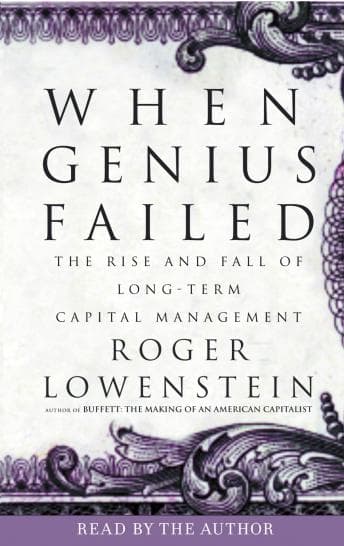

Look, I'm going to complain about something first: why did it take me this long to listen to this book? I've been debugging distributed systems for years, and the entire time there was this perfect audiobook sitting there—basically a postmortem of the most spectacular system failure in financial history. A system built by literal Nobel Prize winners that still crashed and burned. The hubris. The overconfidence in models. The complete blindness to edge cases. This is a distributed systems failure, but for money.
I finished this in about four commutes, and by the end I was genuinely mad at people who've been dead or retired for decades.
The Arrogance is the Feature, Not the Bug
Quick Verdict: Worth your commute. Lowenstein narrates his own book, which normally makes me nervous (authors aren't always good performers), but his background as a Wall Street Journal reporter means he knows how to tell a story clearly. No dramatic flair, no character voices—just a financial journalist walking you through the most expensive "we're smarter than everyone" moment in modern finance.
The LTCM partners genuinely believed they had solved risk. Not reduced it. Solved it. Their models were so elegant, so mathematically pure, that they convinced themselves the market would always behave rationally. They looked at historical data, built beautiful equations, and then leveraged themselves to the point where a single unexpected event could—and did—vaporize everything.
Sound familiar? It should. It's the same mistake we make in tech when we assume our load tests cover all scenarios, or when we ship without chaos engineering because "the math checks out." The ROI on this audiobook is understanding why smart people make catastrophically dumb decisions when they fall in love with their own models.
When Your Backtest Doesn't Include "Russia Defaults"
The most infuriating part is watching these geniuses dismiss anyone who questioned their approach. Lowenstein details how they treated Wall Street banks with barely concealed contempt—while simultaneously borrowing billions from those same banks on sweetheart terms. The banks were so dazzled by the credentials (two future Nobel laureates! Salomon Brothers royalty!) that they basically handed over unlimited leverage.
And then Russia defaulted. Suddenly all those "uncorrelated" positions became extremely correlated. The models said this couldn't happen. The models were wrong.
Five weeks. That's how long it took to go from masters of the universe to begging the Fed for a bailout. Lowenstein's narration during the collapse chapters is almost clinical, which somehow makes it worse. He's not sensationalizing—he doesn't need to. The facts are sensational enough.
Author-Narrated: The Tradeoffs
Lowenstein reads at a measured pace that works for the dense financial content. He's not Ray Porter (nobody is Ray Porter), but he's clear and authoritative. The downside? No vocal variety for the different players. Meriwether, Merton, Scholes—they all sound like Lowenstein reading quotes. For a book this character-driven, a professional narrator might have given more texture.
But honestly? The straightforward delivery kind of works here. This isn't a thriller that needs dramatic tension—the tension is built into the story itself. You're listening to a journalist explain how the smartest people in the room blew up the financial system because they couldn't imagine being wrong.
Perfect for: train, gym. Skip for: deep work (you'll want to take notes). At 9 hours, it's substantial but not bloated—Lowenstein doesn't pad this with unnecessary tangents. Every chapter builds toward the inevitable crash.
Who Gets Value Here (And Who Should Skip)
If you work in tech, finance, or anywhere that builds complex systems, this is required listening. Not because you'll learn trading strategies (you won't), but because you'll recognize the patterns: the groupthink, the dismissal of tail risks, the assumption that past performance predicts future results.
If you want a fast-paced financial thriller with a narrator doing voices, try something else. This is a detailed autopsy, not a heist movie. For actual entertainment with historical depth, Vikings: A History delivers both—though it's a completely different kind of systemic collapse.
Skip if you need entertainment over education, or if financial jargon makes your eyes glaze over. This could've been a blog post if the blog post was 50,000 words and you actually needed all of them to understand the scope of the disaster.
The Commit Message
I listened to the final hour at 6 AM on a packed Caltrain, surrounded by other engineers heading to their own complex systems, and I couldn't stop thinking about how many of our production architectures have the same blind spots. We build elegant solutions, we test against expected scenarios, and we assume the models will hold.
They won't. The market—like production—doesn't care about your equations.
This book is 25 years old and it's never been more relevant. Every crypto collapse, every AI hype cycle, every "this time it's different" moment in tech—it's all here, playing out with bond arbitrage instead of blockchain. The names change. The hubris doesn't.