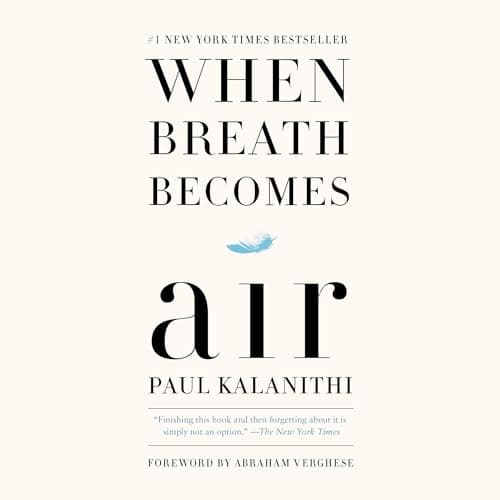

Most books about dying try to comfort you. They wrap mortality in soft language and gentle metaphors until death starts to feel almost pleasant, like falling asleep in a warm bath. When Breath Becomes Air doesn't do that. Paul Kalanithi's posthumous memoir hits you like a CT scan result you weren't prepared for—clinical and devastating and somehow still radiant with meaning.
Here's the contrast that kept nagging at me: this book has a 4.71 rating and a Pulitzer nomination, which usually signals something overhyped, something propped up by sympathy or cultural momentum. But listening to it on a quiet evening with headphones on, I found the opposite problem. If anything, the praise undersells how precisely Kalanithi writes about the collision between a life of extraordinary ambition and the body's indifferent refusal to cooperate.
Kalanithi was a neurosurgeon and a literary mind—a rare combination that gives this memoir its particular electricity. He studied English and biology before medical school, and you can feel both disciplines pulling at the prose. When he describes operating on a brain, it reads like someone who understands that the three pounds of tissue under his scalpel contain everything a person has ever been. When he writes about receiving his own diagnosis at thirty-six, there's no melodrama. Just the quiet vertigo of a man watching his identity—doctor, husband, future father—rearrange itself around a new, terminal fact.
Sunil Malhotra narrates the bulk of the audiobook, and his performance is one of those rare cases where the narrator becomes invisible in the best possible way. He doesn't oversell the emotion. He doesn't inject dramatic pauses where the text doesn't call for them. He delivers Kalanithi's words with a steady, measured gravity that mirrors the author's own tone—a man who has spent years controlling his composure in operating rooms now applying that same discipline to the most personal crisis imaginable. Malhotra captures both Kalanithi's intellectual restlessness and his moments of raw vulnerability without tipping into sentimentality. It's genuinely excellent work.
The structure of the book is deceptively simple. Part one traces Kalanithi's path from a childhood in Arizona through Stanford's neurosurgery residency, driven by an obsession with what gives life meaning. Part two follows his diagnosis and treatment, the decision to have a daughter with his wife Lucy, and his gradual decline. At just over five and a half hours, it's compact—almost alarmingly so, which only reinforces the book's central ache: there wasn't enough time.
And then there's the epilogue. Lucy Kalanithi's account of Paul's final days, narrated by Cassandra Campbell, shifts the entire emotional register. Campbell's delivery is empathetic without being saccharine, and the transition from Paul's voice to Lucy's hits like a door closing. I won't pretend I kept it together. You probably won't either.
What distinguishes this from other end-of-life memoirs—and there are many good ones, from Being Mortal to The Bright Hour—is Kalanithi's dual perspective. Atul Gawande's Being Mortal: Medicine and What Matters in the End covers adjacent ground from the physician's vantage point, and I'd argue the two books are in genuine conversation with each other—Gawande asks what medicine should do, Kalanithi asks what a life should mean. He understands death from both sides of the hospital bed. He's told families their loved ones won't survive. He's watched the light leave patients' eyes. And now he's the one in the gown, parsing his own scans with the expertise to know exactly what they mean. That double vision gives the book a philosophical weight that never feels academic. When he wrestles with Beckett's "I can't go on. I'll go on," it's not a literary exercise. It's a man trying to figure out how to live the months he has left.
The book doesn't answer its own questions neatly, and I think that's what makes it stick. Kalanithi died before finishing the manuscript, and you can feel the absence in the final pages—not as a flaw, but as the most honest possible ending. Life didn't wait for him to wrap things up.
At five hours and thirty-five minutes, this is a short listen, and I'd push back against speeding it up. The prose is dense with ideas and emotion, and rushing through it would be like speed-walking through a cathedral. Give it a quiet evening or a focused morning. It earns your full attention.
One note worth mentioning: if you're currently dealing with a terminal diagnosis—your own or someone close to you—approach this with care. It's not gratuitous, but it is unflinchingly honest about what dying looks like, and that honesty can land hard.
Who Should Listen (And Who Should Skip)
If you're drawn to books that treat mortality with intellectual rigor rather than soft platitudes, this is essential listening. Anyone interested in the intersection of medicine, philosophy, and identity will find it riveting. Skip it if you need tidy resolutions—Kalanithi's story ends mid-thought, by necessity, and that openness is either the point or a deal-breaker depending on your temperament. And again, if terminal illness is close to home right now, proceed gently.
This is one of those audiobooks where the format genuinely adds to the experience. Hearing Kalanithi's words spoken aloud, with Malhotra's careful, almost reverent delivery, makes the memoir feel less like reading and more like being confided in. Campbell's handling of Lucy's epilogue provides a grace note that the printed page can't quite replicate. The production is clean, unadorned, and exactly right for material this raw.