
I started this audiobook on a morning jog through Cambridge and had to stop running. Not because I was tired—because I was standing on the sidewalk, phone in hand, completely frozen by what I was hearing.
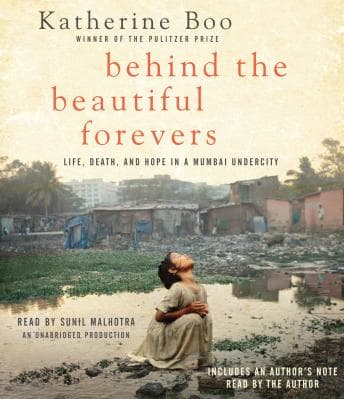
Look, I study human behavior for a living. I've read countless case studies about poverty, resilience, and the psychology of survival. My Confession explores similar themes of survival and moral complexity, though through a very different lens. But Katherine Boo's reporting from Annawadi—a Mumbai slum wedged between luxury hotels and the international airport—hit different. This isn't poverty as abstraction. This is Abdul, a teenage garbage sorter who can identify the market value of any piece of trash by touch. This is Asha, a woman who's figured out that in a corrupt system, the path to respectability runs through corruption itself. The research actually shows that people in extreme poverty make remarkably rational decisions given their constraints. Boo proves this on every page.
Rational Actors in Impossible Circumstances
What makes this book devastating—and I mean that in the best possible way—is how Boo refuses to flatten her subjects into either victims or heroes. Take Abdul's family. They're not sitting around being inspirationally poor. They're calculating. Strategizing. Making morally complicated choices because that's what survival requires.
Abdul doesn't dream of escape through some magical opportunity. He dreams of accumulating enough garbage—sorted, weighed, sold—to buy a better plot of land. Incremental. Realistic. Heartbreaking in its modesty.
And then there's Asha, who might be the most psychologically fascinating character I've encountered in narrative nonfiction this year. She's gaming a system designed to exclude her. It's the kind of strategic thinking you'd find in Art of War, except the battlefield is bureaucracy and the stakes are her family's survival. Is she corrupt? Absolutely. Is she also a product of a society that offers no legitimate paths to power for women like her? Also yes. My therapist would have thoughts about this character—about how we develop moral frameworks that serve our survival, even when they contradict our stated values.
Sunil Malhotra Behind the Mic
Okay, so here's where I have to be honest. Malhotra's narration is technically excellent—he switches between characters with precision, handles the Indian accents with authenticity (which matters enormously for this material), and differentiates voices clearly. I never lost track of who was speaking.
But.
There's a certain... distance? A formality to his delivery that sometimes felt at odds with the intimate, ground-level reporting Boo achieved. Like watching a documentary through glass. Some listeners will find this keeps the material from becoming overwhelming—and given the content warnings here (poverty, violence, abuse, a child death that I'm still not over), maybe that's protective. Others might wish for more emotional warmth.
I found myself somewhere in the middle. The narration is gripping during the courtroom scenes and the slow-motion tragedy involving Abdul's neighbor. But during quieter moments, I occasionally drifted. Not the book's fault. Just a stylistic choice that didn't always land for me.
Hope as Currency, Walls as Metaphor
Here's what I keep coming back to. Boo spent three years reporting this book. Three years in Annawadi, attending court hearings, talking to police officers, watching children sort garbage. What she produced isn't journalism as we usually understand it—it's psychological portraiture at scale.
The book made me rethink everything I thought I knew about hope. In Annawadi, hope isn't some abstract feeling. It's a resource. A currency. And like all currencies in unequal systems, it's distributed unfairly. The "beautiful forevers" of the title—those are advertisements for floor tiles on the wall separating the slum from the airport. Literally a wall of aspirational messaging that the residents can see but never access.
We love stories about people "overcoming" their circumstances. Boo shows us something more honest: people navigating circumstances that will likely never change, making meaning anyway.
Who Should Queue This Up (And Who Shouldn't)
This is a must-listen for anyone who studies human behavior, works in social justice, or wants to understand how the other 90% actually lives. Skip it if you need background listening while doing dishes—Boo jumps between timelines and characters in ways that demand your full attention.
Still Processing This One
For a focused commute? A long flight? Absolutely. Just maybe have tissues ready. And possibly a plan to donate to something afterward, because this book will make you want to do... something.
I'm still processing it, honestly. And that's the mark of genuine narrative nonfiction—it doesn't let you go.