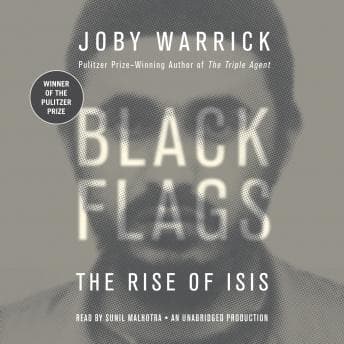
Look, I have a complaint. I started this book on a Thursday night thinking I'd listen to an hour before bed, and suddenly it's 0200 and I'm sitting in the dark kitchen with cold coffee and Ranger staring at me like I've lost my mind. Thirteen and a half hours of content and Warrick makes every single one of them count. That's the problem - you can't put it down. Or whatever the audio equivalent is. You can't pull it out of your ears.
I Watched This Movie. Except It Was Real.
Let me cut to the chase: this is the best book on the rise of ISIS I've encountered, and I've read more than a few. I was in theater when Zarqawi's network was turning Al Anbar province into a slaughterhouse. I knew the broad strokes. Medical Apartheid taught me a similar lesson - how much institutional history stays buried until somebody with the sources digs it up. What I didn't have was the Jordanian intelligence side of the story - the GID officers who'd been tracking this guy since he was a petty thug in Zarqa, the interrogators who sat across from him and recognized something genuinely dangerous behind the dead eyes and the prison tattoos.
Warrick structures the whole thing as a character study, which is a bold choice for what could've been a dry policy book. You get Zarqawi's radicalization in the Jordanian prison system in the late '90s. You get King Abdullah trying to warn Washington that releasing these guys was going to bite everyone. You get the CIA analysts who identified the threat and then watched helplessly as their intelligence was cherry-picked and distorted to justify the Iraq invasion. The author clearly did their homework - his CIA and Jordanian sources gave him operational details I've never seen in open-source reporting.
And here's where it hurts: the book lays out, with painful precision, how the 2003 invasion handed Zarqawi exactly the chaos he needed. Colin Powell's UN presentation - where he named Zarqawi as the supposed link between Saddam and al-Qaeda - basically gave a mid-level extremist a global recruiting poster. I've seen this scenario play out in real life, and reading the decision-making chain that led to it still makes my blood pressure spike.
Malhotra Gets the Names Right (And That Matters More Than You Think)
Sunil Malhotra's narration deserves special mention. In a book dense with Arabic names, tribal affiliations, and organizational acronyms that shift every few years - AQI to ISI to ISIS to ISIL to Islamic State - getting the pronunciation right isn't just a nice touch, it's essential. Malhotra handles every one of them with precision. Abu Musab al-Zarqawi, Abu Muhammad al-Adnani, Abu Bakr al-Baghdadi - they all sound like they should, not like an American newscaster guessing.
It's the same command I heard from him narrating When Breath Becomes Air - a completely different subject matter, but that same instinct for knowing when to stay out of the material's way.His delivery is reportorial, measured, almost clinical at times. And that's exactly what this material needs. The facts are horrific enough - the beheadings, the hotel bombings in Amman, the sectarian slaughter - that a narrator who tried to dramatize them would've been unbearable. Malhotra lets the horror speak for itself. When Warrick describes the wedding reception bombing at the Radisson in Amman in 2005, Malhotra's steady, almost quiet delivery makes it hit harder than any theatrical performance would have.
If you want another demonstration of his range, Behind the Beautiful Forevers shows him bringing that same restraint to reporting from Mumbai's undercity.I listened at my usual 1.25x and it worked fine, though I'll say there were passages - particularly the intelligence-heavy sections where you're tracking multiple actors across borders - where I dropped back to 1x to make sure I was tracking.
Where The Intel Gets Thin
This is where it lost me, just slightly: the Syria chapters toward the end feel rushed compared to the deeply sourced Iraqi sections. Warrick had incredible access to Jordanian and CIA sources for the Zarqawi years, but the 2011-2014 period - the Syrian civil war, the Obama administration's hesitation, the final explosion of ISIS across the border - gets compressed. You can feel the sourcing thin out. It's still solid journalism, but after the extraordinary detail of the first two-thirds, the final act feels like it's operating on a different level of access.
Also - and this is minor - the book ends in mid-2014, right as ISIS is taking Mosul. Which means it captures the rise but not the fall. That's not a flaw exactly, but know going in that you're getting the "how did we get here" story, not the complete picture.
Worth Your Time? Here's The Debrief.
If you served in Iraq or Afghanistan - yeah, you need to hear this. Not because it'll make you feel good. It won't. But because it fills in the strategic picture that most of us only saw at ground level. If you're a civilian who wants to understand how a prison thug from Jordan ended up commanding an army that redrew the map of the Middle East, this is your book.
Who should skip it? Anyone who wants background listening for their commute. This demands focus. There are too many names, too many threads, too many moments where a single intelligence failure cascades into catastrophe. Give it dedicated time.
Pulitzer was earned. Ranger approved this one - though he did give me a look at 0200 that clearly said "go to bed, old man."