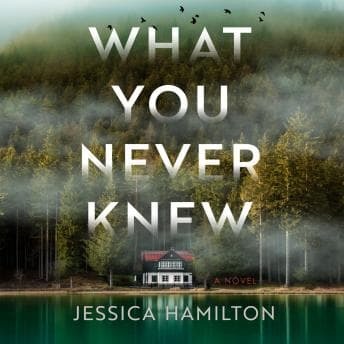

What happens when the stories your family told you were all lies?
I was charting at 3 AM—unit was quiet, which you never say out loud—and I had this playing through my earbuds. Bad idea. June Bennett's slow unraveling on Avril Island had me so tense I nearly jumped out of my skin when the telemetry alarm went off down the hall. False alarm. My heart rate? Not so false.
The Grief That Walks Beside You
Here's what Jessica Hamilton gets right: grief doesn't arrive and leave. It moves in. It rearranges your furniture. June's sister May dies in a car accident, and instead of closure, June inherits an island cottage she thought was sold decades ago—right around the time her father vanished. As someone who's held the hands of family members in waiting rooms at 4 AM, I can tell you Hamilton nails that particular flavor of loss where you're mourning someone while simultaneously realizing you never knew them at all.
The dual timeline works here—June at forty, processing her sister's death while uncovering family secrets, and the ghost of May narrating her own perspective. Summons uses a similar dual-perspective approach to unpack family secrets, though it leans harder into the supernatural elements. It's a structural choice that could've been gimmicky but instead feels like two sisters finally having the conversation they never got to have in life.
Two Voices, Two Sisters, One Haunted Island
Sarah Mollo-Christensen handles June with this soft, smoky quality that genuinely sounds like a woman running on grief fumes and bad coffee. There's a vulnerability in her delivery that reminded me of patients who've been awake too long processing news they can't quite accept. Laura Jennings takes May—the ghost—and gives her this authoritative warmth. Protective older sister energy, even from beyond the grave. When she portrays the spectral moments (doors opening, objects appearing on beds), Jennings doesn't go full horror movie. She sounds like a sister who's frustrated she can't just shake June and tell her the truth directly.
Now. Some listeners find the emotional delivery "too much." I get it. Mollo-Christensen leans into June's grief hard, and if you're not in the mood for that level of feeling, it might grate. But honestly? After fifteen years of watching people process the worst days of their lives, I thought the emotion tracked. Grief IS excessive. It doesn't know how to be appropriate.
The male characters come through clearly—Mollo-Christensen drops into a lower register without making it distracting. No weird caricatures. Just differentiation. Night shift approved.
When Small Towns Keep Secrets
The mystery itself unfolds at a deliberate pace. June's father disappeared when she was twelve, and her mother told her he abandoned them. The townspeople have... different theories. Was he murdered? And by whom? The cottage on Avril Island becomes almost a character—old, creaking, holding onto memories the way old houses do.
This is how small communities work. The way information gets passed around, distorted, protected. The way everyone knows something but nobody knows everything. Below the Belt nails that same small-town dynamic—the way secrets get weaponized in communities where everyone's watching. Hamilton captures that particular claustrophobia of returning to a place where your family's history is public property.
The pacing won't work for everyone. It's a slow burn—atmospheric rather than action-driven. I listened over three night shifts, and the ten-hour runtime felt appropriate for the story being told. If you're looking for constant twists, this might frustrate you. If you want to sink into a family mystery where the revelations come like waves eroding a shoreline, you're in the right place.
Who This Is (And Isn't) For
This one's ideal for focused listening—don't throw it on while you're doing something complicated. The dual narrators and timeline switches require attention. That said, the narration is clear enough that some listeners have sped it up to 3x (wild, but apparently it works). I kept it at 1.25x on my drive home, and it hit just right.
Skip this if: you hate emotional narration, you want a fast-paced thriller, or you're not in the headspace for family trauma and grief. Carlos asked why I looked so drained when I got home after finishing it. I blamed the shift. It wasn't entirely the shift.
Pick this up if: you love gothic-adjacent family mysteries, you appreciate dual narrator audiobooks where the voices actually sound like different people, or you've ever looked at your own family and wondered what stories they're not telling you.
Charting Complete, But I'm Still Thinking About It
Jessica Hamilton wrote a ghost story that's really about the hauntings we create for ourselves—the lies families tell to protect (or destroy) each other. The audiobook production serves it well. Two narrators who sound like actual sisters, clear audio, no distracting production choices. It's not flashy. It doesn't need to be.
My mom would love this (she still thinks I should've been a doctor). It's got that family saga quality she gravitates toward, but with enough suspense to keep her from falling asleep. I might actually recommend it to her, which is not something I say often.
Just maybe don't listen at 3 AM in a quiet hospital. The doors-opening-by-themselves scenes hit different when you're surrounded by actual mysterious hospital sounds.