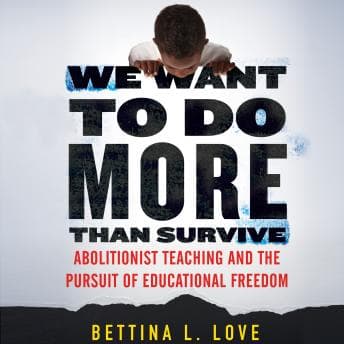

I was sitting in my classroom at 6:45 AM, forty minutes before first bell, drinking bad coffee and staring at a bulletin board I'd decorated with quotes from James Baldwin. The kind of performative allyship that Bettina Love would probably side-eye. And honestly? After seven hours and fifty minutes with this book, I think she'd be right to.
I felt the same uncomfortable recognition reading Drama of the Gifted Child, which digs into the lies we tell ourselves to get through the day.Let me back up. I picked up We Want to Do More Than Survive because a colleague in our equity committee recommended it during one of those professional development sessions where everyone nods earnestly and then goes back to teaching the same way they always have. I expected another reform manual — here are your strategies, here's your acronym, here's your rubric for being less racist. That is emphatically not what this book is.
The Educational Survival Complex Hit Me Where I Live
Love coins this term — the educational survival complex — and it's the kind of phrase that burrows under your skin and stays there. She's talking about how schools serving Black and brown kids have been reduced to grit labs and character education programs and test-prep factories, all dressed up as empowerment but really just teaching kids how to endure a system that was never built for them. Not thrive. Survive.
And here's what got me: I've assigned grit-based readings in my own classroom. I've told students to "push through" and "develop resilience" without ever stopping to ask — resilience against what, exactly? Against a system I'm participating in? Love names the thing I've been circling around for twenty years of teaching, and she names it without flinching. She draws a direct line from the carceral logic of American schooling to the historical subjugation of Black communities, and she does it with personal stories — her own upbringing, her mother's wisdom, her experiences in schools where joy was treated as a discipline problem.
The section where she discusses how zero-tolerance policies function as a pipeline isn't new territory, but the way she frames it through the lens of abolitionist thought — pulling from Ella Baker and Fannie Lou Hamer and Bayard Rustin — gives it a moral urgency that policy papers never achieve. This reminds me of what Hemingway said about prose being architecture, not interior decoration. Love builds an argument structurally. Every anecdote is load-bearing.
Misty Monroe Knows When to Let the Words Breathe
Misty Monroe's narration is clear and measured, which is exactly what a book like this needs. She doesn't overdramatize Love's personal stories or flatten the academic passages into monotone. There's a steadiness to her delivery that lets Love's anger and hope coexist without one drowning out the other. The narrator understands that pause is punctuation — particularly in passages where Love is describing the emotional labor of being a Black educator in predominantly white institutional spaces. Monroe lets those silences land.
Where I wanted more was in the moments where Love's writing shifts registers — from scholarly analysis to something closer to sermon, that call-and-response energy that runs through Black rhetorical tradition. Monroe handles these capably, but a different narrator — maybe the author herself — might have brought the fire that lives in those transitions. That said, Monroe makes the audiobook genuinely accessible. At 7 hours and 50 minutes, it's a focused listen, and her pacing keeps you locked in without exhaustion.
Who This Is Actually For (Be Honest With Yourself)
If you're a white teacher — and I am — this book will make you uncomfortable. Not in the vague, productive-discomfort way that DEI workshops promise. Uncomfortable like realizing your favorite lesson plan might be part of the problem. Love isn't interested in making you feel good about your allyship. She's interested in freedom. There's a difference, and she'll make sure you understand it.
If you're a Black educator, I suspect this book reads like validation — someone finally saying the quiet part loud, with receipts and with love (pun intended, but also not).
My students would hate the academic register in certain chapters. I love it. Love doesn't dumb down her scholarship for a popular audience, and I respect that. But if you're looking for a quick-fix teaching manual with reproducible worksheets, you will be frustrated. This is philosophy. This is history. This is a demand.
Parents and community organizers will find just as much here as educators. Maybe more. Love's vision of abolitionist teaching extends well past the classroom walls.
That insistence on looking beyond institutional walls reminded me of the fierce practicality in Lead from the Outside—it doesn't just theorize about change, it shows you how to build it.Worth Canceling Your Lesson Plans For
I finished this at 11 PM on a Tuesday — papers ungraded, Baldwin quotes still on my bulletin board, but seeing them differently now. We Want to Do More Than Survive didn't give me a new strategy. It gave me a new question: Am I teaching for freedom, or am I teaching for compliance? Twenty years in, and I'm not sure I like my answer. The prose deserves to be savored. Listen at 1.0x. Sit with it. Then do something about it.