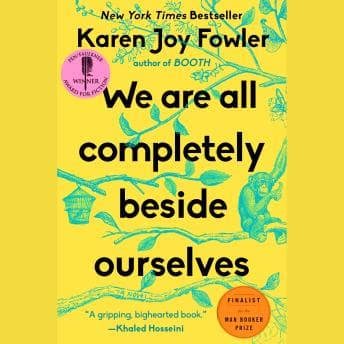

Okay, I need to rant for a second. Fowler tells you — literally tells you through Rosemary's mouth — to start in the middle. And then she actually does it. The narrative jumps around like a trauma patient's vitals on a bad night, and for the first two hours I was sitting in my kitchen at 8 AM, eggs going cold, thinking: where is this going? Carlos came in, saw my face, and asked if someone died in the book. I told him I didn't know yet. That's the kind of audiobook this is.
But here's the thing. By hour three, I realized the disjointed structure isn't a flaw. It's the whole point. Rosemary Cooke can't tell her story straight because she literally can't process it straight. She was raised alongside a chimpanzee — her sister Fern — as part of her psychologist father's experiment, and when Fern was removed from the family, everything fractured. The narrative fractures mirror the family's fracture. Once that clicked, I stopped fighting it and just... listened.
The Part Where I Didn't See It Coming
I'm going to be careful here because Fowler plays a very specific game with information. She holds back the reveal about Fern's identity — what Fern actually is — until you're already invested in this as a story about a missing sister. And even though I just told you Fern is a chimp (the publisher does too, it's right on the description), the way Fowler structures Rosemary's childhood memories makes you forget. You start thinking of Fern as a person. As a sister. Which is exactly the point Fowler is making about language and identity and who we decide counts as family. We Begin at the End wrestles with that same question about who we claim as family and what it costs us when we lose them — though it gets there through very different wreckage.
What got me — really got me — was how the book handles Rosemary's guilt. Not dramatic guilt, not thriller-novel guilt. The quiet kind. The kind where you stop talking for years because you're afraid of what you might say. As someone who's sat with families in waiting rooms at 4 AM, I can tell you that's exactly how real grief works. It doesn't announce itself. It just... removes pieces of you until you notice what's missing.
Orlagh Cassidy Understands the Assignment
Cassidy narrates this with a girlish quality that fits college-age Rosemary perfectly, but she's smart about it — there's an undercurrent of something harder beneath the surface. She handles the wisecracks and the grief with equal precision, and the transitions between Rosemary's sardonic observations and her raw emotional breaks feel earned, not performed.
Now. Some people find Rosemary's voice whiny. I get it. She's a 22-year-old who's been carrying a family catastrophe since she was five, and she's not always likeable about it. But I've talked to enough patients and families to know that the ones processing the heaviest stuff often sound exactly like this — scattered, self-deprecating, circling the thing they can't say directly. Cassidy captures that. Whether you have patience for it is another question.
No sound effects, no music, no full cast. Just Cassidy and the story. Which is the right call. This book lives in Rosemary's head, and adding production would've been like putting a soundtrack over a confession.
When the Science Hits Close
The psychology and primate research in this book? Accurate enough that I didn't yell at my dashboard once. Fowler clearly did her homework on cross-fostering studies, attachment theory, the ethics (and disasters) of raising primates in human families. The Cooke parents aren't villains — they're researchers who genuinely believed they were doing something important, and watching the consequences unspool across their children's lives is genuinely heartbreaking.
Carlos asked why I was crying in the car. I blamed allergies. But it was the scene where Rosemary describes what happened to Fern after the separation — where she ended up, what that world looked like compared to the home she'd known. I won't spoil the specifics, but if you've ever watched someone you love get transferred to a facility that can't possibly give them what they need, you'll feel it in your chest.
Who This Is For (And Who Should Bail)
If you need linear storytelling and a fast plot, this will frustrate you. Full stop. The structure demands patience and the payoff is emotional, not procedural. But if you're someone who processes stories the way real people process memories — in circles, in fragments, with the painful parts arriving last — this is going to wreck you in the best way.
Perfect for that post-shift decompression when you're too wired to sleep but too tired to do anything but listen and feel things.
Night Shift Prescription
PEN/Faulkner winner, Man Booker finalist, and it actually deserves both. My mom would love this (she still thinks I should've been a doctor), but she'd also cry, and then she'd call me to talk about it for an hour. Which honestly? That's the mark of a book that matters. Night shift approved.