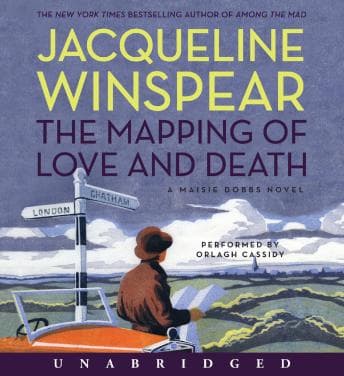

I have a complaint. Jacqueline Winspear has no business making me care this much about a dead cartographer I never met.
Seriously. I'm walking the lakefront on a Saturday morning, Denise is pointing out the new coffee shop on Diversey, and I'm nodding along while internally devastated about a fictional man who got murdered in a dugout in France in 1917. My wife knows the signs by now. She looked at me and said, "You're in a book again, aren't you." I was.
A Dead Man's Letters and the Geography of Grief
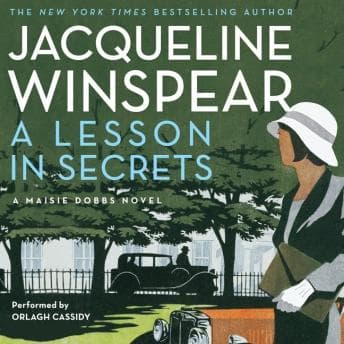
Here's what Winspear does that most mystery writers don't bother with: she makes you feel the weight of the question before she ever chases the answer. Michael Clifton is a young American cartographer - his father's English, his mother's American money - and he's mapping land in California's Santa Ynez Valley when the war breaks out. He sails to England out of duty to his father's homeland. Three years later, missing in action. Fifteen years after that, his remains turn up in France with love letters from an unnamed nurse tucked among his things.
That setup alone. If you loved Regeneration by Pat Barker, this is its spiritual successor in the sense that it treats WWI not as backdrop but as a wound that keeps weeping into the present. Maisie Dobbs isn't just solving a murder - she's excavating a love story that the war swallowed whole. And here's the gut punch: the investigation keeps pulling Maisie back into her own wartime love, the one she lost. Winspear isn't subtle about the parallel, but she doesn't need to be. Sometimes the echo is the point.
The cartography angle is genuinely clever. Michael's profession - mapping terrain, measuring distances, charting what's known against what's unknown - becomes the metaphor for everything Maisie does as an investigator. Let's talk about what the author is really saying: that love and death occupy the same coordinates. That you can map a landscape but never fully map a person. My students would hate this. I love it.
Orlagh Cassidy Knows That Pause Is Punctuation
I've listened to several Maisie Dobbs audiobooks now, and Cassidy's consistency across the series is remarkable - she carries Maisie's interior life with this quiet authority that never tips into melodrama. What struck me here specifically is how she handles the class divide. The Clifton family scenes have this transatlantic tension - the American mother's directness against the English father's formality - and Cassidy shifts between them without ever making it feel like a performance. It just feels like a family that doesn't quite speak the same emotional language.
The love letters are the real test, though. When Cassidy reads Michael's correspondence with the unnamed nurse, she slows down in a way that respects the intimacy of it. These are private words being read by a stranger decades later, and Cassidy makes you feel that violation - the tenderness and the intrusion simultaneously. I listened at 1.0x because the prose deserves to be savored, and there's a particular passage where Michael describes the landscape he was mapping before the war that's so achingly pastoral you almost forget what's coming. Almost. That attention to emotional nuance is something I've admired in her other audiobooks, too. Before I Go To Sleep showcases her ability to convey vulnerability without ever slipping into pathos.
I don't have specific complaints about the narration. Cassidy's won Audie Awards for good reason. If I'm being honest, I wanted just slightly more grit in the scenes where the investigation turns dangerous - there's a web of violence that closes in on Maisie and the Clifton family in the final third, and I wanted the tension ratcheted up just a notch more vocally. But that's a preference, not a flaw.
The Subplot That Wrecked Me at a Faculty Meeting
I need to mention the Maisie-specific emotional arc here because it's the thing that separates Winspear from your standard historical mystery. Maisie's mentor is dying. She knows it. The book knows it. And while she's chasing a fifteen-year-old murder, she's also watching someone she loves slip away in real time. There's also a new love interest - Mark Scott, an American - and the way Maisie holds herself back from it, the way she's aware she's falling and resisting simultaneously, that's the kind of psychological honesty that makes this series worth the investment.
Worth pausing the faculty meeting for. (I did. Principal Martinez was reviewing standardized test protocols. I regret nothing.)
This is why we still read the classics of the genre - because the best mysteries aren't really about who did it. They're about what we do with loss.
Who This Is For (and Who Should Wait)
If you've been following the Maisie Dobbs series, this is essential - the character development here pays off threads from earlier books, and Cassidy's narration maintains that continuity beautifully. If you're new to the series, you can start here, but you'd be cheating yourself out of the accumulated emotional weight. Start with book one.
If you want a fast-twitch thriller with a body every chapter, this isn't it. This is a slow burn. A meditation on wartime love dressed up as a murder mystery. The pacing is deliberate. The reward is proportional.
The Lesson Plan I'll Never Assign
I keep thinking about Michael Clifton drawing maps of land he'd never farm, writing love letters he'd never send home. There's something about the distance between what we document and what we actually live that Winspear captures here - and Cassidy delivers - that stayed with me long after the 9 hours and 54 minutes were up. Denise asked me what it was about. I said, "A mapmaker who couldn't find his way home." She said that was sad. She's right.