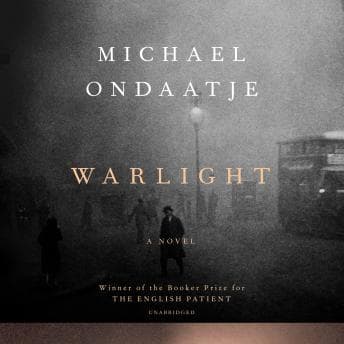

Ondaatje doesn't write novels so much as he composes them. And Warlight might be his most fugue-like work yet.
I started this one during a late November faculty meeting—Principal Martinez was explaining something about parking lot protocols—and within fifteen minutes I was so deep into post-war London that I nearly missed my name being called for committee assignments. Worth it. Absolutely worth it.
Memory as Unreliable Architecture
This is not a book that hands you answers. Short History of Nearly Everything operates on the opposite principle—Bryson gives you every answer, sometimes three times over—but both books share this commitment to making you work for understanding. Nathaniel, our narrator, is reconstructing his adolescence from fragments—the years after 1945 when his parents abandoned him and his sister Rachel to the care of a man called The Moth. And here's what Ondaatje understands that lesser writers don't: memory doesn't arrive chronologically. It arrives in images. In sensations. In the way light fell across a Thames barge at midnight.
Steve West's narration captures this perfectly. His London-born voice carries that particular quality of someone speaking from a great distance—not geographically, but temporally. When Nathaniel describes those nights on the river with the Darter, smuggling unnamed goods through wartime darkness, West's tone mixes sophistication with something almost childlike. Innocence that doesn't know yet what it's witnessing.
My students would absolutely hate this. They'd call it "slow" and "nothing happens." And I'd have to explain—again—that what happens in a novel isn't always plot. Sometimes what happens is the gradual revelation of a world.
The Moth's Eccentric Court
Ondaatje populates Nathaniel's adolescence with figures who feel pulled from a Graham Greene fever dream. The Moth himself, quiet and watchful. The Darter with his river knowledge. Marsh Felon—and what a name—scaling buildings in Cambridge and London like some nocturnal creature. These aren't characters so much as presences, people defined by what they don't say.
The prose deserves to be savored. I listened at 1.0x, obviously, because Ondaatje chooses his words the way a surgeon chooses instruments. There's a scene where Nathaniel and Agnes make love in a grand west London house, and the language is so precise, so careful, that rushing through it would be like speed-walking through the Louvre.
West handles the shifts between past and present—between the Nathaniel who lived these events and the adult Nathaniel who's trying to understand them—with a subtlety I didn't fully appreciate until the second half. The mystery isn't just what his mother was doing during those silent months. It's whether we can ever truly know the people who raised us.
Where It Demands Patience
I'll be honest: this audiobook requires focus. The narrative meanders deliberately, circling back on itself, withholding and revealing in equal measure. If you're looking for something to half-listen to while grading essays—trust me, I tried—you'll lose the thread entirely. This is a book that punishes distraction.
Some listeners have called it slow. They're not wrong, exactly. But "slow" implies the pacing is a flaw rather than a choice. This reminds me of what Hemingway said about the iceberg theory—the dignity of movement of an iceberg is due to only one-eighth of it being above water. Ondaatje keeps most of his story submerged. You feel its mass without seeing it directly.
The lack of clear character voice differentiation from West isn't a dealbreaker, but it's noticeable. In dialogue-heavy sections, you occasionally need a beat to track who's speaking. A minor complaint for what is otherwise an elegant performance.
Who Should Listen (And Who Should Skip)
If you loved The English Patient, this is its spiritual successor—the same lyrical density, the same fascination with how war reshapes ordinary lives. If you prefer audiobooks you can tune in and out of, look elsewhere. This one demands your attention like a difficult but rewarding student.
The 8-hour-37-minute runtime feels right. Long enough to build its atmosphere, short enough that the mystery doesn't overstay its welcome. I finished it on a Sunday morning walk along the lakefront with Denise, the November wind coming off Lake Michigan, and the ending hit me harder than I expected. Ondaatje doesn't give you closure so much as he gives you understanding—which is, I think, what Nathaniel was after all along.
Worth Pausing the Faculty Meeting For
This is why we still read the classics, and why Ondaatje will be among them. Warlight is a novel about the stories parents don't tell their children, about the invisible wars that continue long after treaties are signed. West's narration serves the material with intelligence and restraint.
Not for everyone. But for the right listener—someone willing to sit with ambiguity, to let meaning accumulate rather than arrive—this is genuinely special. My mom will probably fall asleep during my podcast episode about it. But I'll record it anyway.