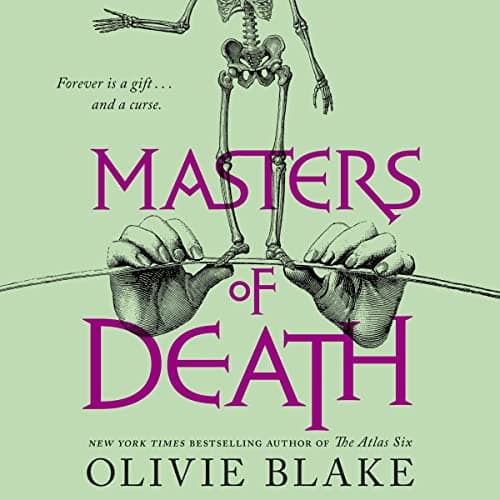

Olivie Blake wrote a D&D campaign where every player chose the most chaotic backstory possible, and somehow it works.
I was sitting cross-legged on my apartment floor at 1 AM, supposedly sorting through a box of board games I'd impulse-bought at a con last year, when Death opened his mouth and Steve West made me put down my copy of Betrayal at House on the Hill. That opening — Death's voice, this low, knowing rumble that West delivers with just enough cosmic weariness — hooked me immediately. I did not touch those board games again for three nights.
The Party Sheet Is Absurd (And I Mean That Lovingly)
Let me lay out the character roster for you: a vampire real estate agent, a fraudulent medium who's actually the godson of Death, a murder-victim ghost squatting in a house he refuses to leave, a demonic personal trainer, a poltergeist with zero chill, a lovesick reaper, and an angel with a voice like a disappointed professor. If that sounds like a one-shot I'd pitch to my D&D group after too many Mountain Dews — yeah, basically. But Blake plays it straight enough that the absurdity becomes the world's internal logic rather than a gag. The magic system isn't Sanderson-level hard magic (let's be real, nothing is), but the supernatural hierarchy — how Death operates as a bureaucracy, how vampires and reapers interact with overlapping jurisdictions — actually has internal consistency that rewards paying attention. The last time I felt this kind of payoff for tracking a supernatural power structure was Gray Plague, though Blake's version is considerably more fun to inhabit.
The central mystery (who killed the ghost, and why does he keep haunting Vi's listing?) is almost a MacGuffin. It matters, but what Blake really cares about is the relationships: Fox and Vi circling each other with this brittle, sarcastic energy that eventually cracks open into something genuinely tender. Fox's reunion with his long-lost lover hit me harder than I expected — West leans into the longing there, slows his cadence just enough that you feel the years of absence in the pauses between words.
Steve West Rolled a Nat 20 on Charisma
Look, Steve West isn't Steven Pacey. (Steven Pacey walked so other narrators could run, and I'll keep saying it.) But West does something really smart here: he gives every supernatural species a different vocal register. The vampires get this clipped, controlled delivery — Vi sounds like someone who's been alive long enough to find everything mildly exhausting. Fox is looser, warmer, with a slight self-deprecating edge that makes his con-man persona feel lived-in rather than written. And Death? Death gets this rich, unhurried bass that sounds like someone who has literally never been in a rush in the history of existence. Because he hasn't.
The sarcasm lands especially well in audio. Blake writes these rapid-fire internal observations — characters mentally roasting each other or themselves — and West's comedic timing sells them. I actually laughed out loud during a scene where the demonic personal trainer tries to motivate someone with the same energy as a CrossFit bro, except the stakes are existential damnation.
Now. The minority who hate West's character voices — I get it, kind of. When you have this many distinct characters and a single narrator, some voices are going to blur, especially the secondary supernatural characters who show up mid-book. By hour 8 I occasionally had to rewind to figure out who was talking. That's partly a Blake problem (she throws a LOT of characters at you without much runway) and partly an inherent limitation of single-narrator fantasy with an ensemble cast.
The Info-Dump Question
If you don't like info-dumps, this isn't for you. (But you're wrong.) Blake front-loads a lot of worldbuilding through dialogue — long, winding conversations where characters explain supernatural politics to each other. Some listeners found these pointless. I found them... kind of the point? The banter IS the plot engine. The conversations ARE the character development. But this means the pacing is genuinely slow for the first five hours. You're investing. The payoff is satisfying once it kicks in, but you have to trust Blake enough to sit through what feels like a supernatural bureaucracy simulation before the emotional and plot rewards start landing.
At 15 hours, it's a commitment, but not an unreasonable one for what you get. The back half moves significantly faster than the front.
Who Gets a Seat at This Table (And Who Gets Booted)
Pick this up if you want urban fantasy that reads more like literary fiction wearing a vampire costume — witty, relationship-driven, unafraid to be weird. Skip it if you need a tight plot with clear momentum from chapter one, or if you mostly listen while multitasking. This one demands your attention. I read this instead of writing my thesis, and I regret nothing. (Dr. Patel, if you're reading this: I wasn't listening to audiobooks. I was doing research. On... procedural narrative generation. In vampire real estate.)
I'd Give It a Spell Slot
Masters of Death is the kind of book where the vibes are immaculate even when the structure wobbles. Blake's voice is so distinctly hers — sharp, funny, a little melancholy underneath the snark — that you forgive the overstuffed cast and the meandering middle. West's performance elevates it from a good read to a genuinely fun listen. Not flawless, but I'm already eyeing her other stuff on my TBR. My D&D group would love this.