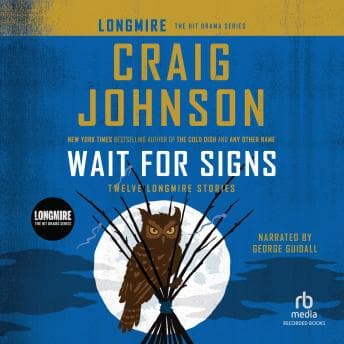

Everyone tells you short story collections are the perfect gateway to a new series. I've always thought that was nonsense - like telling someone to watch deleted scenes before the movie. But here's the thing about Wait for Signs: Craig Johnson wrote these stories after creating Walt Longmire, not before. They're not appetizers. They're the stuff that didn't fit in the novels, the quiet moments between the big cases, the weird Tuesday afternoons in Absaroka County. And somehow that makes them better entry points than anyone has a right to expect.
I started this on a Sunday morning walk along the lakefront with Denise. She was on the phone with her sister, I had my earbuds in, and George Guidall was telling me about a sheriff getting mistaken for a god in 'Ministerial Aide.' Five hours later I was still listening - at the kitchen table, pretending to review lesson plans.
Twelve Postcards from a County That Shouldn't Exist
Let's talk about what Johnson is really doing here. Each story is a Christmas Eve gift he sent to fans, which means they carry this peculiar warmth - like a writer who genuinely likes his audience and trusts them to show up for small stakes. 'Messenger,' where the bulk of the action takes place inside a Port-A-Potty, is the kind of premise that could be pure gimmick. But Johnson uses the claustrophobia to strip Walt down to voice and wit. No badge, no backup, just a man stuck in a plastic box trying to talk his way out of trouble. This reminds me of what Hemingway said about knowing what to leave out - Johnson knows that confining his hero physically lets the character expand.
Then there's 'Old Indian Trick,' the story that started it all and won the Hillerman Award. A diner robbery, Cheyenne Lonnie Little Bird, and Walt doing that thing he does where he seems slow until he isn't. The story runs maybe twenty minutes but it has more character density than most full novels I assign my juniors. (My students would hate this. I love it.)
The new story in the collection, 'Petunia, Bandit Queen of the Bighorns,' is pure Johnson mischief - the title alone tells you he's having fun, and when you're dealing with a writer this confident in his world, fun is contagious.
Guidall Doesn't Read Longmire - He Is Longmire
Here's where I have to push back on the people who say any competent narrator could handle short stories. George Guidall has narrated the entire Longmire series, and you can hear the difference that continuity makes. When he drops into Walt's dry, slightly weary cadence, it's not a voice choice made in a recording booth - it's muscle memory. The narrator understands that pause is punctuation. Guidall leaves space after Walt's one-liners the way a comedian holds for the laugh, except Walt doesn't know he's funny, and Guidall plays that perfectly.
His Henry Standing Bear is quieter, more deliberate - you can hear the thoughtfulness in the pacing, not just the timbre. And when Deputy Moretti shows up with that fast-talking, slightly exasperated energy, Guidall shifts gears without making a show of it. No theatrical voice changes. Just enough difference that your brain registers a new person in the room.
If you've listened to, say, the full Longmire novels and then come to this collection, the consistency is remarkable. Same sheriff, same county, same narrator who's lived in this world for years. If you haven't listened to any of them - well, you're getting the distilled version, and Guidall makes sure nothing is lost in compression.
Where It Breathes and Where It's Thin
At five hours and ten minutes, this is a lean listen. Some stories hit harder than others - that's the nature of collections. A couple of the middle entries feel more like sketches than complete stories, moments that would shine as chapters in a novel but feel slightly undernourished standing alone. But Johnson's prose deserves to be savored, and even the lighter pieces have at least one line or observation that made me pause my walk and just... stand there by the lake like a weirdo, thinking.
The production is clean, solo narration, no sound effects or music. Just Guidall and Johnson's words. Exactly right for this material.
Who Gets the Most Out of This
Longmire fans already know they need this - it fills in gaps the novels skip. But if you've never met Walt, this collection is a low-commitment audition. Five hours, twelve stories. You'll know by story three whether you want to spend the next twenty-something novels in Absaroka County.
If you loved Tony Hillerman's Leaphorn and Chee books, this is their spiritual successor - same respect for landscape and indigenous characters, same unhurried sense of place, but with a drier, more self-aware humor. That same careful attention to indigenous characters and the weight of history on a community is something I found in Five Little Indians too - different setting, different stakes, but the same refusal to treat culture as backdrop.
Skip it if you need a single sustained plot. These are vignettes. Beautiful ones, but vignettes.
Worth Pausing the Faculty Meeting For
At 1.0x speed - because the author chose those words - this collection reminded me why short fiction still matters. Not every story needs three hundred pages. Sometimes a sheriff in a Port-A-Potty is enough.