
"The mind can build its own traps."
That line hit me somewhere around the 45-minute mark, and honestly? It's been living in my head ever since. I wasn't expecting a 1950s pulp sci-fi novella to deliver philosophical gut-punches, but here we are.
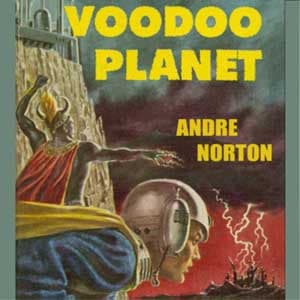
I picked up Voodoo Planet because I'm on this Andre Norton kick lately - classic sci-fi from before the genre got all self-serious. And at under three hours, this felt like perfect thesis-procrastination material. (Dr. Patel, if you're reading this, I was definitely working on my procedural generation chapter. Definitely.)
When Safari Planet Meets Mind-Bending Wizard
The premise is basically "what if you took a bunch of space traders and dropped them on a planet where the local shaman might actually have psychic powers?" The Solar Queen crew - fresh off their troubles in Plague Ship - ends up on Khatka, this safari world that's basically a hunting preserve for rich interstellar tourists. But there's a power struggle happening between the planet's chief and a wizard named Lumbrilo who may or may not be able to control minds.
And here's where it gets interesting. Norton doesn't just handwave the "is it magic or is it science" question. She actually engages with it. That same blend of wonder and uncertainty runs through Alice in Wonderland (Drama), where reality itself becomes negotiable. The crew has to figure out whether they're dealing with genuine psychic phenomena or really sophisticated psychological manipulation. It's giving me major D&D vibes - like when your party encounters something that could be arcane OR just really clever illusion work. Heart Seeker plays with similar ambiguity in its magic system, though it leans harder into the fantasy side of things.
The world-building is tight for such a short book. Khatka feels real - the dangerous fauna, the social structures, the tension between offworld technology and local traditions. Norton was doing this in 1959, and honestly? The magic system here - if you can call it that - is chef's kiss. There are actual rules to how Lumbrilo's powers work, even if those rules are murky to the characters.
Mark Nelson Does the Heavy Lifting
Mark Nelson handles this pretty well. His pacing is solid - not too rushed, which matters because Norton's prose can be dense with worldbuilding details. He's got good character differentiation, important when you're juggling the Solar Queen crew plus all the Khatkan characters.
I've seen some folks mention he occasionally leans into accents a bit hard, and... yeah, I can see that. There are moments where it feels like he's reaching for something that doesn't quite land. But honestly? For a LibriVox-style production (this is a public domain recording), it's way better than you'd expect. He clearly loves the material, and that comes through.
The production itself is clean. No weird audio artifacts or jarring edits that I noticed. Some reviewers have mentioned the occasional awkward pause - I didn't find it distracting, but your mileage may vary.
The 1959 of It All
Let's be real for a second. This book is a product of its time. Some of the language around the Khatkan people feels dated in ways that might make modern readers wince. Norton was actually pretty progressive for her era, but "progressive for 1959" and "holds up in 2024" aren't always the same thing.
That said, if you can contextualize it as a historical artifact of the genre, there's a lot to appreciate here. The pacing is snappy - no bloat, no filler. Norton gets in, tells her story, and gets out. At 2 hours 47 minutes, it's basically the length of a long movie. I knocked this out during a coding session when I was supposed to be debugging my thesis project's terrain generation. (The bugs are still there. The audiobook was worth it.)
The confrontation with Lumbrilo builds nicely. There's genuine tension about whether our protagonists are going to get their minds scrambled. And the resolution - without spoiling it - actually earns its payoff. This isn't a "and then the good guys won because they're the good guys" ending. There's strategy involved.
Roll for Initiative (Or Just Hit Play)
If you're running a D&D campaign with any kind of psionics or "is it magic or tech" ambiguity, steal from this liberally. The way Norton handles the uncertainty around Lumbrilo's powers is a clinic in keeping players - I mean, readers - guessing.
For classic sci-fi fans, this is essential Andre Norton. For newcomers to her work, it's a decent entry point, though you might want to hit Plague Ship first for context on the Solar Queen crew. Skip this one if dated 1950s language is a dealbreaker for you, or if you need your sci-fi to run 20+ hours. But if you want something short that you can finish in an afternoon? This delivers.
It's not Sanderson-level world-building. It's not going to change your life. But it's a fun, tight little adventure story with some genuinely interesting ideas about the nature of belief and power. Sometimes that's exactly what you need.
Now if you'll excuse me, I have a thesis chapter that's been glaring at me for the past three hours.