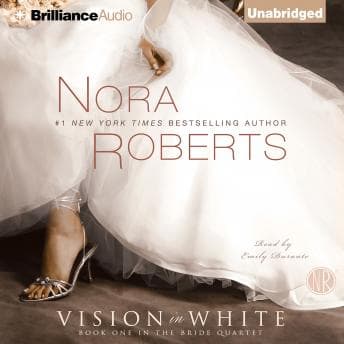

I picked this up because Denise has been on a Nora Roberts kick lately, and I figured if I was going to hear about the Bride Quartet at dinner every night, I might as well actually listen to it. Plus—and this is the part I'm slightly embarrassed to admit—the male lead is an English teacher. Carter Maguire. High school English. Like me.
My students would roast me mercilessly if they knew I spent nearly ten hours listening to a romance novel about a guy who basically has my job. They'd never let me live it down. (Don't tell them. Seriously.)
Why Roberts Gets the Formula Right
Here's the thing about Nora Roberts that I've come to appreciate as someone who teaches narrative structure for a living: she understands pacing in a way that's almost invisible. You don't notice the craft because you're too busy being pulled through the story. Vision in White isn't literary fiction—it's not trying to be—but it's doing exactly what it sets out to do with remarkable efficiency.
Mac Elliot is a wedding photographer with commitment issues stemming from a chaotic mother. Carter Maguire is the stable, slightly awkward English teacher who quotes poetry and actually means it. On paper, it sounds like every romance trope stacked on top of each other. And it is. But Roberts executes the tropes with such confidence that you stop noticing they're tropes at all.
The real strength here is the friendship between the four women who run Vows wedding planning business together. Parker, Emma, Laurel, and Mac have the kind of shorthand that only comes from decades of knowing each other. Their banter feels lived-in. Authentic. The romance is almost secondary to watching these women support each other through the chaos of running a business and navigating their own messy lives.
Emily Durante's Steady Hand
Emily Durante narrates this one, and she's... competent. Solid. I want to be more enthusiastic, but I also want to be honest. She handles the female voices well—each of the four friends has a distinct enough quality that I could usually tell who was speaking without the dialogue tags. Mac's slightly guarded delivery. Parker's crisp efficiency. Emma's warmth.
Where Durante struggles a bit is with the male characters. Carter comes across a little flat in her interpretation, which is frustrating because in the prose, he's actually charming in that fumbling-professor way. The pacing can also drag in places—some scenes that should snap along feel stretched. I found myself wishing she'd pick up the tempo during the banter sections.
But here's what she does get right: the emotional beats. When Mac's mother shows up and the tension ratchets up, Durante leans into it without going melodramatic. She understands that pause is punctuation. The quieter moments between Mac and Carter—the ones where they're actually connecting instead of just flirting—land because Durante gives them room to breathe.
The English Teacher Thing
Okay, I have to address this. Carter Maguire is the kind of English teacher who exists primarily in fiction. He's handsome, he's patient, he quotes Yeats at appropriate moments, and he apparently has unlimited time and energy despite grading papers for 150 students. (I have questions about his workload, Nora. Real questions.)
But—and this is the part that got me—Roberts actually captures something true about people who teach literature for a living. Carter sees stories everywhere. He reads people like texts. When he's falling for Mac, he's paying attention to her narrative, trying to understand her arc. It's a little on-the-nose, sure. But it's also kind of sweet.
Denise caught me smiling during the scene where Carter shows up at a wedding Mac is photographing, just to see her work. She asked what I was listening to. I told her it was a podcast about Hemingway. (It wasn't. Obviously.)
Who This Works For (And Who Should Skip)
If you're looking for literary complexity, this isn't it. Skip it if you need your fiction to challenge you intellectually. But if you want something warm and well-constructed to listen to while grading papers at 11 PM—something that rewards your attention without demanding your full engagement—Vision in White delivers. It's comfort food. Well-made comfort food.
The audiobook works best for long walks or mindless tasks. I listened to most of it on the lakefront with Denise, and honestly? It made the walks better. The Seven Husbands of Evelyn Hugo had the same effect on us—characters that felt real enough to debate over coffee. We'd pause it to talk about the characters like they were people we knew. That's not nothing.
Roberts is doing something my students would recognize if they were paying attention in class: she's using genre conventions as a foundation, not a crutch. She does this throughout the Bride Quartet—Perfect Hope wraps up the series with the same confident execution. The romance is predictable in the best way. You know where it's going, and the pleasure is in watching it get there.
Worth pausing the faculty meeting for. (Sorry, Principal Martinez.)