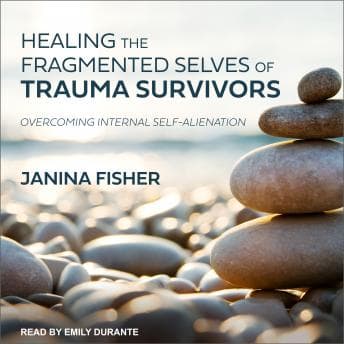

Look, I spend half my life analyzing why fictional characters make terrible decisions and the other half trying to convince my mother that reading about murder doesn't mean I'm depressed. But sometimes, you have to put down the Agatha Christie and look at the actual wiring under the hood.
Janina Fisher's work is heavy. We're talking 14 hours of deep-dive neurobiology and trauma theory. It's not the kind of thing you listen to while casually browsing Trader Joe's for snacks (I tried; I ended up staring at a bag of frozen dumplings for five minutes contemplating my attachment style).
There's a lot of noise in the psychology world right now—everyone on social media suddenly has a diagnosis—but Fisher is the real deal. She's not selling you a quick fix; she's explaining why your brain literally won't let you be happy sometimes. And frankly? It's exhausting. But in a good way.
The Voice in the Clinical Void
Let's address the elephant in the audio booth: Emily Durante.
If you look at the reviews, people are torn. Some say she's clear and professional; others say she sounds like a GPS trying to navigate you through an emotional breakdown.
Here's my take: She is dry. There's no getting around it. If you're expecting a performance that tugs at your heartstrings or does voices for your inner child, you're going to be disappointed. She reads this like a textbook.
Durante brings that same controlled, almost clinically laminated energy to Emotionally Absent Mother, which is either reassuring or mildly haunting depending on your childhood.
But—and hear me out—I actually think that works here. When you're listening to sections about how trauma fragments the personality and creates self-loathing, you don't necessarily want a narrator emoting all over the place. You want a steady hand. Durante is the designated driver. She's not drinking the wine; she's just getting you home safely.
That said, I cranked the speed up to 1.25x. At 1.0x, I found my mind wandering back to my dissertation defense (a trauma in itself). Speed it up, and she sounds less like a robot and more like a very efficient professor.
Making Friends with the "Crazy" Parts
Fisher's whole thesis is about "parts" work. The idea that we aren't one solid block of "self," but a collection of fragmented parts trying to protect us.
As someone who studies narrative identity, this is catnip to me. It's basically treating your mind like a cast of characters. You have the angry protector, the scared child, the functioning adult who pays taxes.
Fisher explains why we have these parts without making you feel like you're losing it. She uses neuroscience to back it up—talking about the prefrontal cortex going offline and the amygdala hijacking the bus.
(My therapist has been trying to explain this to me for years, but somehow hearing it framed as "survival strategy" rather than "pathology" made it click. Don't tell her I said that. She'll raise her rates.)
What I loved is the lack of shame. Fisher doesn't ask "What's wrong with you?" She asks "How did this help you survive?" It's a subtle shift, but it changes the whole narrative.
Who This Is (and Isn't) For
If you're looking for a soothing, emotional journey, this might feel too clinical. The narration is functional, not artistic. Skip it if you want warmth and hand-holding. But if you're a nerd like me who needs to understand the mechanism of why we feel broken before we can fix it—if you want the science, not just the feelings—this is gold.
That mechanism-hunting part of my brain also had a field day with Power of Habit, though that one is less “hello, trauma response” and more “why did I eat six biscuits standing over the sink.”
Closing the Case File
This isn't a beach read. It's not entertainment. It's a dense, academic toolkit for people who are tired of fighting themselves.
Just, you know, maybe don't listen to the heavy chapters right before bed. Trust me on that one.